



|
Getting your Trinity Audio player ready...
|
By: David Avrushmi
In the luminous glare of the Olympic spotlight, where national symbols are meant to unite and athletic excellence is intended to transcend politics, a sharp and disquieting rupture emerged this week. As the world’s attention turned to the pageantry and competition of the 2026 Winter Olympics, a brief but emotionally charged exchange between President Trump and American freestyle skier Hunter Hess ignited a broader debate about patriotism, representation and the burdens athletes carry when the nation they compete for is riven by political division. The episode, reported on by USA Today on Sunday, has reverberated far beyond the halfpipe, stirring questions about what it means to “wear the flag” in an era of polarized civic life.
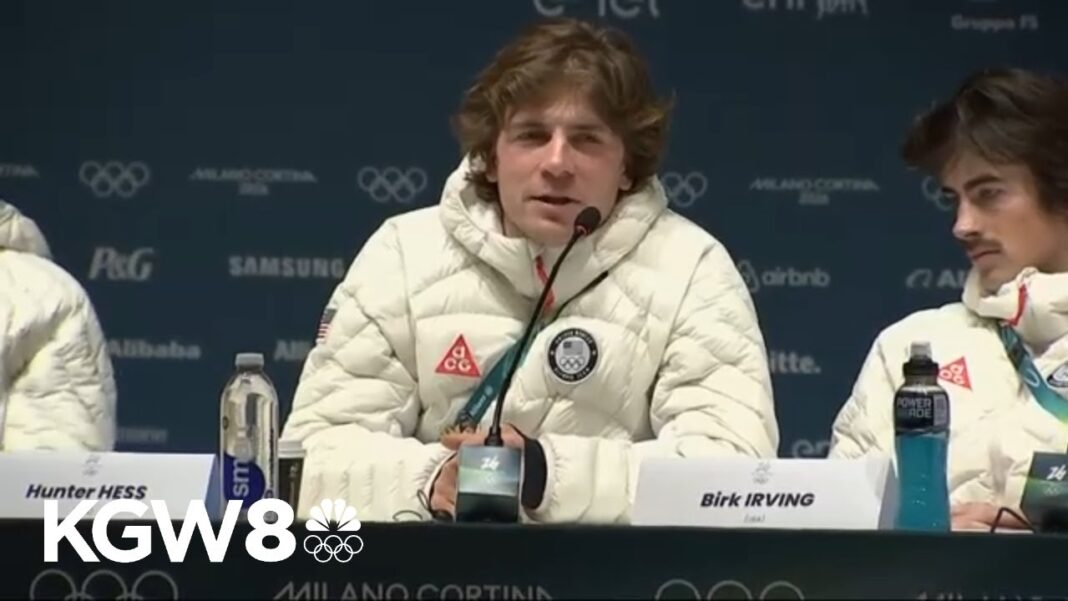
Hunter Hess, a rising figure in American freestyle skiing and a competitor in the halfpipe discipline, spoke candidly in the days preceding the opening ceremony. His remarks were not incendiary, nor were they unprecedented in tone. Rather, they reflected a generational unease that has increasingly surfaced among athletes asked to embody national identity on the world stage. According to the information provided in the USA Today report, Hess acknowledged that representing the United States at this moment in history was emotionally complicated. “It’s a little hard,” he said, noting that the political climate at home had made the act of competing under the American flag fraught with mixed emotions. He was careful to draw a distinction between the nation’s ideals and the policies or politics he finds troubling, emphasizing that wearing the flag does not equate to endorsing every action undertaken in the name of the country.
Such nuance, however, proved combustible in the digital arena of contemporary politics. President Trump, responding on social media platform Truth Social, seized upon Hess’s remarks with characteristic bluntness. As USA Today reported, the president derided the Olympian as a “real loser,” castigating him for expressing ambivalence about representing the nation while nonetheless competing for a place on Team USA. Trump’s post framed Hess’s introspection as a form of disloyalty, asserting that anyone who does not fully embrace the symbolism of national representation should not have sought to compete under the American banner. The president’s closing slogan, “MAKE AMERICA GREAT AGAIN,” underscored how seamlessly the rhetoric of partisan politics has come to infuse even the ostensibly apolitical domain of international sport.
The exchange was brief, but its implications are expansive. The USA Today report contextualized Hess’s comments within a broader pattern of athletes articulating conflicted feelings about national representation in times of domestic turmoil. The modern Olympian is no longer merely a vessel of athletic prowess; he or she is a public figure navigating the intersection of personal conscience and national symbolism.
Hess himself elaborated on this tension, explaining that when he wears the flag, he does so in honor of the people and principles that resonate with his moral compass: his family, his friends, the communities that nurtured his ambitions, and the aspects of American life he believes are worthy of pride. This articulation of selective identification challenges a more monolithic conception of patriotism, one that equates national representation with wholesale endorsement of the state’s current political leadership.
The president’s rebuke reflects a contrasting view of patriotism—one rooted in unambiguous allegiance to national symbols and, implicitly, to the political order presided over by those symbols. In this framing, any public ambivalence voiced by a national representative is construed as a betrayal. The rhetorical force of labeling an Olympian a “loser” for expressing moral complexity speaks to a broader cultural impatience with dissenting narratives, particularly when they emanate from figures elevated by national institutions.
The Olympics, long idealized as a realm where politics are temporarily suspended in favor of universal human excellence, have once again become a theater for the projection of domestic ideological conflicts.
This moment also illuminates the evolving expectations placed upon athletes in the age of social media. In earlier eras, an Olympian’s private reflections on national identity might have remained confined to intimate circles. Today, such reflections are instantaneously amplified, refracted through partisan lenses, and weaponized in the ongoing culture wars. The USA Today report noted how athletes increasingly find themselves compelled to articulate their values publicly, whether on matters of racial justice, gender equity or political governance. The backlash that can ensue is swift and unforgiving, particularly when those values appear to diverge from dominant political narratives.
Hess’s comments, as reported by USA Today, were measured rather than confrontational. He did not repudiate his country; he acknowledged the difficulty of reconciling love for one’s homeland with disapproval of certain political realities. This is a sentiment that resonates with many citizens who experience patriotism as an evolving, contested relationship rather than a fixed, uncritical allegiance. Yet the president’s response suggests a narrowing tolerance for such complexity, particularly when voiced on a global stage where national image is perceived to be at stake.
The incident invites reflection on the burdens of symbolic representation that athletes bear. To compete in the Olympics is to become a living emblem of one’s nation, subject to scrutiny not only for athletic performance but also for personal beliefs. USA Today has chronicled numerous instances in which athletes have grappled with this duality, striving to honor their country while remaining true to their conscience. The expectation that athletes serve as unproblematic avatars of national unity is increasingly at odds with the pluralistic realities of modern democracies, where dissent and diversity of thought are integral to civic life.
Moreover, the president’s intervention shines a spotlight on how political leadership can shape the discourse surrounding sport and national identity. When the head of state publicly disparages an athlete for expressing moral ambivalence, it sends a powerful signal about the boundaries of acceptable speech. USA Today’s report highlighted the chilling effect such rhetoric may have on other athletes who harbor similar doubts but fear reprisal. The Olympics, ideally a forum for the celebration of human excellence across borders, thus become another arena in which political orthodoxy is policed.
Yet there is also a counternarrative emerging from this episode. Hess’s insistence that he represents the values and people he cherishes, rather than the entirety of the political apparatus, articulates a more capacious understanding of patriotism—one that allows for critique alongside commitment. This perspective resonates with a generation of athletes and citizens who view national identity as a tapestry woven from diverse, sometimes conflicting threads. In this view, to love one’s country is not to endorse it unconditionally, but to engage with it critically in pursuit of its better angels.
As the Winter Olympics unfold, the performances on snow and ice will no doubt recapture the public’s imagination. Yet the controversy surrounding Hunter Hess and President Trump, as documented in the USA Today report, lingers as a reminder that the games do not occur in a vacuum. They are embedded in a world where political division permeates even the most hallowed international rituals. The question that remains is whether the Olympic ideal—of peaceful competition among nations—can endure in a climate where national symbols are contested and athletes are drawn into the vortex of domestic ideological struggle.
In the end, the halfpipe may offer moments of transcendent athletic beauty, but the discourse swirling around it reveals a deeper, unresolved tension about who gets to define patriotism and how dissent is accommodated within the narrative of national pride. The exchange between an Olympian wrestling with his conscience and a president demanding unequivocal allegiance encapsulates a broader cultural reckoning. The episode stands as a poignant illustration of how the simple act of “wearing the flag” has become, in our time, a profoundly complex moral gesture.
