



|
Getting your Trinity Audio player ready...
|
By: Fern Sidman
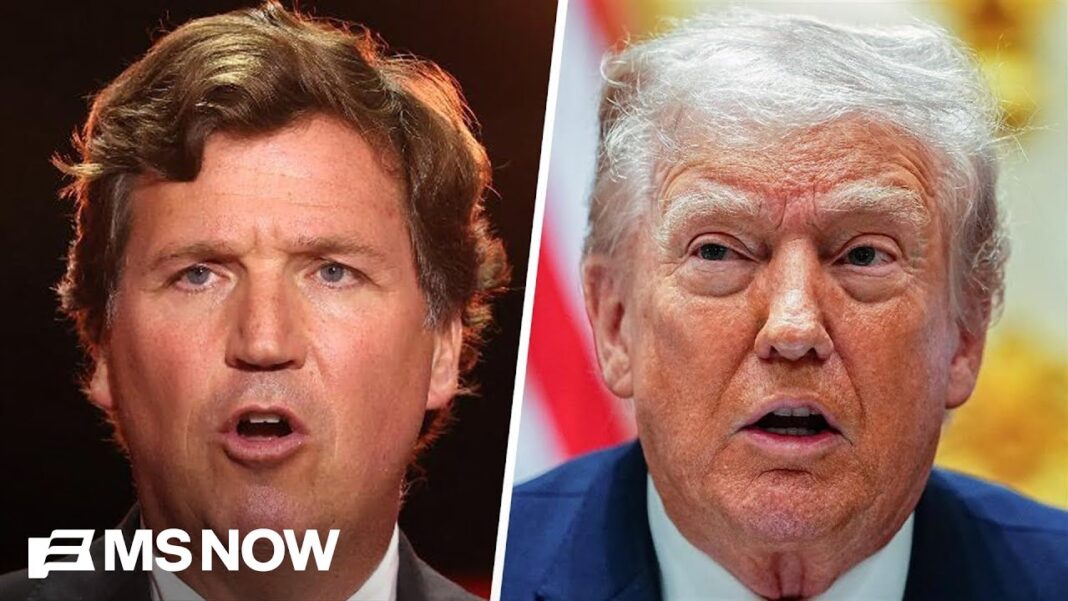
President Donald Trump publicly distanced himself Thursday from conservative commentator Tucker Carlson, declaring that the once-prominent media ally has “lost his way” and no longer represents the political philosophy or priorities of the Make America Great Again movement. The comments, delivered during an interview with ABC News, mark one of the most direct and personal rebukes Trump has issued toward Carlson in recent years and underscore growing tensions within segments of the conservative political sphere over U.S. foreign policy and the direction of the populist right.
The remarks came in response to Carlson’s sharp criticism of the administration’s recent military strikes against Iran, a campaign that has triggered intense debate across American political and media circles. Carlson, who for years was regarded as one of the most influential voices among Trump’s supporters, condemned the strikes in stark moral terms, describing them as “absolutely disgusting and evil.” His criticism placed him at odds with the White House at a moment when the administration has been emphasizing strength and deterrence in its approach to Tehran.
Trump, however, dismissed Carlson’s objections in blunt terms. According to a report on Thursday at VIN News, the president made clear that he no longer views Carlson as aligned with the ideological core of the MAGA movement.
“I knew that a long time ago,” Trump said in the interview. “And he’s not MAGA. MAGA is saving our country. MAGA is making our country great again. MAGA is America First, and Tucker is none of those things. And Tucker is really not smart enough to understand that.”
The comments represent a striking shift in tone toward Carlson, who previously maintained a complex but generally sympathetic relationship with Trump’s political agenda. Carlson’s media platform has often amplified themes central to Trump’s political identity, including skepticism toward globalization, criticism of entrenched political elites, and calls for a more nationalist orientation in American policy.
Yet the two figures have increasingly diverged on matters of foreign policy, particularly regarding the use of American military power abroad. Carlson has long positioned himself among a faction of conservative commentators who advocate a more restrained approach to international conflicts, frequently warning against what he describes as the dangers of interventionism.
Trump’s administration, by contrast, has defended the recent strikes on Iranian military infrastructure as both necessary and strategically effective. According to coverage referenced by VIN News, the president characterized the attacks as a decisive blow to Iran’s ability to rebuild its strategic capabilities in the near term.
“They are decimated for a 10-year period before they could build it back,” Trump said, referring to the damage inflicted by the strikes.
Administration officials have similarly framed the military action as part of a broader effort to neutralize threats posed by Iran’s weapons programs and regional activities. Supporters of the operation argue that the strikes demonstrated American resolve while degrading Iran’s military capacity in ways that could deter future aggression.
Carlson, however, has emerged as one of the most prominent critics of the campaign within conservative media. His condemnation of the strikes has been part of a wider critique of the administration’s foreign policy decisions, including its approach to the ongoing war in Ukraine and its handling of politically sensitive domestic issues such as the investigation into the late financier Jeffrey Epstein.
According to analysis cited by VIN News, Carlson has suggested that Trump’s actions in Iran could reshape the political landscape in ways that may ultimately affect the coalition of voters that helped propel the president to power. Carlson argued that the decision to escalate militarily could “shuffle the deck in a profound way,” potentially altering the alignment of factions within the conservative movement.
Trump’s response, however, suggests little patience for such criticisms. In his interview, the president portrayed the MAGA movement as unified behind his policies and dismissed Carlson and other dissenting commentators as figures who have drifted outside the movement’s ideological boundaries.
Among those Trump referenced was journalist Megyn Kelly, another media personality who has offered pointed commentary on certain administration decisions. Trump suggested that both Carlson and Kelly represent voices operating beyond the core of the MAGA political project.
The president’s framing of the dispute reflects a broader effort to define the parameters of the movement that has dominated Republican politics over the past decade. Since first emerging as a campaign slogan during Trump’s 2016 presidential run, “Make America Great Again” has evolved into a broader political identity encompassing a range of policy priorities and cultural themes.
At its core, the MAGA philosophy emphasizes national sovereignty, economic protectionism, strict immigration policies, and a rejection of the failures of traditional political elites. Yet within that framework, significant differences have emerged regarding foreign policy, particularly over the question of when and how the United States should engage militarily abroad.
As VIN News has observed in its coverage of the dispute, Carlson has increasingly positioned himself within a segment of conservative thought that favors strategic restraint and prioritizes domestic concerns over overseas conflicts. This perspective has gained traction among some populist activists who argue that American resources should be directed primarily toward addressing internal challenges rather than global military engagements.
Trump, however, has consistently rejected the notion that decisive military action contradicts the principles of America First. Throughout his presidency and beyond, he has argued that strength and deterrence are essential components of national security and that failing to confront adversaries such as Iran would ultimately invite greater instability.
In defending the strikes, Trump reiterated his belief that the operation had successfully undermined Iran’s strategic capabilities while reinforcing the credibility of American power. According to the information provided in the VIN News report, the administration views the operation as both a tactical victory and a demonstration of resolve to adversaries around the world.
The public rift between Trump and Carlson also reflects the evolving dynamics of conservative media influence. For several years, Carlson’s nightly commentary played a significant role in shaping political narratives among right-leaning audiences. His critiques often resonated with grassroots activists and voters who saw him as a champion of populist themes.
However, Trump’s willingness to dismiss Carlson so forcefully suggests that the former president remains confident in his own ability to define the movement’s direction. By emphasizing that Carlson is “not MAGA,” Trump signaled that loyalty to the movement’s core principles—at least as he defines them—remains the ultimate measure of political alignment.
Observers cited by VIN News note that such disputes are not unusual within broad political movements that encompass diverse viewpoints. As the MAGA coalition has expanded over the years, it has inevitably absorbed factions with differing perspectives on policy and strategy.
What distinguishes the current disagreement is the prominence of the individuals involved. Both Trump and Carlson command substantial followings and wield considerable influence over conservative audiences. Their divergence therefore carries implications not only for media discourse but also for the broader ideological trajectory of the American right.
For now, Trump appears determined to frame the debate on his own terms, presenting the Iran strikes as evidence of strong leadership while portraying critics as detached from the movement’s mission.
Whether Carlson’s criticism will resonate with a broader segment of MAGA supporters remains uncertain. Yet as VIN News has repeatedly emphasized in its reporting, the episode highlights the continuing evolution of a political movement that has reshaped American conservatism—and whose internal debates are likely to intensify as the nation navigates complex questions of foreign policy and national identity.
