



|
Getting your Trinity Audio player ready...
|
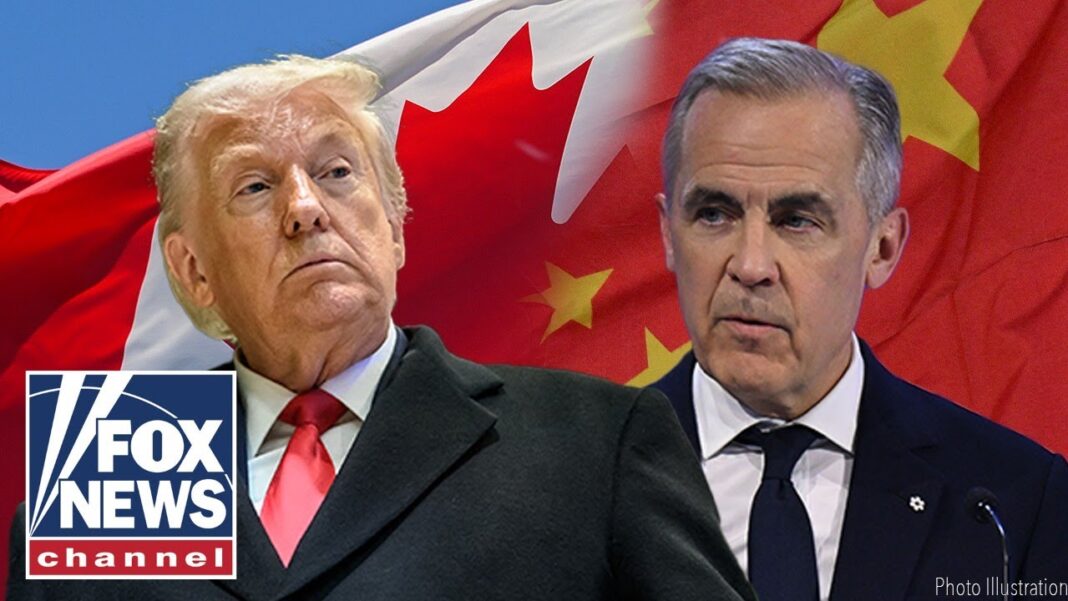
(Epoch Times) U.S. President Donald Trump says Canada is “systematically destroying itself,” adding that the “China deal is a disaster for them.”
“Canada is systematically destroying itself. The China deal is a disaster for them. Will go down as one of the worst deals, of any kind, in history,” Trump said in a Jan. 25 post on Truth Social. “All their businesses are moving to the USA. I want to see Canada SURVIVE AND THRIVE!”
Trump included a video in his post of Canadian Vehicle Manufacturers’ Association president and CEO Brian Kingston speaking at a Jan. 21 press conference in Ontario. Trump called the video a “must watch.”
In the video, Kingston said Ottawa’s trade deal with Beijing is “deeply concerning” as it has the potential to “undermine Canada’s auto sector and presents risks to the future of our integrated North American automotive supply chain.”
“With 90 percent of Canadian production destined for the United States, there is no industry without U.S. access and North American integration,” Kingston said.
He added that the future of Canada’s auto industry depends on “securing our trade relationship with the United States.” In addition, he said diversification is “not an option” for the auto sector as markets in Europe and Asia are better served by assembly plants in those regions.
Trump Says Canada Will Face 100 Percent Tariffs if It ‘Makes a Deal With China’
In a subsequent Truth Social post on Jan. 25, Trump said China is “successfully and completely taking over the once Great Country of Canada.”
These posts come as Trump has made other posts over the last few days expressing concerns about Canada’s recent agreements with China and saying if Canada “makes a deal with China,” it would be subject to 100 percent tariffs on all Canadian goods exported to the United States.
During his trip to China earlier this month, Carney signed a series of agreements with Beijing, including slashing tariffs on Chinese electric vehicle imports from 100 percent to 6.1 percent for the first 49,000 vehicles in exchange for a reduction of Chinese tariffs on Canadian canola until at least the end of the year.
While he was in China, Carney said that Ottawa is in a “strategic partnership” with Beijing and that the progress made in the partnership “sets us up well for the new world order.” He also said relations between Ottawa and Beijing had entered a “new era.”
In response to Trump’s 100 percent tariff threat, Carney told reporters on Jan. 25 that Canada has “no intention” of pursuing a free trade agreement with China. He said Canada has commitments under the United States–Mexico–Canada Agreement (USMCA) “not to pursue free trade agreements with non–market economies without prior notification.”
“We have no intention of doing that with China or any other non-market economy,” Carney said. “What we’ve done with China is to rectify some issues that developed in the last couple of years.”
U.S. Administration’s Concerns
The White House Rapid Response social media account on Jan. 25 posted a video of U.S. Treasury Secretary Scott Bessent speaking in an interview with ABC News, in which he said the United States has a “highly integrated” market with Canada.
Story continues below advertisement
“We can’t let Canada become an opening that the Chinese pour their cheap goods into the U.S,” Bessent said.
“I’m not sure what Prime Minister Carney is doing here, other than trying to virtue signal to his globalist friends at Davos,” he added. “I don’t think he’s doing the best job for the Canadian people.”
While Trump initially shrugged off Carney’s new agreement with China, telling reporters it’s a “good thing” for Carney to sign a trade deal with China, senior members of Trump’s cabinet expressed concerns.
U.S. Transport Secretary Sean Duffy said in a Jan. 17 post on X that Ottawa will “regret” its decision to partner with Beijing and bring Chinese EVs into its market.
U.S. Trade Representative Jamieson Greer made similar comments on CNBC on Jan. 16, saying the agreement is “problematic for Canada” and that Washington had imposed tariffs on Chinese EVs to protect autoworkers. He said that in the “long run” Canada is “not going to like having made that deal.”
U.S. Commerce Secretary Howard Lutnick also said on Jan. 22 that Ottawa could risk jeopardizing the upcoming USMCA renegotiations by seeking closer relations with China.
