



|
Getting your Trinity Audio player ready...
|
Trump Intervenes as Conservative Feud Erupts into Vulgar Spectacle Amid Iran War Debate
By: Fern Sidman
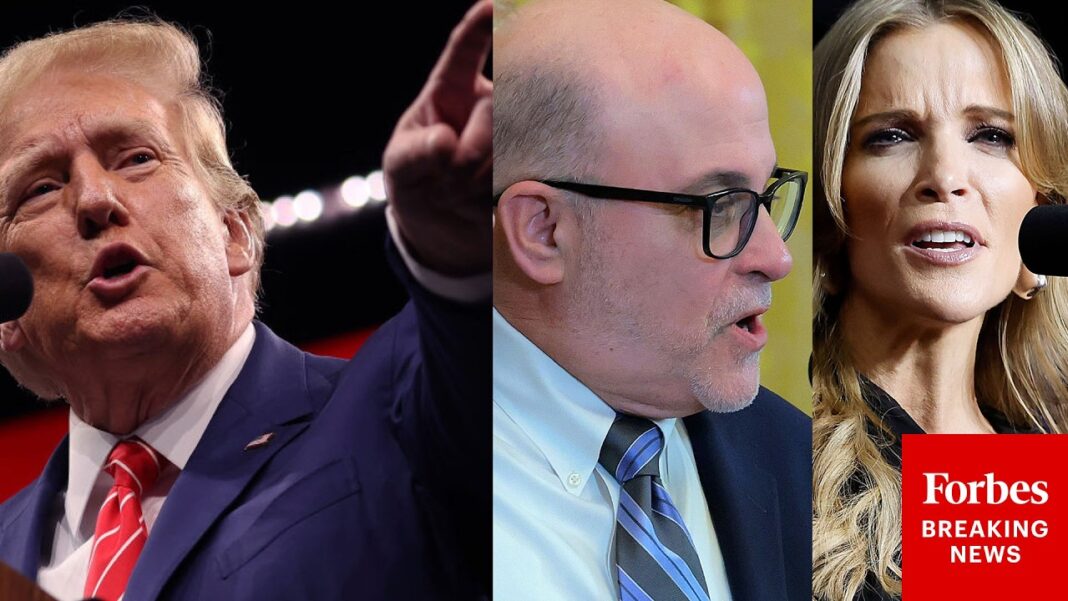
In an episode that has blurred the boundaries between political discourse and personal invective, a bitter and deeply uncivil feud between two prominent conservative media figures—radio host Mark Levin and podcaster Megyn Kelly—has escalated into a national controversy, drawing in none other than President Donald Trump himself. What began as a clash over foreign policy, particularly the United States’ military campaign against Iran, has devolved into a spectacle of insults, conspiracy theories, and ideological fractures within the broader conservative movement.
As detailed extensively on Monday in a report by The Algemeiner, the episode underscores not only the intensifying divisions among right-leaning commentators but also the extent to which discourse surrounding Israel and Iran has become entangled with broader cultural and political fault lines.
On Sunday night, President Trump inserted himself decisively into the controversy, issuing a forceful defense of Mark Levin via a post on his Truth Social platform. The president’s remarks were not merely supportive—they were emphatic, even effusive, in their praise.
Trump described Levin as a “truly Great American Patriot” and lauded his intellect, strength, and loyalty to the country. He went further still, asserting that Levin was under attack from individuals lacking both “Intellect” and “Capability,” a clear, if indirect, rebuke of critics such as Kelly.
According to The Algemeiner report, Trump’s intervention also served a dual purpose: reinforcing his foreign policy stance on Iran while drawing ideological boundaries within the so-called “Make America Great Again” (MAGA) movement. “THEY ARE NOT MAGA, I AM,” Trump declared, framing opposition to his Iran policy as incompatible with the core tenets of his political base. He reiterated his long-standing position that Iran must never be allowed to obtain nuclear weapons and pledged to confront the regime with decisive force.
This rhetorical fusion of personal loyalty, ideological purity, and national security policy reflects a broader trend in Trump-era politics, where internal dissent is often cast as a deviation from collective identity rather than a legitimate difference of opinion.
The dispute between Levin and Kelly did not emerge in a vacuum. It is rooted in a growing schism within conservative circles over U.S. foreign policy, particularly regarding Israel and Iran. Levin, a staunch advocate of a strong U.S.-Israel alliance and a vocal supporter of the military campaign against Iran, has increasingly clashed with a cohort of commentators who espouse a more isolationist worldview. This faction, which includes figures such as Tucker Carlson, Candace Owens, and, more recently, Megyn Kelly, has criticized the intervention as unnecessary and has, in some cases, advanced controversial claims about Israeli influence on U.S. policy.
As The Algemeiner has reported, Kelly’s alignment with this group has drawn particular scrutiny, especially in light of her past comments praising Nick Fuentes—a figure widely condemned for his extremist views, including admiration for Adolf Hitler and support for Hamas. Kelly’s statement that Fuentes was “very interesting” and “very smart,” coupled with her assertion that there was “value” in his messaging, has alarmed many observers and contributed to her growing estrangement from more traditional pro-Israel conservatives.
If the ideological divide provided the backdrop, the ensuing exchange between Levin and Kelly quickly abandoned substantive debate in favor of personal attacks of a strikingly crude nature. Levin initiated the latest round of hostilities with a blistering post on X (formerly Twitter), describing Kelly as “emotionally unhinged” and “utterly toxic.” The language, while harsh, remained within the realm of political insult.
Kelly’s response, however, marked a dramatic escalation. In a post that rapidly garnered millions of views, she resorted to explicit mockery of Levin’s masculinity, employing language that shocked even seasoned observers of online political discourse. Levin responded in kind, invoking a mix of insult and innuendo that further degraded the tone of the exchange. What might once have been a serious policy debate had now descended into what The Algemeiner report characterized as a “grade-school-level” confrontation.
The spectacle did not end there. Kelly doubled down on her remarks, accusing Levin of seeking validation from the president and portraying him as incapable of handling criticism. Levin, for his part, denied any coordination with Trump and dismissed his critics as purveyors of “lies and conspiracies.”
The feud soon drew in additional figures, amplifying its reach and intensity. Candace Owens, a close ally of Kelly, entered the fray with a lengthy statement that not only criticized Levin but also advanced controversial and widely debunked claims regarding Israel. Owens suggested that Israel bore responsibility for broader geopolitical events, including the alleged murder of conservative activist Charlie Kirk—a claim for which no evidence has been presented. She further accused supporters of Israel of engaging in “slander” and “deception,” rhetoric that critics argue echoes longstanding antisemitic tropes.
As The Algemeiner report noted, such claims have been met with widespread condemnation from analysts and advocacy organizations, who warn that they distort public understanding and risk inflaming prejudice. Former Representative Marjorie Taylor Greene also weighed in, siding with Kelly and endorsing her rhetoric. Her comments, which included explicit support for Kelly’s insults, underscored the extent to which the dispute had become a proxy for broader ideological battles within the conservative movement.
Central to the controversy is the reemergence of conspiracy-driven narratives regarding Israel’s role in U.S. foreign policy. Critics of Levin and Trump’s Iran policy have, in some cases, alleged that Israel exerts undue influence over American decision-making—a claim that has been repeatedly challenged by experts.
According to The Algemeiner report, national security analysts emphasize that while Israel is a close ally that shares intelligence and strategic concerns, decisions to use military force are ultimately made by U.S. leadership based on American interests.
The persistence of such narratives, however, reflects a broader trend in political discourse, where complex policy decisions are often reduced to simplistic—and sometimes misleading—explanations.
Despite the intensity of the online debate, polling data suggests that Trump’s policy enjoys substantial support among his base. As highlighted by The Algemeiner, approximately 85 percent of Republicans and 91 percent of self-identified MAGA supporters back the decision to strike Iran. This divergence between online discourse and broader public opinion raises important questions about the representativeness of high-profile commentators. While figures such as Kelly and Owens command significant audiences, their views may not reflect the prevailing sentiment within the conservative electorate.
The Levin-Kelly feud is more than a personal dispute; it is a manifestation of deeper tensions within the conservative movement. At its core lies a fundamental question: what should American foreign policy look like in an era of shifting global dynamics?
For some, the answer lies in a robust international posture that prioritizes alliances and confronts adversaries such as Iran. For others, it involves a retreat from overseas entanglements and a reevaluation of longstanding partnerships.
As The Algemeiner report observed, these competing visions are increasingly colliding in public and often acrimonious ways. Perhaps the most striking aspect of the episode is not the disagreement itself but the manner in which it has been conducted. The descent into vulgarity and personal attack reflects a broader erosion of standards in political communication.
In an age of social media, where immediacy often trumps deliberation, even seasoned commentators can find themselves drawn into exchanges that prioritize spectacle over substance. The result, as this episode demonstrates, is a degradation of discourse that obscures rather than illuminates the issues at hand.
As the dust begins to settle, the implications of this extraordinary episode remain far-reaching. It has exposed fractures within a political movement, reignited debates over foreign policy and alliances, and highlighted the challenges of maintaining civility in an increasingly polarized environment.
For President Trump, the decision to intervene signals both a commitment to his allies and a willingness to define the boundaries of his movement. For commentators like Levin and Kelly, the episode serves as a stark reminder of the power—and peril—of their platforms.
And for the broader public, as The Algemeiner has repeatedly emphasized, it underscores the importance of separating rhetoric from reality, and of engaging with complex issues in a manner that prioritizes truth over provocation.
In the end, the feud may fade, as such controversies often do. But the questions it raises—about leadership, loyalty, and the nature of political discourse—are likely to endure.
