



|
Getting your Trinity Audio player ready...
|
By: Fern Sidman – Jewish Voice News
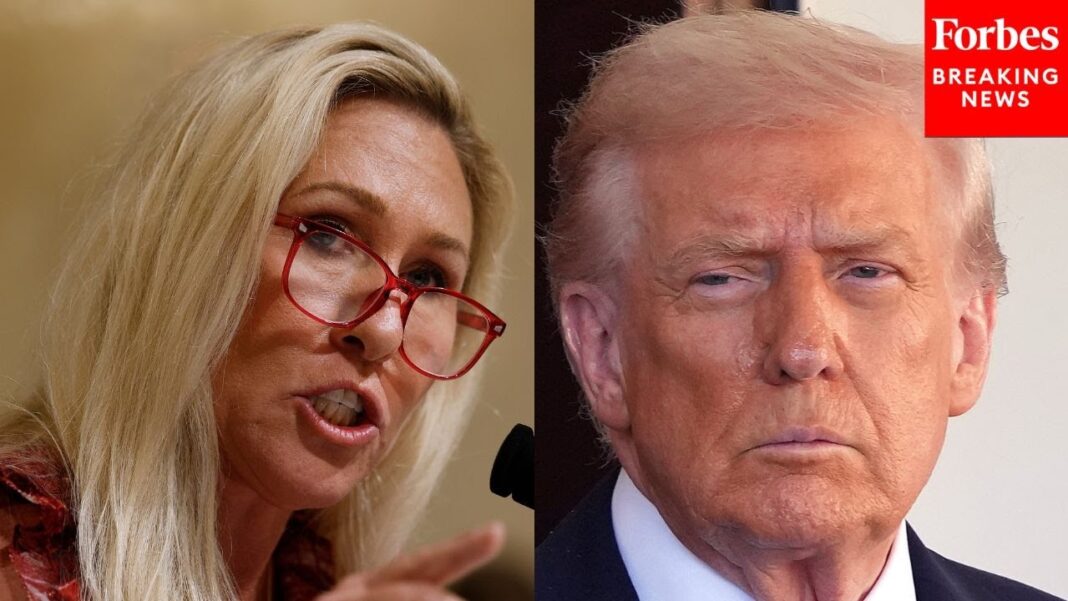
President Donald Trump has formally withdrawn his endorsement of Rep. Marjorie Taylor Greene (R-Ga.), signaling the abrupt end of one of the most visible and controversial political alliances in recent Republican history. The decision followed weeks of escalating tension between the two, culminating in sharp public exchanges that revealed a deep personal and ideological rupture.
World Israel News reported on Saturday that Trump’s statement which was issued on Friday via social media, marked a dramatic departure from years of mutual political support. “I am pulling back my endorsement of Marjorie Taylor Greene,” he declared, adding pointedly:
“All I see ‘Wacky’ Marjorie do is COMPLAIN, COMPLAIN, COMPLAIN!”
As reported by World Israel News, the president accused the Georgia congresswoman of veering “far left” and engaging in erratic behavior, saying he no longer had time to “take calls from a ranting lunatic,” given his demanding schedule of Cabinet meetings, congressional negotiations, and foreign policy discussions.
The break between Trump and Greene, long seen as ideological allies within the populist wing of the Republican Party, did not occur overnight. According to the information provided in the World Israel News report, tensions between the two began surfacing in recent months as Greene increasingly distanced herself from the administration’s foreign policy and political messaging.
Greene, who is up for reelection in 2026, had publicly criticized the president’s approach to international diplomacy, accusing him of spending excessive time abroad while domestic issues remained unresolved.
Earlier on Friday, Trump defended his foreign travel, arguing that his engagements with global leaders — including those from Europe, the Middle East, and Asia — had brought economic benefits to American industries, particularly in Georgia.
“Traveling long distances is hardly my preference,” Trump stated. “I’m in the U.S. almost all the time, but these meetings create jobs and trade for our people — including workers in Marjorie’s own district.”
The World Israel News report noted that the president’s comments reflected his broader effort to position foreign policy achievements as directly linked to U.S. economic growth, while countering Greene’s claims that his diplomacy was a distraction from domestic priorities.
Within hours of Trump’s announcement, World Israel News reported that Greene issued a defiant response on social media, claiming that the president’s decision was motivated by an entirely different agenda — namely, her push to force the release of Justice Department documents related to the late financier Jeffrey Epstein.
“He’s going after me to warn everyone else before next week’s vote on the Epstein files,” Greene wrote, alleging that Trump was attempting to intimidate congressional Republicans ahead of the scheduled vote.
Greene went on to claim that she had received security alerts about threats directed toward her since the president’s statement, blaming Trump for “stirring and encouraging” hostility.
As World Israel News reported, the Georgia lawmaker’s remarks drew widespread attention, both for their explosive tone and for their implication that the former president’s rebuke was part of a broader power struggle within the GOP.
In his social media remarks, Trump accused Greene of abandoning core conservative principles and straying from the populist platform that once united them. According to the report at World Israel News, he suggested that her behavior had alienated not only him but also her own constituents. “She’s changed politically,” Trump said. “Voters in her district are already talking about supporting a challenger. And I will be endorsing someone new.”
While Trump did not identify a potential replacement, the World Israel News report noted that his comments were widely interpreted as an open invitation for a primary challenger to enter the race for Georgia’s 14th Congressional District.
This development marks a major shift in Republican primary politics. Trump’s endorsement has long been viewed as a decisive factor in GOP contests, and his withdrawal of support could seriously weaken Greene’s hold on her district — once considered one of the safest pro-Trump strongholds in the country.
Greene’s recent positions on Israel have placed her increasingly at odds with the White House and many Republican lawmakers. The congresswoman has diverged sharply from mainstream party consensus by labeling Israel’s military operations in Gaza as “genocide,” remarks that have drawn condemnation from senior GOP leaders and pro-Israel organizations alike.
Her statements contrast with Trump’s strong, consistent backing of Israel. The former president has repeatedly praised Israel’s right to self-defense and has expressed unambiguous support for Prime Minister Benjamin Netanyahu’s government.
World Israel News reported that Greene’s rhetoric has alarmed Republican strategists, who view her language as echoing left-wing and activist narratives that undermine bipartisan U.S. support for Israel.
In recent weeks, Greene has also reignited controversies from her early political career. During an appearance on HBO’s “Real Time with Bill Maher,” she revisited previous conspiracy theories, including remarks about the Rothschild family and wildfires allegedly caused by “Jewish space lasers.” When pressed on her past statements, Greene told Maher that she once “didn’t know the Rothschilds were Jewish,” a comment that again prompted backlash and fueled accusations of antisemitism.
As the World Israel News report observed, these incidents have only deepened divisions within the Republican Party, where many now see Greene as a liability rather than a leader of the populist movement she once embodied.
Trump’s public withdrawal of support for Greene marks a significant political and symbolic break. For years, Greene was one of Trump’s most vocal defenders — frequently echoing his positions, amplifying his messaging on social media, and positioning herself as a national face of the “America First” movement.
Her close alignment with Trump once earned her a prominent place in conservative media, and she was often cited as one of the few members of Congress fully in sync with the president’s agenda.
However, as the World Israel News report noted, Greene’s increasing defiance of the administration’s priorities — particularly her criticisms of foreign policy, her clashes with congressional leadership, and her incendiary rhetoric on Israel — have alienated many within Trump’s inner circle.
A senior Republican source cited in the World Israel News report described the split as “a long time coming,” noting that Greene’s recent statements had “crossed a line” within the party.
“When you start calling Israel genocidal and attacking the president who made peace deals in the Middle East, you’re not part of the same movement anymore,” the source said.
Trump’s withdrawal of support is expected to reshape the dynamics of the 2026 midterm elections, particularly in Georgia. Analysts believe that his endorsement of a new Republican challenger could shift donor support and organizational backing away from Greene, effectively isolating her within the party.
Meanwhile, Greene has vowed to remain defiant. “I’ll never stop fighting for truth,” she wrote in a subsequent post, again referencing her demand for transparency in the Epstein documents case.
Her statement suggests that she intends to frame her feud with Trump as a fight against establishment pressure — a strategy similar to the one that initially brought her national prominence.
Yet, as the World Israel News report pointed out, the president’s influence among Republican voters remains formidable. His denunciation of Greene, couched in personal and political terms, may prove difficult for her to overcome in a state where his approval remains overwhelmingly high.
The dissolution of the Trump–Greene partnership, once viewed as emblematic of the modern populist right, represents a profound turning point in Republican politics. As reported by World Israel News, it highlights the volatility of alliances built on personality-driven movements and the ongoing struggle within the GOP to define its post-2024 identity.
For now, Trump’s message was unmistakable. “I’ve moved on,” he wrote in closing. “The people of Georgia — and America — deserve leaders who lift them up, not drag them down.”
With those words, a once formidable alliance that reshaped the political landscape of the Republican Party came to an abrupt and definitive end.