



|
Getting your Trinity Audio player ready...
|
By: Fern Sidman
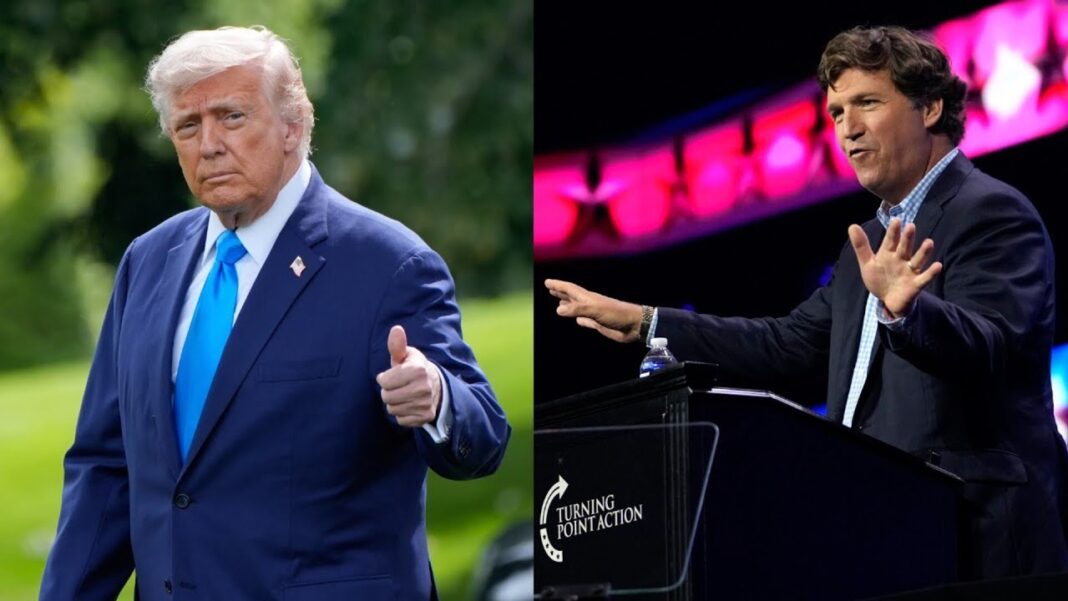
President Donald Trump fired back sharply at former Fox News anchor Tucker Carlson on Monday, brushing aside the conservative commentator’s blistering critique of his handling of the escalating crisis between Israel and Iran. The exchange, which unfolded amid the tense backdrop of the G7 summit in Canada, highlights a widening rift within American conservative circles over the direction of U.S. foreign policy in the Middle East.
According to a report at VIN News, Carlson took to the social media platform X to accuse Trump of being “complicit in an act of war” following Israel’s precision strikes on Iranian nuclear facilities and the killing of several senior officers in Iran’s Islamic Revolutionary Guard Corps (IRGC). The operation, reportedly one of the most far-reaching in Israel’s history, has drawn praise from U.S. allies and condemnation from Tehran—but also sparked unease among isolationist factions within American political discourse.
Carlson, a longtime critic of foreign intervention, lambasted Trump for allegedly drifting away from his 2016 campaign promise to keep America out of entanglements in the Middle East. In his post, Carlson warned ominously that “this unfolding crisis will define Donald Trump’s presidency,” and claimed that Trump was being manipulated by “warmongers” like Fox News personalities Sean Hannity and Mark Levin, whom Carlson accused of egging on a broader military confrontation.
When questioned about Carlson’s remarks during a joint press conference with British Prime Minister Mark Carney, Trump appeared visibly irritated. “I don’t know what Tucker Carlson is saying,” he replied curtly. “Let him go get a television network and say it so that people listen.” His comment, reported by VIN News, signaled not only a personal rebuke but also a calculated dismissal of Carlson’s influence within the conservative movement.
Trump stopped short of endorsing any full-scale American intervention in the region but emphasized that the United States had played a critical defensive role in intercepting Iranian retaliatory missile strikes. The VIN News report confirmed that U.S. forces, operating in coordination with Israel and regional allies, assisted in neutralizing several incoming threats targeting Israeli airspace in the aftermath of the Israeli operation.
Despite Carlson’s accusations, Trump has thus far maintained that his administration is pursuing a strategy of “maximum pressure” without crossing into direct warfare. Still, as the VIN News report noted, the president’s tone in recent days has shifted. During a separate media availability, Trump remarked that “Iran is not winning this war” and warned Tehran that “now is the time” to return to the negotiating table. He has also hinted that a new nuclear deal is within reach—provided Iran backs down on its demand to maintain uranium enrichment capabilities.
The feud with Carlson illustrates a deeper philosophical schism within the right: between nationalist non-interventionists who view U.S. military involvement abroad as a betrayal of Trump’s original populist mandate, and hawkish defenders of Israel who see Iran’s nuclear program as a red line requiring firm deterrence.
The VIN News report indicated that Carlson’s critique is not merely performative. Since his departure from Fox News, Carlson has cultivated a loyal audience through digital platforms, where his isolationist message has found resonance among younger and more libertarian-leaning Republicans.
Still, within the Israeli security establishment and among pro-Israel figures in Washington, Trump’s posture has been welcomed. As the VIN News report pointed out, Israeli officials have praised the U.S. role in defending against Iranian reprisals and view Trump’s refusal to condemn the Israeli operation as a critical endorsement of their campaign against Iran’s military and nuclear infrastructure.
At the heart of the tension lies a difficult truth: Israel’s strike has fundamentally altered the strategic landscape in the Middle East, and the United States—whether reluctantly or not—is now part of the equation. Trump’s calibrated support and Carlson’s fiery opposition are two sides of a growing domestic debate over how far America should go in confronting Iran and defending its allies.
As the VIN News report observed, Trump’s latest comments suggest he is unlikely to be swayed by Carlson’s warnings. Yet the growing divergence between conservative media personalities and the president hints at a broader reckoning within the GOP over war, diplomacy, and America’s place in a volatile world.
