



|
Getting your Trinity Audio player ready...
|
By: Ariella Haviv
In a dramatic escalation of rhetoric between Washington and Jerusalem, President Donald Trump has publicly demanded that Israeli President Isaac Herzog immediately pardon Prime Minister Benjamin Netanyahu, intensifying a controversy that has simmered for months and now threatens to test the delicate balance between political alliance and sovereign legal process.
In a phone interview with Israel’s Channel 12, reported on Thursday by The Times of Israel, Trump declared that Herzog must grant Netanyahu a pardon “today,” asserting that the Israeli prime minister should not be distracted by ongoing legal proceedings while Israel prosecutes its war against Iran. The president’s remarks marked one of his most forceful interventions yet in Israel’s domestic judicial affairs and represented the second time in less than a month that he had openly criticized Herzog over the matter.
According to the information provided in The Times of Israel report, Trump described Herzog as a “disgrace” for failing to act and claimed that he had personally raised the issue with the Israeli president for a year. He further alleged that Herzog had promised him “five times” that he would pardon Netanyahu, an assertion that has not been corroborated by Israeli officials. Trump also stated that he was refusing to meet Herzog until the pardon was granted, though The Times of Israel report noted that there have been no reported efforts by Herzog to seek such a meeting.
The American president’s comments underscore the extent to which Netanyahu’s ongoing trial — on charges of fraud, bribery, and breach of trust — has become entangled in broader geopolitical calculations. Trump has been publicly advocating for a pardon since June 2025, less than a year ago, arguing that the prime minister’s legal entanglements risk undermining Israel’s strategic focus at a moment of regional peril.
At the heart of the controversy lies a tension between political expediency and the rule of law. Netanyahu’s trial has been proceeding in Israeli courts for years, reflecting a legal process that supporters argue demonstrates the robustness of Israel’s democratic institutions. Trump, however, has framed the matter as an unnecessary distraction at a time when Israel is engaged in a high-stakes military confrontation with Iran.
“I don’t want him bothered by anything other than the war,” Trump said in his Channel 12 interview, as reported by The Times of Israel. The implication was clear: in Trump’s view, national security exigencies should override judicial proceedings.
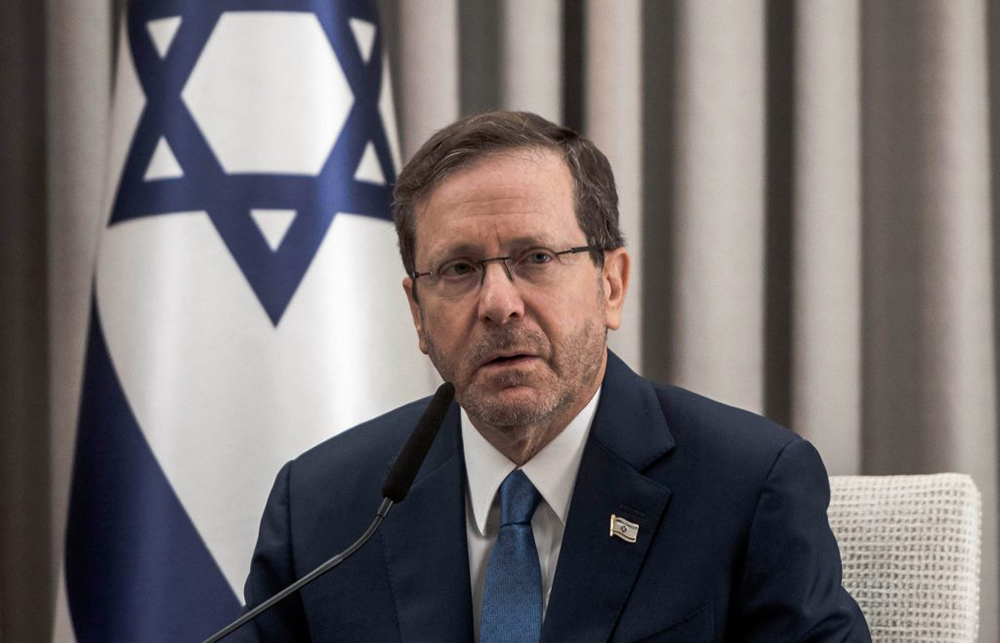
Herzog’s office responded with measured but firm language. In a statement cited by The Times of Israel, the Israeli presidency rejected Trump’s characterization of events and clarified that no decision on a pardon has been made. The matter, the statement explained, remains under review by Israel’s Justice Ministry, which must provide a formal legal opinion before the president can exercise his constitutional authority.
“Only upon completion of that process will President Herzog consider the request in accordance with the law, the best interests of the State of Israel, guided by his conscience, and without any influence from external or internal pressures of any kind,” the statement read. The carefully chosen phrasing signaled both respect for Trump’s role as a key ally and a clear assertion of Israeli sovereignty.
Indeed, The Times of Israel report emphasized that Herzog’s response included an expression of gratitude toward Trump for his contributions to Israel’s security, while simultaneously underscoring that Israel is “a sovereign state governed by the rule of law.” The dual message appeared designed to defuse diplomatic friction without yielding to external pressure.
Trump’s latest comments follow a pattern of increasingly sharp criticism. In February, he declared that Herzog “should be ashamed of himself” for not granting the pardon, marking the first public rebuke of its kind. This month’s remarks, however, escalated the confrontation by introducing personal invective and suggesting broken promises.
The question of presidential pardon authority in Israel is complex. While the president possesses the power to grant clemency, that authority is traditionally exercised after the legal process has concluded, or at least after formal recommendations from legal bodies. As The Times of Israel has reported in previous coverage, clemency decisions are typically guided by considerations of justice, public interest, and legal precedent rather than political expediency.
Legal experts quoted by The Times of Israel in earlier analyses have noted that intervening in an ongoing trial would be unusual and potentially controversial. Such a move could be interpreted as undermining judicial independence at a time when Israel’s legal institutions have already been the subject of intense domestic debate.
Netanyahu himself has not publicly requested a pardon in recent weeks, and his legal team continues to contest the charges in court. The prime minister has repeatedly denied wrongdoing and characterized the case against him as politically motivated. His supporters argue that a pardon would allow him to devote full attention to national security challenges, particularly the confrontation with Iran.
Critics, however, contend that halting the trial would erode public trust in the justice system. The Times of Israel has documented widespread debate within Israel over the proper balance between executive authority and judicial process, especially in light of past controversies over proposed judicial reforms.
The diplomatic dimension adds further complexity. Trump’s staunch support for Netanyahu has been a defining feature of the US-Israel relationship during his presidency. From recognizing Jerusalem as Israel’s capital to backing Israeli military operations, Trump has positioned himself as an unwavering ally. His insistence on a pardon can be seen as an extension of that loyalty.
Yet public pressure from Washington on a matter of Israeli domestic law is unprecedented in tone. While American leaders have occasionally commented on Israeli politics, direct demands regarding judicial outcomes are rare. Herzog’s statement subtly suggested concern that Trump’s remarks could be construed as interference in Israel’s sovereign affairs.
The broader context of the war with Iran looms over the dispute. Israeli officials have emphasized the need for unity and focus as military operations intensify. Trump’s argument rests on the premise that internal legal distractions weaken strategic resolve. Whether that view resonates within Israel is uncertain.
Public opinion in Israel remains divided on the pardon question. Some see clemency as a pragmatic step to consolidate leadership during wartime; others view it as an unacceptable circumvention of due process. The Times of Israel report highlighted the diversity of views across Israel’s political spectrum, reflecting a society deeply engaged with the principles of accountability and governance.
For Herzog, the stakes are high. As a largely ceremonial head of state, his role is often one of moral arbiter and national unifier. Exercising pardon authority in a case of this magnitude would define his presidency. Yielding to external pressure could invite criticism at home, while resisting Trump’s demands risks straining relations with a crucial ally.
For Trump, the issue appears to be both strategic and personal. His longstanding political partnership with Netanyahu has weathered previous disagreements, and his public defense of the prime minister aligns with his broader narrative of standing by allies under siege.
As The Times of Israel continues to report on the evolving dispute, the immediate outcome remains uncertain. The Justice Ministry’s legal review has not yet concluded, and Herzog has given no indication of a timeline for decision. Trump’s refusal to meet Herzog until a pardon is granted adds a layer of diplomatic theater but may ultimately prove symbolic.
What is clear is that the controversy has illuminated the intricate interplay between law, politics, and alliance. In pressing for immediate clemency, Trump has injected urgency into a process traditionally governed by deliberation. In responding with a reaffirmation of legal procedure, Herzog has sought to preserve institutional integrity.
Whether the impasse deepens or yields to quiet diplomacy will depend on developments in both Jerusalem and Washington. For now, the episode stands as a vivid illustration of the tensions that can arise when wartime exigencies intersect with the enduring principles of democratic governance.
