



|
Getting your Trinity Audio player ready...
|
To understand @Harvard you need to understand #DEI https://t.co/yxfwZ2K4VK
— The Jewish Voice (@JewishVoice) December 17, 2023
Edited by: TJVNews.com
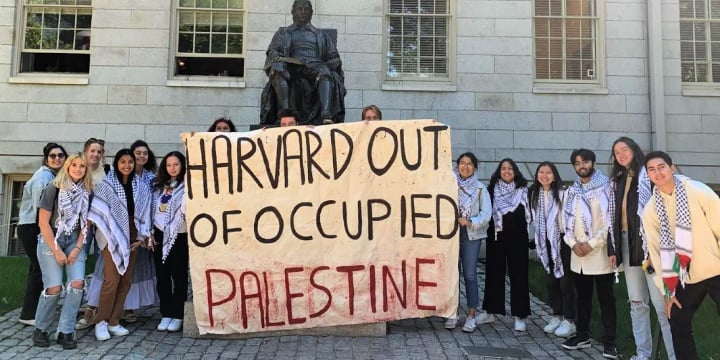
In recent months, American universities have become battlegrounds for debates surrounding the Israeli-Palestinian conflict, as institutions grapple with the challenge of maintaining free expression while addressing concerns of anti-Semitism and violence on campus, as was recently reported in the New York Times.
The University of Pennsylvania found itself in the midst of controversy when approval for the screening of a documentary critical of Israel was denied. Meanwhile, at Brandeis University, known for its public commitment to free speech, a pro-Palestinian student group faced restrictions due to statements made by its national chapter, according to the NYT report. These incidents reflect a broader trend of universities facing challenges in navigating discussions around the Israeli-Palestinian conflict.
Student Sues Qatari Funded Carnegie Mellon for Anti-Semitic Abuse – https://t.co/AwwoDdkLbc @QatarNewsAgency @CarnegieMellon #lawsuit @PittsburghPG @antisemitism @StopAntisemites #YaelCanaan #Israeli #anxiety #depression
— The Jewish Voice (@JewishVoice) December 15, 2023
The University of Vermont witnessed the cancellation of a talk by a Palestinian poet after accusations of anti-Semitism, showcasing the intensification of the struggle on campuses. As was indicated in the NYT report, some universities have chosen to cancel or delay events, while others have taken more drastic measures such as shutting down student groups and disciplining students. The fear for personal safety among some students has further exacerbated the situation, with reports of alumni creating do-not-hire lists and external groups doxxing protesting students, the NYT report added.
Amidst these developments, universities face mounting pressure from donors, alumni, and politicians who justifiably point to pro-Hamas protests that glorify terrorism and wanton murder of Jews as constituting an anti-Semitic campaign. The involvement of external influences has added an additional layer of complexity to the challenges faced by university leaders.
As videos of protests went viral, depicting physical altercations and confrontations, university officials found themselves under heightened scrutiny to address the escalating tensions. According to the NYT report, the need to contain these demonstrations without infringing on the principles of free expression has become a central concern for administrators.
According to Radhika Sainath, an attorney with Palestine Legal, the organization has seen an unprecedented surge in requests for assistance, with over 450 campus-related cases reported since the October 7th Hamas attack on Israel in which 1200 Israelis and others were brutally massacred. As was reported in the NYT, these cases range from revoked scholarships and doxxing of students to disciplinary actions against professors as well as pressure being placed on administrators from trustees. Sainath describes the current situation as a “’60s-level moment” marked by both repression and mass student mobilization.
Doxxing Trucks Return at Harvard President Claudine Gay’s House – https://t.co/LXs1Z61Cf9 #doxxing @Harvard @gay_claudine @BillAckman @antisemitism @StopAntisemites @AccuracyInMedia @Penn @MIT @_SAFECAMPUS @JewishonCampus_ #jewishlivesmatter
Follow us on the Jewish Voice…— The Jewish Voice (@JewishVoice) December 13, 2023
In a significant development, Students for Justice in Palestine (SJP), the most prominent pro-Palestinian campus group, has faced suspensions from at least four universities, including Columbia, Brandeis, George Washington, and Rutgers. The NYT reported that allegations of supporting Hamas, disrupting classes, and intimidating other students have been leveled against the group. SJP, a network of autonomous chapters founded around 30 years ago, vehemently denies these accusations.
In response to the suspensions, the national Students for Justice in Palestine group issued a strongly-worded statement, decrying the actions as a “dangerous escalation of repressive measures,” the NYT reported. According to the group, administrators are unfairly characterizing anti-Zionist student organizers as a violent and existential threat, accusing them of crafting an infrastructure for mass repression, censorship, and intellectual manipulation, the report added.
In Florida, the chancellor of the State University System sparked controversy by instructing school presidents to “deactivate” SJP chapters in the state, as per the NYT report. Civil rights groups argue that this directive blatantly violates the First Amendment. The order highlights the delicate position university leaders find themselves in, torn between ensuring intellectual openness and addressing the concerns of traumatized and frightened students.
The calls for Jewish students to fight back against the vicious onslaught of anti-Semitism on college campuses is getting louder and louder with each passing moment. @StopAntisemites @antisemitism @EndJewHatred @_SAFECAMPUS @JewishonCampus_ @JewishLifeNow @HillelIntl… pic.twitter.com/copAkRGVbO
— The Jewish Voice (@JewishVoice) December 13, 2023
Legal experts, such as Burt Neuborne of NYU Law, emphasize the delicate balance university leaders must strike. The report in the NYT said that Neuborne acknowledges the potential price in intellectual openness if campuses become unduly restrictive in speech, yet he recognizes the need to address the fears of young people affected by the ongoing conflict.
Kenneth L. Marcus, head of the Brandeis Center, a Jewish civil rights group independent of Brandeis University, argues that administrators must take action when Jewish students face assault, intimidation, and threats, according to the NYT report. Marcus contends that it is not merely offensive speech but outrageous conduct that demands a response. He advocates for universities to enforce existing rules consistently and evenhandedly.
The University of Vermont faced scrutiny when administrators canceled an in-person event featuring Palestinian poet Mohammed el-Kurd, citing anti-Semitism concerns raised by some students. The NYT reported that the Anti-Defamation League has criticized el-Kurd for displaying a “troubling pattern of rhetoric and slander.” Lecture organizers reject the charges, asserting that conflating criticism of Israel and anti-Zionism with anti-Semitism curbs academic freedom.
William Youmans, an associate professor at George Washington University and former SJP member, observes that while university officials’ tactics can sometimes be chilling to student activism, external forces exerting pressure through doxxings and warnings to potential employers are having more profound consequences, as per the NYT report. He suggests that the strategy of external pressure is more effective at silencing dissent, as administrators suppressing speech may face pushback given their obligation to uphold free expression.
Despite the potential backlash, Dr. Youmans notes that university responses to the Israeli-Palestinian conflict have consequences. Some administrators may issue statements to signal action, potentially pleasing donors. However, these responses can inadvertently stigmatize certain groups and forms of speech, creating an environment where open dialogue becomes increasingly challenging, the report in the NYT said.
More hypocrisy from Harvard U as told by Maya Sulkin. @Harvard #intifada #mayasulkin https://t.co/VjBBlzBFZF
— The Jewish Voice (@JewishVoice) December 8, 2023
The deteriorating environment for discussions on the Israeli-Palestinian conflict is reflected in a biannual survey conducted by the University of Maryland and George Washington University. The NYT report said that the survey, carried out last month, reveals that 66 percent of respondents reported self-censoring on the Middle East in general, up from 57 percent in the fall of 2022. Scholars studying and writing about the conflict find themselves navigating increasingly sensitive terrain.
In mid-November, the Harvard Law Review declined to publish an article by Rabea Eghbariah, a Palestinian scholar and human rights lawyer, which evaluated events in Gaza within and beyond the legal framework of genocide as defined by the United Nations, according to the report in the NYT. The decision sparked controversy, with the Review citing rigorous editorial processes, while dissenting editors condemned the move as a response to public intimidation and harassment. Eghbariah criticized the decision as discriminatory and indicative of a “Palestine exception to free speech,” the NYT report added.
At the University of Pennsylvania, a progressive Jewish student group, Penn Chavurah, faced challenges in planning a screening of the documentary “Israelism.” The film, made by American Jews reevaluating their beliefs about Israel, explores the country’s treatment of Palestinians. As was noted in the NYT report, the screening, initially scheduled for October 24, was postponed due to its proximity to the Hamas attack. The documentary has polarized campuses, with Hunter College canceling a screening last month.
Undeterred, the students sought approval from the school’s Middle East Center, which initially received consent for the event. However, when administrators learned that the film in question was “Israelism,” students were warned of potential disciplinary consequences if the screening proceeded, according to the NYT report.
A Penn spokesperson declined to comment to the NYT on the specifics of potential student discipline but cited the university’s commitment to the safety and security of the campus community. The university postponed the screening until February, asserting that the organizers had disregarded the school’s wishes to reschedule the event for that time, the NYT reported. The decision came after the issue gained public attention.
Looks like Nyu University fighting back against Hamas supporters on campus https://t.co/RbsXgAVf5O
— The Jewish Voice (@JewishVoice) December 8, 2023
In a twist to the narrative, University of Pennsylvania President M. Elizabeth Magill resigned after a challenging appearance before Congress. During the hearing, she provided a legalistic response to a question about the school’s code of conduct and whether it would penalize students advocating for the genocide of Jews, according to the NYT report.
The fact that pro-Hamas forces on campuses throughout the United States that are committed to promulgating the most egregious forms of anti-Israel propaganda are now feeling pressure by the administrations of their respective universities to curtail their mendacious propaganda serves as proof that the campaign waged by Jewish alumni , Jewish donors, Jewish student activist groups to create a safe collegiate environment for Jewish and pro-Israel students has reached an impressive measure of success.
With the help of such elected officials as Rep. Elise Stefanik and the House committee investigating the formidable surge of anti-Semitism on college campuses, the issue has received national attention and continues to dominate the headlines.
Virulently anti-Semitic and anti-Zionist diatribes as well as harassment and bullying of Jewish students who support Israel can no longer be acceptable in any form on our campuses.
While exercising their first amendment right of free speech must be respected, these pro-Hamas forces, (who, incidentally also harbor a deep animus towards America as well as Israel) can no longer control the political narrative by extolling their bald faced lies, gross distortions and half truths.
As administrators grapple with competing interests and legal complexities, the broader implications for intellectual openness and academic freedom remain at the forefront of this contentious debate.