



|
Getting your Trinity Audio player ready...
|
By: Fern Sidman
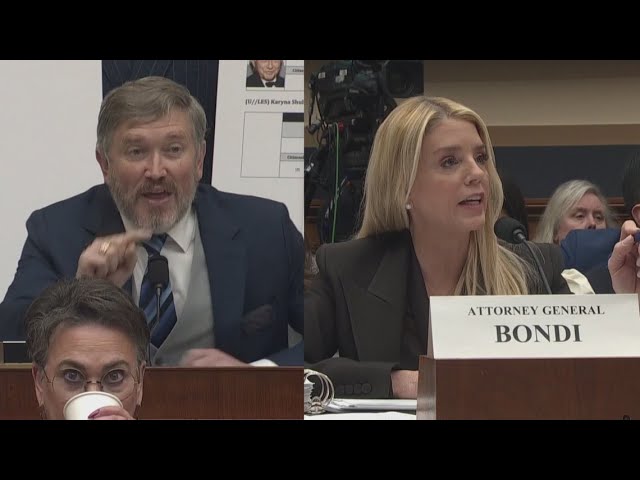
The cavernous hearing room of the House Judiciary Committee, long accustomed to the ritualized theater of partisan oversight, became on Wednesday the stage for an unusually raw display of political antagonism. Attorney General Pam Bondi, summoned to testify on the Department of Justice’s handling of the still-radioactive Jeffrey Epstein files and a constellation of other departmental priorities, found herself at the epicenter of a confrontation that exposed the depth of Washington’s institutional mistrust and the volatile passions surrounding one of the most disturbing criminal sagas in modern American history. As VIN News reported on Wednesday, the session quickly degenerated from procedural inquiry into an exchange of barbed words, personal invective, and bitter recrimination, offering a vivid tableau of the fraying norms that increasingly characterize congressional oversight.
Bondi, a former Florida attorney general who assumed her current post in early 2025 following her nomination by President Trump, entered the hearing with a reputation as a seasoned courtroom combatant. Yet even seasoned litigators can be caught off guard by the peculiar dynamics of congressional interrogation, where legal precision collides with political spectacle. The hearing, nominally convened to review the Justice Department’s operations, became dominated by questions surrounding the government’s stewardship of materials related to Epstein, the late financier whose sprawling web of abuse allegations continues to haunt the American conscience. For Democrats on the committee, the Epstein files represent not merely a prosecutorial matter but a moral reckoning—one that, in their view, the Department of Justice has yet to confront with adequate urgency and transparency.
Tensions rose almost immediately as Democratic members pressed Bondi on whether the department had been forthright in disclosing documents, whether any tacit understandings had shielded powerful figures from scrutiny, and whether survivors of Epstein’s crimes were being afforded the dignity of full disclosure. The questions, layered with insinuations of cover-ups and institutional inertia, were framed not simply as demands for information but as indictments of the department’s ethical compass. Bondi, for her part, bristled at the implication that the DOJ had abdicated its responsibilities. She insisted that the department continued to pursue all viable investigative avenues and rejected any suggestion that political considerations had intruded upon prosecutorial judgment.
The rhetorical temperature of the room reached a boiling point during exchanges with Representative Jerry Nadler of New York and Representative Jamie Raskin of Maryland, the committee’s ranking Democrat. As interruptions multiplied and competing lines of questioning collided, Bondi accused her interlocutors of indulging in what she characterized as performative outrage. According to the information provided in the VIN News report and corroborated by widely circulated video clips, she dismissed the tenor of the questioning with the caustic aside, “Here we go with the theatrics,” a remark that drew audible reaction in the chamber and signaled her impatience with what she perceived as political grandstanding.
If that comment underscored the adversarial tone of the proceedings, Bondi’s subsequent exchange with Raskin pushed the encounter into even more combustible territory. When the Maryland lawmaker interjected with a procedural admonition—“I told you, Attorney General—”—Bondi’s response was swift and cutting. “You don’t tell me ANYTHING, you washed up—you’re not even a lawyer!” she retorted, a remark that reverberated through the hearing room and instantly ignited controversy. The irony of the insult was not lost on observers: Raskin, before entering Congress, had been a constitutional law professor and practicing attorney. The outburst, while perhaps born of the moment’s intensity, crystallized the breakdown of civility that increasingly afflicts high-profile oversight hearings.
The exchange was emblematic of a broader deterioration in the decorum traditionally expected of interactions between cabinet officials and lawmakers. Where once such hearings aspired—at least in theory—to balance rigorous scrutiny with mutual respect for institutional roles, they now more often resemble gladiatorial contests in which verbal blows are exchanged for partisan advantage. The presence of Epstein survivors in the hearing room lent an additional layer of emotional gravity to the proceedings. Several Democratic lawmakers invoked their presence to underscore what they described as the human cost of bureaucratic delay and obfuscation, urging Bondi to address the survivors directly and to acknowledge the enduring trauma inflicted by Epstein and any accomplices who have yet to face justice.
Bondi, however, resisted the framing that cast the Department of Justice as indifferent to victims’ concerns. She reiterated that the department’s mandate is to pursue justice within the confines of law and evidence, not to satisfy the performative demands of political adversaries. In her telling, the DOJ’s ongoing work on Epstein-related matters is constrained not by lack of will but by the complexities inherent in cases involving deceased defendants, sealed records, and interlocking jurisdictions. VIN News reported that she sought to situate the department’s actions within a broader context of legal process, cautioning against conflating procedural deliberation with moral indifference.
The hearing, chaired by Representative Jim Jordan of Ohio, did not confine itself exclusively to the Epstein files. Broader questions of DOJ policy, including immigration enforcement priorities and retrospective assessments of past prosecutions, surfaced throughout the session. Yet it was the Epstein-related questioning that dominated public attention, in part because it taps into a deep reservoir of public distrust toward elite institutions. The Epstein saga, with its implications of privilege, impunity, and systemic failure, has become a prism through which many Americans view the justice system itself. For Democrats on the committee, pressing Bondi on these matters was as much about signaling solidarity with victims as it was about asserting congressional authority over an executive branch department they regard with skepticism.
From the perspective of VIN News, the hearing’s significance lies not only in the particulars of the exchange but in what it reveals about the evolving relationship between the Department of Justice and Congress. Oversight, in theory, is designed to ensure accountability and transparency. In practice, it has become increasingly entangled with partisan narratives that frame the department either as a bulwark against lawlessness or as a politicized instrument of executive power. Bondi’s confirmation earlier this year was itself contentious, reflecting deep divisions over the direction of the DOJ under the current administration. Wednesday’s hearing thus functioned as a proxy battle over broader questions of institutional trust: Who controls the narrative of justice in America, and to what extent can the DOJ insulate itself from political crossfire?
No immediate policy shifts emerged from the session, and no new disclosures regarding the Epstein files were announced. Yet the symbolic resonance of the encounter may prove more consequential than any formal outcome. The spectacle of an attorney general trading personal barbs with lawmakers risks further eroding public confidence in the capacity of democratic institutions to engage in sober, principled deliberation. At the same time, the intensity of the questioning underscores the depth of public anger over perceived failures to fully reckon with Epstein’s crimes and their aftermath. In this sense, the hearing can be read as a microcosm of a larger national unease: a struggle to reconcile demands for transparency and accountability with the procedural realities of the legal system.
The VIN News report observed that the polarized reception of Bondi’s performance—applauded by some as a robust defense of executive prerogative, condemned by others as unbecoming of the nation’s chief law enforcement officer—mirrors the broader fragmentation of American political culture. In an era when every public utterance is instantly disseminated and dissected across digital platforms, moments of confrontation acquire a life far beyond the hearing room. Bondi’s remarks, stripped of context and circulated in viral clips, are likely to shape perceptions of her leadership style and, by extension, the character of the Justice Department she leads.
As the dust settles from Wednesday’s acrimonious session, the enduring questions remain unresolved. Will the Department of Justice provide fuller transparency regarding the Epstein files? Can congressional oversight reclaim a measure of decorum without sacrificing rigor? And perhaps most crucially, can the institutions entrusted with upholding the rule of law demonstrate to a skeptical public that justice is neither selective nor subject to partisan calculus? The hearing offered no definitive answers. What it did provide was a stark reminder that the pursuit of accountability in contemporary America is inseparable from the politics of confrontation—a reality that continues to test the resilience of the nation’s democratic norms.
What I can’t seem to understand and clarify- why when Biden was President and both the House and Senate were controlled by the Democrats- why wasn’t the Epstein files opened up and allow the American public to see? I strongly believe this was a toll to use later to use against Trump. The Democrats knew they were all over the Epstein files and if I was the Trump administration- I would releases all of the files and not delete a single item. The truth would be exposed once and for all and probably shut the Democrats down.