



|
Getting your Trinity Audio player ready...
|
Sid Rosenberg Apologizes For “Cockroach” Remark Against Mamdani After Political Firestorm Erupts
By: Julie Herndon
A volatile political and media controversy unfolded this week after 77 WABC morning host Sid Rosenberg issued a public apology for inflammatory social media pot sts targeting New York City Mayor Zohran Mamdani. The remarks, which quickly ignited widespread condemnation across the political spectrum, have reignited debate over the boundaries of political rhetoric, the responsibilities of influential broadcasters, and the increasingly combustible intersection of media and municipal politics.
According to report on Wednesday by VIN News, Rosenberg had posted on X earlier this week, referring to Mamdani as a “Radical Islam cockroach” and a “Jihadist America-hating Mayor,” while urging President Trump to cease engaging with the newly elected mayor. The language, widely viewed as dehumanizing and incendiary, drew swift backlash from elected officials, advocacy organizations, and even personal acquaintances of the radio host.
The New York chapter of the Council on American-Islamic Relations (CAIR) called for Rosenberg’s show to be canceled outright, characterizing the comments as emblematic of Islamophobia. Gov. Kathy Hochul denounced the remarks as “hateful, racist, and disgusting,” stating that such rhetoric undermines the civic fabric of the state. Senate Majority Leader Chuck Schumer similarly condemned the posts, describing them as “a disgusting display of bigotry and Islamophobia that should receive universal condemnation.”
Even NYPD Commissioner Jessica Tisch — widely regarded as friendly with Rosenberg — publicly criticized the comments, underscoring the breadth of the reaction. The chorus of disapproval extended across partisan and institutional lines, reflecting both the intensity of the language and the high-profile nature of the personalities involved.
Mayor Mamdani, when asked about the remarks, responded with a tone of weary familiarity. “This language is both painfully familiar to me as a Muslim New Yorker, but also as someone who was born in East Africa,” he said. “It is difficult to hear.” His response, as reported by VIN News, refrained from escalating the confrontation but made clear the personal toll of such rhetoric.
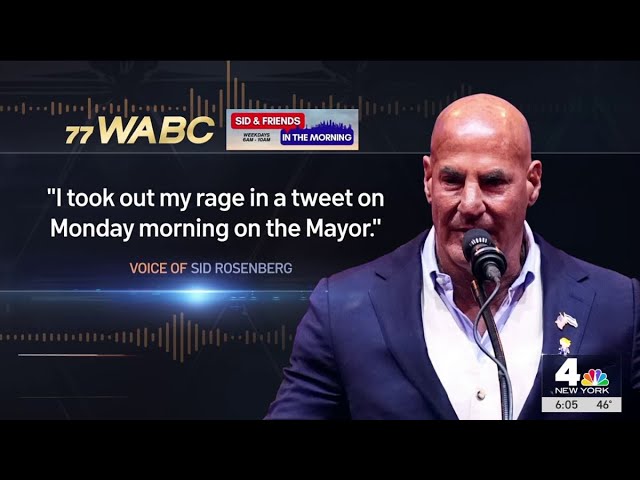
On Wednesday morning, Rosenberg addressed the controversy directly during his 77 WABC broadcast. He issued what he described as a “heartfelt apology” to the mayor and to anyone else offended by the post. “To the mayor, and anyone else that I offended with my tweet on Saturday, I send out a heartfelt apology,” Rosenberg said, according to the VIN News report. He also deleted the original message from his social media account.
In explaining himself, Rosenberg conceded that calling someone a “bug” was inappropriate. “Not nice to call somebody a bug, I get it,” he remarked on air, though he insisted that his words “had nothing to do with anybody’s religion or faith or anything.” Some guests on his program defended his broader criticisms of Mamdani’s policies, drawing a distinction between harsh political commentary and religious animus.
Yet the episode underscores the precarious line between ideological critique and language that many interpret as crossing into dehumanization. Referring to an elected official as a “cockroach” evokes historical patterns of rhetoric that have been used to marginalize and vilify minority communities. Critics argue that regardless of intent, such terminology carries weight and consequence.
The controversy was further amplified when President Trump posted a photograph of Mayor Mamdani standing next to the Declaration of Independence during a visit to the Oval Office. As the VIN News report observed, the image was widely interpreted by commentators as a subtle rebuke to Rosenberg’s remarks, given the timing of the post and the ongoing public dispute. While Trump did not directly reference Rosenberg in his caption, the juxtaposition was viewed by many as signaling continued engagement with the mayor despite calls from some conservative voices to distance the administration from him.
The broader political context cannot be ignored. Mayor Mamdani, whose progressive platform has generated both enthusiastic support and sharp criticism, has emerged as a polarizing figure in New York politics. Rosenberg, a longtime conservative commentator with a loyal audience, has frequently criticized left-leaning municipal policies. The clash between the two reflects deeper ideological divisions within the city and the nation at large.
VIN News has chronicled the rapid escalation of the dispute, noting that what began as a social media post evolved into a statewide controversy within days. The speed of amplification illustrates the power of digital platforms to transform a single message into a flashpoint for national debate.
For Rosenberg, the fallout raises questions about professional consequences. Although CAIR has called for the cancellation of his program, it remains unclear whether 77 WABC or its parent company intends to take disciplinary action. Radio talk show hosts traditionally operate within a wide latitude of rhetorical expression, often cultivating provocative personas. However, as public sensitivities evolve and advertisers scrutinize brand associations more closely, the tolerance for incendiary language may be narrowing.
Mayor Mamdani has not indicated whether he considers the matter closed following Rosenberg’s apology. It remains unclear whether city officials plan to formally respond. In political terms, accepting an apology may serve to de-escalate tensions, while pursuing further action could risk prolonging the controversy.
Beyond the immediate actors, the episode highlights a larger cultural reckoning. Political discourse in the United States has grown increasingly confrontational, with social media platforms amplifying extreme phrasing and emotional reactions. When influential media figures engage in rhetoric that critics label dehumanizing, the ripple effects can extend far beyond a single exchange.
At the same time, defenders of robust free expression argue that political debate must allow room for sharp, even abrasive criticism. They caution against conflating policy disagreements with prejudice, contending that public officials should expect vigorous scrutiny. The challenge lies in discerning when language moves from pointed critique into territory that alienates and demeans communities based on identity.
VIN News has framed the episode as emblematic of the tensions shaping contemporary public life — where ideological divides intersect with questions of civility, media responsibility, and the lived experiences of minority communities. For many Muslim New Yorkers, Mamdani’s comments about the familiarity of such rhetoric resonate as a reminder of ongoing social challenges. For others, Rosenberg’s apology may represent an acknowledgment of misjudgment rather than malice.
In the end, the controversy serves as a case study in the volatile interplay between media personalities and elected officials in the digital age. A single tweet can provoke institutional condemnation, political calculation, and national headlines within hours. Whether Rosenberg’s apology will restore equilibrium or merely mark a temporary pause in a deeper ideological clash remains to be seen.
As VIN News reported, the episode stands as a reminder of the enduring power of words — and the responsibilities borne by those who wield them before a vast audience.
