



|
Getting your Trinity Audio player ready...
|
By: Fern Sidman
By any measure, the debate that unfolded this week between Pennsylvania Governor Josh Shapiro and Vice President JD Vance was about far more than a single social media post. It was, as VIN News reported on Thursday, a collision of memory, identity, political power, and the moral vocabulary of public life — a confrontation that exposed the fragile fault lines in how American leaders speak about antisemitism, the Holocaust, and the responsibilities of remembrance in an era of deep polarization.
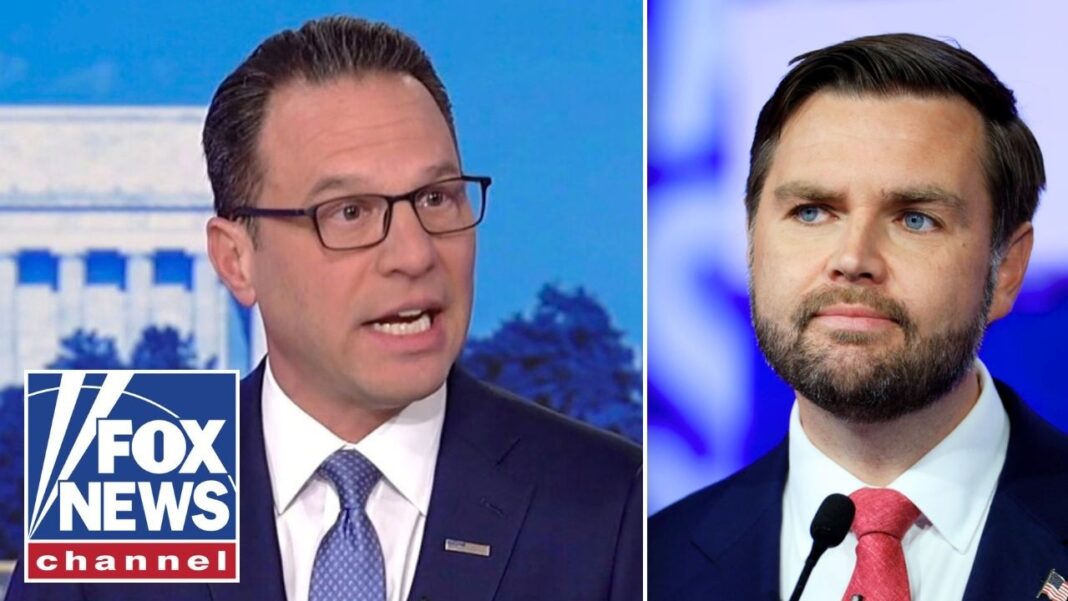
Appearing Thursday on Special Report with Bret Baier on Fox News, Shapiro did not retreat from his sharp criticism of Vance, despite questions about whether his language contradicted his own calls for less incendiary political discourse. Instead, as the VIN News report detailed, Shapiro doubled down, framing his remarks not as rhetorical excess, but as a principled response to what he described as a troubling pattern in the vice president’s political posture toward the far right and toward the moral clarity demanded by Holocaust memory.
At the center of the controversy was Vance’s Holocaust Remembrance Day post on X, which featured photographs from his visit to the Dachau concentration camp memorial in Germany. The post offered reflections on human cruelty, suffering, and the importance of remembrance, concluding with a broad pledge that “we promise never again to go down the darkest path.” Yet, it did not explicitly name Jews as the primary victims of the Holocaust, nor did it directly reference the Nazi regime responsible for the genocide.
For Shapiro — who is Jewish and has long made confronting antisemitism a central theme of his public life — the omission was not incidental. Speaking earlier to NBC News, he described the post as deeply troubling, saying, “The fact that JD Vance couldn’t bring himself to acknowledging that six million Jews were killed by Hitler and by the Nazis speaks volumes.” The VIN News report noted that this criticism quickly reverberated across political and Jewish communal spaces, with advocacy groups and commentators from across the ideological spectrum expressing concern that the Holocaust was being rhetorically universalized in a way that diluted its historical specificity.
On Fox News, Baier pressed Shapiro directly: how could he reconcile such pointed language with his stated goal of lowering the temperature of American political discourse? Shapiro’s response, as VIN News reported, was deliberate and composed. He argued that calling out antisemitism — even when politically uncomfortable — is not inflammatory, but morally necessary. His criticism of Vance, he said, was not a personal attack but part of a broader concern about how political leaders engage with extremist rhetoric and historical truth.
“I don’t believe naming antisemitism is divisive,” Shapiro said in essence. “I believe ignoring it is.” According to VIN News, he framed his remarks as consistent with a larger ethical obligation: to speak clearly when historical memory is blurred and when moral language becomes vague at moments that demand precision.
The controversy, however, quickly became more complex. A spokesperson for Vance pushed back forcefully, accusing Shapiro of political opportunism and hypocrisy. The spokesperson pointed out that Shapiro’s own Holocaust Remembrance Day message did not explicitly mention Jews either, even though it addressed antisemitism more broadly. As the VIN News report noted, this rebuttal shifted the debate from a single post to a broader question: how should public officials speak about the Holocaust in an age where symbolic language, social media brevity, and political signaling often replace historical specificity?
The White House declined immediate comment, but the silence did little to slow the controversy. Within hours, the exchange had become emblematic of a deeper national tension — not only about antisemitism, but about how memory itself is politicized.
VIN News reported that Shapiro’s comments must also be understood within the context of his broader public identity. He is currently promoting his memoir, “Where We Keep the Light: Stories From a Life of Service” – a work that intertwines personal faith, public duty, and moral responsibility. Throughout his career, Shapiro has consistently foregrounded his Jewish identity and spoken openly about the importance of confronting antisemitism, particularly as hate crimes against Jews continue to rise across the United States.
For Shapiro, Holocaust remembrance is not merely ceremonial. It is a moral framework — one that demands clarity, specificity, and courage. In his view, failing to name Jews as the central victims of the Holocaust is not a neutral omission, but a distortion that weakens the historical and ethical force of remembrance.
Vance’s defenders, however, argue that his post was meant to universalize the lessons of the Holocaust rather than erase Jewish suffering. They point to his language about human cruelty and the dangers of dehumanization as evidence of a broader moral message. Yet critics counter, as the VIN News report highlighted, that universalization without specificity risks transforming the Holocaust into an abstract symbol of suffering rather than a historically grounded genocide with identifiable victims and perpetrators.
This tension — between universal moral messaging and historical precision — is not new. Scholars of memory politics have long warned that when the Holocaust is detached from its Jewish specificity, it becomes vulnerable to appropriation, distortion, and relativization. This is precisely why many Jewish organizations reacted so strongly to Vance’s post: because they see such rhetorical shifts as part of a broader cultural drift that weakens the integrity of Holocaust memory.
The political stakes are equally significant. Shapiro and Vance are both widely viewed as potential contenders in the 2028 presidential race. Their clash is not occurring in a vacuum, but within the long arc of emerging national leadership battles. The way each man positions himself on issues of antisemitism, historical memory, and moral leadership is already shaping public perception — not just within Jewish communities, but across the broader electorate.
Shapiro’s critique of Vance extended beyond the Holocaust post itself. He has previously accused the vice president of offering “comfort” to antisemites on the far right — a charge that reflects Shapiro’s broader concern about the normalization of extremist rhetoric in American politics. For Shapiro, antisemitism is not an isolated phenomenon but part of a larger ecosystem of hate that thrives when political leaders fail to draw clear moral boundaries.
Vance’s allies reject this framing, arguing that he has consistently condemned hatred and extremism, and that Shapiro’s attacks are politically motivated. Yet the debate itself reveals how antisemitism has become a litmus test in American political discourse — not only in terms of policy, but in the language of symbolism, commemoration, and historical memory.
At its core, this controversy is about more than two politicians or two social media posts. It is about how societies remember trauma, how leaders shape collective memory, and how moral language can either illuminate or obscure historical truth. The VIN News report repeatedly emphasized that Holocaust remembrance is not simply about honoring the past, but about shaping the ethical consciousness of the present.
For many Jewish observers, the fear is not only antisemitism itself, but its subtle normalization — the gradual erosion of clarity, the softening of language, the replacement of specificity with abstraction. In that sense, the Shapiro–Vance exchange is not just political theater; it is a cultural signal.
Shapiro’s insistence on naming Jewish victims reflects a deeper conviction: that remembrance without truth is hollow, and that moral leadership requires precision, not platitudes. Vance’s supporters, by contrast, argue for a more universal framing of memory, one that emphasizes shared humanity over particular identity.
The unresolved tension between these two approaches may define the future of Holocaust remembrance in American public life. Will it remain anchored in historical specificity, or will it increasingly become a generalized symbol of human suffering? The VIN News report suggested that this question is not academic — it has real consequences for how antisemitism is understood, confronted, and prevented.
As political polarization intensifies and memory becomes increasingly mediated through social media and soundbites, the risks of distortion grow. In that environment, the responsibility of public officials becomes heavier, not lighter. Words matter. Omissions matter. Framing matters.
In the end, the Shapiro–Vance controversy reveals a nation still struggling to define the moral grammar of remembrance. It exposes the fragile space where history, identity, politics, and ethics converge — and sometimes collide. As VIN News underscores throughout its coverage, this is not simply a dispute over rhetoric, but a reflection of deeper anxieties about truth, memory, and the future of moral leadership in American democracy.
Whether this episode fades or becomes a defining moment in the political trajectories of both men remains to be seen. But one thing is already clear: the language of Holocaust remembrance is no longer just commemorative. It is political. It is contested. And it is, increasingly, a mirror of the broader battles shaping American public life.
In that sense, the story is not only about Josh Shapiro and JD Vance. It is about a society negotiating how it remembers its darkest chapters — and how honestly it is willing to speak about them.
