



|
Getting your Trinity Audio player ready...
|
Senate Democrats Push Resolution for U.S. to Recognize Palestinian State
By: Fern Sidman
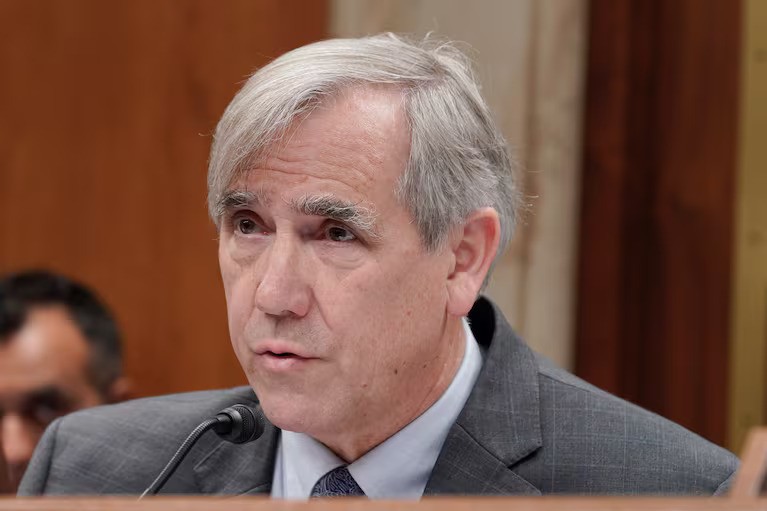
A new political flashpoint erupted in Washington this week as a group of seven Senate Democrats unveiled a resolution urging the United States to unilaterally recognize a Palestinian state. The move, spearheaded by Sen. Jeff Merkley (D-OR) and co-sponsored by prominent progressives and foreign policy voices, marks one of the most significant congressional efforts in years to alter U.S. policy toward Israel and the Palestinians.
According to a report that appeared on Friday at Jewish Insider, the resolution was introduced Thursday and quickly drew attention across Capitol Hill for its timing, its defiance of long-standing bipartisan norms, and its reflection of a shifting Democratic consensus on Middle East policy.
The resolution, led by Merkley and co-sponsored by Sens. Chris Van Hollen (D-MD), Tim Kaine (D-VA), Bernie Sanders (I-VT), Peter Welch (D-VT), Tina Smith (D-MN), Tammy Baldwin (D-WI), and Mazie Hirono (D-HI), explicitly calls for the U.S. to recognize Palestinian statehood outside the framework of direct negotiations with Israel.
“Recognition of a Palestinian state is not only a practical step the United States can take to help build a future where Palestinians and Israelis can live in freedom, dignity, and security, but it is the right thing to do,” Merkley declared in his statement, quoted by Jewish Insider. “America has a responsibility to lead, and the time to act is now.”
The resolution frames itself as a reaffirmation of U.S. commitment to a two-state solution. It highlights that both Democratic and Republican administrations have historically viewed two states as the only path to a sustainable peace. Yet, as the Jewish Insider report noted, it departs from decades of precedent in advocating unilateral recognition, sidestepping the traditional U.S. view that statehood must emerge from negotiations between the parties.
For co-sponsor Tim Kaine, Israel’s political decisions forced the change in strategy. “Since July 2024, when the Israeli Knesset voted to deny a path to Palestinian statehood and made clear that Israel would not accept Palestinian autonomy, I have believed the U.S. should no longer condition recognition on Israeli assent but rather on Palestinian willingness to live in peace with its neighbors,” Kaine said in remarks reported by Jewish Insider.
Kaine’s comments underscore the frustration among Senate Democrats who believe Israel’s current government, led by Prime Minister Benjamin Netanyahu, has not only rejected but actively obstructed the possibility of two states.
Chris Van Hollen, a frequent critic of Israeli policy, echoed this line. He argued that Congress must assert its stance because, in his view, “the Netanyahu government has obstructed that goal [of a two-state solution] and the Trump Administration has abandoned it,” according to the report at Jewish Insider.
The U.S. has for decades expressed rhetorical support for a two-state solution but has consistently opposed unilateral recognition of a Palestinian state, whether through United Nations resolutions or congressional action.
Senator Welch described the resolution as a natural extension of U.S. policy, though through a different mechanism. “Recognizing a two-state solution is long overdue and the only way forward — something Republican and Democratic administrations have agreed on for decades,” Welch said. As the Jewish Insider report emphasized, the resolution portrays recognition as consistent with U.S. values, while critics argue it overturns the very principle of negotiated settlement that undergirded past bipartisan policy.
The timing of the resolution was not accidental. Merkley and Van Hollen had recently returned from a trip to Israel, where they met with officials, humanitarian groups, and residents. They later released a scathing report accusing Israel of “deliberate ethnic cleansing” and “collective punishment” in Gaza, claims that have fueled fierce debate in Washington.
According to the information provided in the report at Jewish Insider, their visit informed the framing of the resolution and gave added urgency to the call for unilateral recognition. Merkley’s comments, in particular, highlighted his view that continued delay would condemn future generations to “suffering from the same insecurity and affliction.”
The resolution does not ignore Hamas. It explicitly condemns the October 7 attacks that left 1,200 Israelis dead and 251 taken hostage, and it reaffirms Israel’s right to exist. Yet it also calls for Hamas to surrender and release its hostages, while simultaneously urging Israel to “end the war in Gaza.”
The Jewish Insider report observed that this balancing act reflects a broader trend among progressive Democrats: condemning terrorism while holding Israel to heightened scrutiny for its military and political responses.
The resolution also comes against the backdrop of growing momentum among U.S. allies to recognize a Palestinian state. Several European countries have already taken or are preparing similar steps, and Arab states have made normalization with Israel contingent on a path to Palestinian statehood.
The legislation states bluntly: “Failure to advance a two-state solution risks entrenching an unacceptable permanent occupation, further destabilizing the region, and undermining United States interests and values.”
As the Jewish Insider report noted, the resolution’s sponsors appear eager to align the U.S. with this international trend, portraying America as lagging behind rather than leading.
The far-left, pro-Hamas advocacy group J Street, long an influential player in Democratic foreign policy debates, quickly endorsed the resolution. J Street has consistently argued that the U.S. must use its leverage to press Israel toward a two-state framework and welcomed the Senate effort as a bold step.
Jewish Insider reported that the group praised the resolution as a reaffirmation of the U.S.’s moral responsibility and as a recognition of the dangers of indefinite occupation.
However, opposition is expected to be fierce. Critics argue that unilateral recognition rewards Palestinian leaders who have failed to curb violence, reform institutions, or negotiate in good faith. They also warn that the resolution undermines the bipartisan principle that peace must be the product of direct negotiations.
Sen. Bernie Sanders’ inclusion among the co-sponsors reflects the growing mainstreaming of ideas that were once confined to the far-left fringe of Democratic politics. Sanders has long advocated for conditioning U.S. aid to Israel and for a more balanced U.S. policy between Israelis and Palestinians. His endorsement, reported by Jewish Insider, signals the degree to which progressive positions have gained traction in the Senate.
The resolution is unlikely to advance into law, given Republican control of the House and deep divisions in the Senate. Still, its introduction alone marks a significant shift in U.S. discourse on the Israeli-Palestinian conflict.
The Jewish Insider report emphasized that the symbolism of seven senators — representing both progressive icons like Sanders and more traditional voices like Kaine — illustrates how far the Democratic conversation has moved since the days of near-unanimous support for Israel.
The resolution also foreshadows intense debate, as Democrats wrestle with balancing longstanding alliances, evolving constituencies, and the pressures of international diplomacy.
The Merkley-led resolution has jolted Washington by calling for something no U.S. administration has ever supported: unilateral recognition of a Palestinian state. For its supporters, it is a moral imperative and a pragmatic step to salvage hopes for peace. For its critics, it is a reckless departure from negotiated principles that could destabilize both Israel and the region.
As the Jewish Insider report indicated, the initiative reflects a deepening fissure in American politics — one where traditional bipartisan consensus on Israel is giving way to sharper ideological divides. Whether or not the resolution gains traction, it has already reshaped the contours of the debate, placing the question of recognition firmly at the heart of U.S. policy discussions.
For now, the future of Palestinian statehood remains uncertain. But one thing is clear: the battle over whether America should recognize it unilaterally is no longer a fringe idea — it is front and center in the halls of the U.S. Senate.
