



|
Getting your Trinity Audio player ready...
|
By: Ariella Haviv
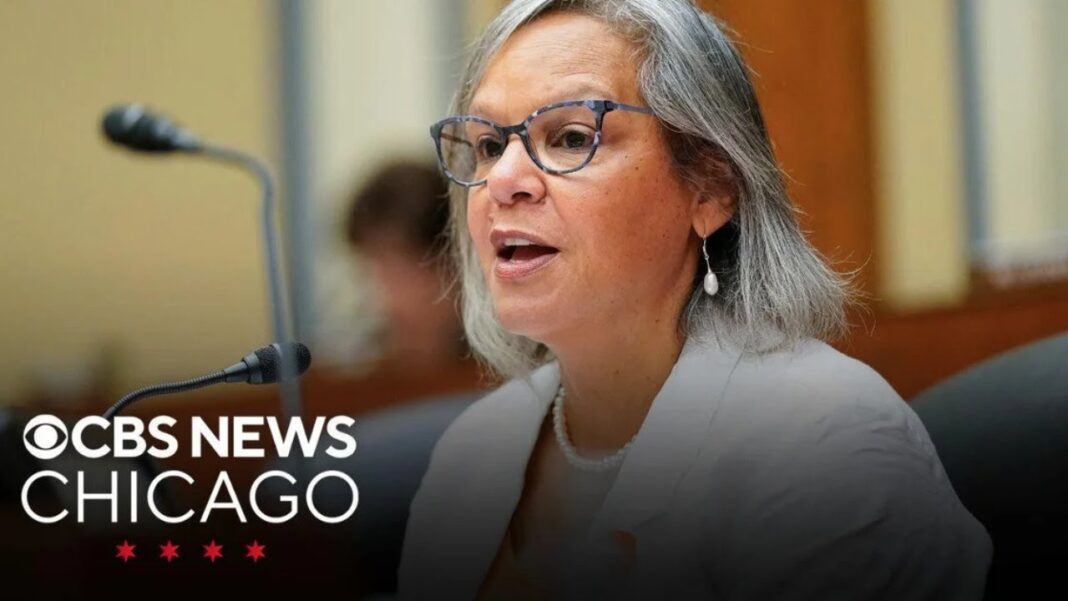
The vocabulary of American politics is not merely descriptive; it is constitutive, shaping the moral horizons within which policy debates unfold. When a sitting member of Congress, standing on a debate stage in the heartland of American electoral politics, pronounces that Israel has committed “genocide” in Gaza, the reverberations extend far beyond the immediate contours of a primary race.
The remark by Rep. Robin Kelly of Illinois, who is running to succeed the retiring Sen. Dick Durbin, marks a conspicuous inflection point in the Democratic Party’s evolving relationship with Israel. As The Jewish Telegraphic Agency (JTA) reported in detail on Friday, Kelly’s statement during a Thursday night debate—“It may not have started off being like that, but I believe that is what it turned into”—is emblematic of a broader sea change in Democratic sentiment, one that has gathered force in the wake of a protracted and polarizing Israel-Hamas war and a fragile, U.S.-brokered ceasefire that has yet to heal the moral fissures it exposed.
The JTA, which has closely tracked the rhetorical and political shifts unfolding across Democratic primaries, situates Kelly’s declaration within a rapidly transforming landscape. In the immediate aftermath of the debate, Kelly turned to social media to underscore her distinctiveness among the three frontrunners. “Every candidate on stage tonight had the opportunity to condemn genocide in Gaza,” she wrote. “I’m the only one who did.” The performative clarity of the statement, amplified by the unforgiving immediacy of digital platforms, functioned as both a moral claim and a campaign tactic.
The JTA report noted that such language is no longer confined to activist circles or campus demonstrations but is increasingly finding expression within mainstream Democratic politics, with candidates recalibrating their stances in response to an electorate whose attitudes toward Israel have undergone a dramatic recalibration.
The timing of Kelly’s remarks is not incidental. The JTA report contextualized the debate as occurring months after a ceasefire ushered the two-year-old Israel-Hamas war into a new phase, one characterized less by daily bombardment than by sustained political reckoning. During the war, some polls indicated that Democratic voters’ approval of Israel plummeted to the single digits, a precipitous decline that has since reshaped the incentives confronting ambitious politicians.
The JTA has chronicled how an array of Democrats who had previously avoided overt criticism of Israel adopted increasingly harsh rhetoric as the humanitarian toll in Gaza dominated headlines and saturated social media feeds. In this environment, the language of “genocide,” once a juridical term deployed sparingly and contentiously, has migrated into the vernacular of electoral competition.
Kelly’s position also stands in contrast to her own political past. She has traveled to Israel multiple times on congressional delegations and, until recently, sought to cultivate support within Chicago’s Jewish community. In 2016, following her second trip to Israel, Kelly met with leaders from Chicago’s Jewish United Fund and Jewish Community Relations Council, which later described her as backing a two-state solution and supporting Israel’s ongoing security needs.
Such statements situate Kelly firmly within the mainstream pro-Israel consensus that long prevailed among Democratic officeholders. The pivot she has executed since announcing her Senate candidacy last May—embracing sharper critiques of Israel and aligning herself with efforts to constrain U.S. military support—underscores the degree to which electoral ambition is now intertwined with evolving moral narratives.
The JTA report traced this evolution with granular attention. In August, Kelly indicated that she would have voted in favor of a pair of Bernie Sanders-led resolutions in the Senate designed to block certain arms sales to Israel. In the House, she cosponsored the Block the Bombs Act, which would withhold the transfer of offensive weapons to Israel.
In a statement at the time, cited by the JTA, Kelly articulated a moral rationale that framed her policy shift in stark humanitarian terms: “I have supported Israel, but in this moment, I cannot in good conscience defend starving young children and prolonging the suffering of innocent families. Now is the time for moral leadership in the U.S. Senate.” The cadence of this language—appealing to conscience, invoking innocence, and demanding moral leadership—mirrors the rhetorical strategies employed by activists who have sought to reframe U.S.-Israel relations through the lens of human rights.
The debate stage itself became a microcosm of the Democratic Party’s internal contestations over how to speak about Gaza. The JTA reported that none of the three candidates—Kelly, Illinois Lieutenant Gov. Juliana Stratton, and Rep. Raja Krishnamoorthi—offered a straightforwardly pro-Israel position. Asked whether she would support Rep. Rashida Tlaib’s resolution to recognize “the genocide of the Palestinian people in Gaza,” Stratton declined to adopt the term, instead emphasizing the “devastation and suffering” and the imperative of humanitarian aid.
Krishnamoorthi, for his part, voiced concern that the public is “extremely divided” over “what exactly happened,” warning that such division could imperil the fragile ceasefire and risk a return to war. Kelly, while acknowledging she had not read Tlaib’s resolution, reiterated her belief that Israel’s actions constituted genocide. The JTA report called attention to the semantic delicacy of the moment: candidates navigate between acknowledging humanitarian catastrophe, avoiding legalistic declarations that could alienate constituencies, and signaling moral clarity to a base increasingly impatient with equivocation.
The rhetorical escalation evident in Kelly’s remarks echoes earlier controversies. Just a month prior, Scott Wiener, a Jewish politician running to replace Rep. Nancy Pelosi in California, drew fire after initially declining to answer a debate question about whether Israel had committed genocide in Gaza, only to later say he had concluded that it had.
The sequence of hesitation followed by affirmation illustrates the intense pressure candidates face to adopt definitive moral positions in an environment where ambiguity is often interpreted as complicity. The fact that Wiener’s identity as a Jewish politician did not insulate him from criticism further underscores the extent to which the discourse has shifted; communal affiliation no longer guarantees ideological latitude.
The financial and organizational dimensions of this transformation are equally revealing. Kelly received a donation from AIPAC, the pro-Israel lobby, just a year before adopting her more critical stances. Since declaring her Senate candidacy, she has pledged not to accept funds from AIPAC, a notable departure from her earlier willingness to engage with the organization. Federal Election Commission filings indicate that she accepted contributions from AIPAC’s PAC as recently as March and April 2025, underscoring the recency of her repositioning.
The JTA report situated this shift within a broader realignment of Democratic fundraising networks, as candidates weigh the benefits of distancing themselves from traditional pro-Israel groups against the potential costs of alienating donors and segments of the Jewish electorate.
At a candidates’ forum in October, several contenders reportedly referred to Israel’s campaign in Gaza as a “genocide,” according to coverage cited by the JTA. Kelly did not employ the term at that forum but did pledge to eschew AIPAC funding, signaling an incremental progression toward her current stance.
The forum also revealed subtle divergences among the candidates: Stratton was the only one to acknowledge the upcoming two-year anniversary of Hamas’ October 7, 2023, attack on Israel, while Stratton and Krishnamoorthi did not renounce AIPAC contributions. These distinctions illustrate how even within a cohort of candidates broadly critical of Israel’s conduct, the calibration of language and alliances remains a delicate exercise.
The electoral implications of Kelly’s rhetorical turn are far from settled. The JTA report described the March 17 Democratic primary as a three-person race, with Kelly, Stratton, and Krishnamoorthi vying to define the party’s posture on foreign policy as much as on domestic priorities. Kelly has garnered endorsements from Sens. Cory Booker and Chris Murphy, while Stratton boasts the backing of Sen. Elizabeth Warren and Illinois Gov. JB Pritzker. Krishnamoorthi’s endorsements include Bill Daley, former White House chief of staff under President Obama, alongside a cadre of state and federal representatives.
Notably, the race has not yet attracted reported spending by pro-Israel groups such as AIPAC or its super PAC, the United Democracy Project—a conspicuous absence that may reflect strategic caution in a political climate increasingly hostile to overt pro-Israel interventions.
The Jewish communal dimension of the race adds another layer of complexity. Jewish Insider reported last year that votes from Chicagoland’s sizable Jewish community are “up for grabs,” given that no candidate possesses particularly deep ties to the community. The JTA report noted that Kelly’s previous engagement with Jewish organizations and travel to Israel once positioned her as a familiar figure within communal networks. Her current rhetoric, however, may recalibrate those relationships, testing the elasticity of communal support in an era when Jewish voters themselves are navigating divergent responses to Israel’s conduct and the war’s humanitarian toll.
What is at stake in this primary is not merely the composition of Illinois’s Senate delegation but the symbolic meaning of language in American politics. The invocation of “genocide” carries juridical, historical, and moral weight, evoking the gravest crimes recognized under international law and conjuring the specter of irreparable moral rupture. When such a term is deployed in the context of a U.S. Senate race, it signals that the boundaries of acceptable discourse have shifted in ways that will reverberate through party platforms, donor strategies, and diplomatic postures.
Krishnamoorthi’s warning about division imperiling a fragile ceasefire reflects a countervailing concern that absolutist rhetoric, however morally cathartic, may foreclose the incremental diplomacy necessary to avert renewed violence. Stratton’s emphasis on humanitarian aid, absent the juridical label of genocide, gestures toward a politics of compassion that seeks to avoid entrenching narratives of total moral condemnation. Kelly’s own admission that she had not read Tlaib’s resolution even as she endorsed its central accusation illustrates the tension between the urgency of moral signaling and the slower rhythms of legislative deliberation.
As the primary approaches, the JTA report suggested that Kelly’s success or failure may serve as a barometer of how heavily Democratic voters now weigh Israel and Gaza in their electoral calculus. The war’s aftershocks continue to reverberate through American politics, reshaping alliances and reconfiguring the moral vocabularies candidates deploy. In this sense, the Illinois Senate race is less an anomaly than a crucible in which the Democratic Party’s evolving relationship with Israel is being tested under the heat of electoral competition.
The emergence of “genocide” as a contested term in this contest underscores a deeper transformation: the migration of moral absolutes into the quotidian mechanics of campaigning. Whether this rhetorical shift heralds a durable realignment or a transient oscillation remains uncertain. What is clear, however, is that the lexicon of American politics has been irrevocably altered, and that the consequences of this alteration will continue to unfold long after the ballots in Illinois have been cast.