



|
Getting your Trinity Audio player ready...
|
By: David Avrushmi
A simmering ideological struggle within American conservatism burst into full public view this week at Turning Point USA’s AmericaFest, laying bare a movement increasingly divided over leadership, rhetoric, and the moral boundaries of political discourse. As reported on Sunday by VIN News, what was intended to be a celebratory gathering of young conservative activists instead became the stage for an unusually raw and personal confrontation, with commentator Ben Shapiro emerging as a central—and polarizing—figure in the unfolding drama.
AmericaFest, one of the largest annual gatherings of conservative youth in the United States, has traditionally functioned as a showcase for rising stars and established voices alike. This year, however, the event evolved into something far more combustible. According to the information provided in the VIN News report, tensions that had been building quietly for months erupted into open conflict, revealing deep fractures between different factions of the right: policy-oriented institutional conservatives, populist firebrands, and media personalities whose influence rests as much on cultural grievance as on ideology.
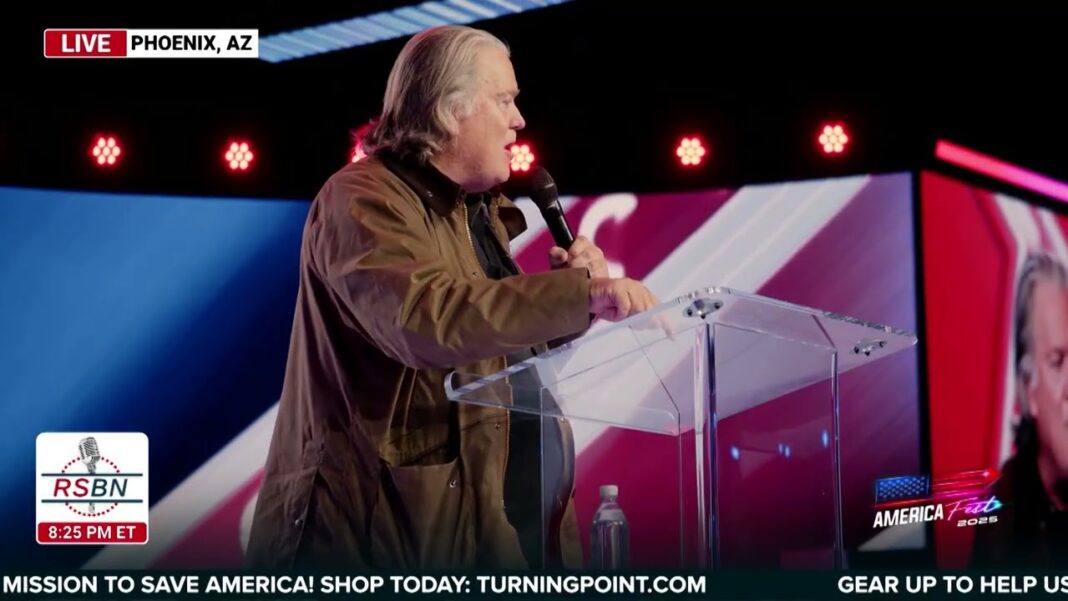
The most explosive moment came Friday night, when former White House strategist Steve Bannon took the stage before thousands of attendees and launched a direct, unambiguous attack on Shapiro by name. In remarks that quickly reverberated across conservative media ecosystems, Bannon accused Shapiro of attempting to exert undue influence over conservative institutions and painted him as a destabilizing force within the movement. Framing the dispute as a battle for control and ideological direction, Bannon’s rhetoric suggested that the stakes were nothing less than the soul of American conservatism.
The language of Bannon’s speech immediately drew sharp criticism—not only from Shapiro’s supporters, but from Jewish leaders and commentators across the political spectrum. Many argued that Bannon’s framing echoed long-standing antisemitic tropes about power, manipulation, and control, crossing a line from legitimate political disagreement into personal vilification. While Bannon did not explicitly reference Shapiro’s Jewish identity, critics warned that such rhetoric carries historical baggage that cannot be ignored.
Several Jewish commentators told VIN News that the episode was particularly troubling because it occurred in front of a young, impressionable audience. They cautioned that when political disputes are cast in conspiratorial or personalized terms, they risk normalizing forms of attack that go beyond policy critique and venture into dangerous cultural territory. For these observers, the incident raised urgent questions about responsibility, rhetoric, and the boundaries of acceptable discourse within the conservative movement.
The confrontation did not arise in a vacuum. According to the information contained in the VIN News report, tensions had already been running high earlier in the week following Shapiro’s own appearances at Turning Point USA events. In one widely discussed address, Shapiro delivered a pointed critique of media personality Tucker Carlson for platforming white nationalist Nick Fuentes. Shapiro argued that elevating extremist figures, even in the name of free speech or audience engagement, undermines conservatism’s moral credibility and corrodes its ability to function as a serious governing philosophy.
Shapiro’s remarks struck at a sensitive nerve. A growing segment of the right has embraced a confrontational, anti-establishment posture that prizes provocation and cultural warfare over traditional policy debate. For Shapiro, drawing firm lines against extremism is not merely a moral imperative but a strategic necessity. Movements unwilling to police their own boundaries, he has argued, risk alienating mainstream voters and forfeiting long-term electoral viability.
That position has earned Shapiro both praise and resentment. Supporters view him as a principled voice attempting to preserve conservatism’s ethical foundation; critics see him as sanctimonious, overly concerned with respectability, or disconnected from the populist energy driving the movement. AmericaFest brought those tensions into stark relief, with Shapiro’s speeches applauded by some attendees and quietly bristled at by others.
The fault lines widened further when media personality Megyn Kelly addressed the AmericaFest crowd and made a startlingly personal revelation: she no longer considers Shapiro a friend. Kelly criticized Shapiro for airing internal conservative disagreements at such a high-profile forum, suggesting that doing so reflected a broader erosion of trust and cohesion within the movement. While Kelly did not endorse Bannon’s rhetoric or personal attacks, her comments underscored how deeply the dispute has penetrated personal as well as ideological relationships.
Kelly’s remarks were measured but unmistakably pointed. She framed her disappointment not as a rejection of Shapiro’s principles, but as a critique of his tactics. For some observers cited in the VIN News report, this distinction highlighted a recurring dilemma within conservatism: how to reconcile ideological clarity with movement unity, and whether internal disputes should be resolved privately or aired publicly in the name of transparency.
Turning Point USA officials, for their part, sought to distance the organization from the escalating feud. The group emphasized that AmericaFest was designed to showcase a broad range of conservative viewpoints and to encourage robust debate among young activists. The organization stressed that it does not take sides in disputes between speakers, even as disagreements at the event became increasingly personal and public.
That stance, however, has drawn mixed reactions. Some attendees and commentators praised Turning Point USA for allowing open debate, arguing that intellectual diversity is a strength rather than a weakness. Others questioned whether the organization underestimated the risk of such disputes spiraling into public acrimony, particularly when influential figures use the stage to settle personal scores.
Political analysts interviewed by VIN News say the episode reflects a deeper, structural struggle within American conservatism. On one side are policy-oriented thinkers and institutional voices who emphasize governance, coalition-building, and moral boundaries. On the other are populist figures who command large, intensely loyal audiences through confrontational rhetoric and a narrative of cultural grievance. The friction between these camps, analysts argue, has been building for years and is now becoming impossible to contain.
AmericaFest, with its youthful audience and media spotlight, proved to be an accelerant. The event’s emphasis on energy, spectacle, and star power can amplify disagreements that might otherwise remain contained within op-ed pages or social media threads. Once brought onto a live stage, however, those disagreements take on a different, more visceral quality—one that resonates far beyond the conference hall.
As the weekend progressed, there were few signs that the fallout was subsiding. Conservative media outlets devoted hours of coverage to parsing the speeches, analyzing tone and intent, and debating what the clash means for the movement’s future. According to the VIN News report, social media platforms were flooded with commentary, ranging from calls for unity to demands that one side or the other be marginalized or expelled from the conservative coalition.
For Shapiro, the episode represents both a challenge and a validation. While he has faced fierce criticism, he has also seen renewed support from those who believe his warnings about extremism and rhetoric are prescient. For Bannon and his allies, the confrontation reinforces their narrative of a movement under siege from internal elites and external enemies alike.
What remains clear is that the conservative movement is at a crossroads. With a pivotal political period approaching, unresolved internal divisions threaten to complicate messaging, strategy, and coalition-building. Whether leaders can find a way to channel disagreement into constructive debate—or whether the fractures will deepen into lasting schisms—remains an open question.
AmericaFest was meant to energize a generation of conservative activists. Instead, it has become a mirror reflecting the movement’s most profound anxieties and contradictions. As the dust settles, one lesson is already apparent: the fault lines within conservatism are no longer hidden. They are public, personal, and increasingly impossible to ignore.
Whether antisemitism comes from the Left or Right, it’s sick, wrong and needs to be called out. It takes both moral clarity and courage to do so. Anyone who refuses to do so for any reason supports antisemitism. Tucker, Megyn, JD Vance, Bannon , Kanye and others on the Right need to be called out, isolated and thrown out of the movement, out of the party and on their asses in public. The young students need to see it happen with their own eyes. I’m thrilled that at least one man, Ben Shapiro has both and stood up to these vile antisemites.