



|
Getting your Trinity Audio player ready...
|
Reza Pahlavi Vows to ‘Make Iran Great Again’ in Fiery CPAC 2026 Address
By: Fern Sidman
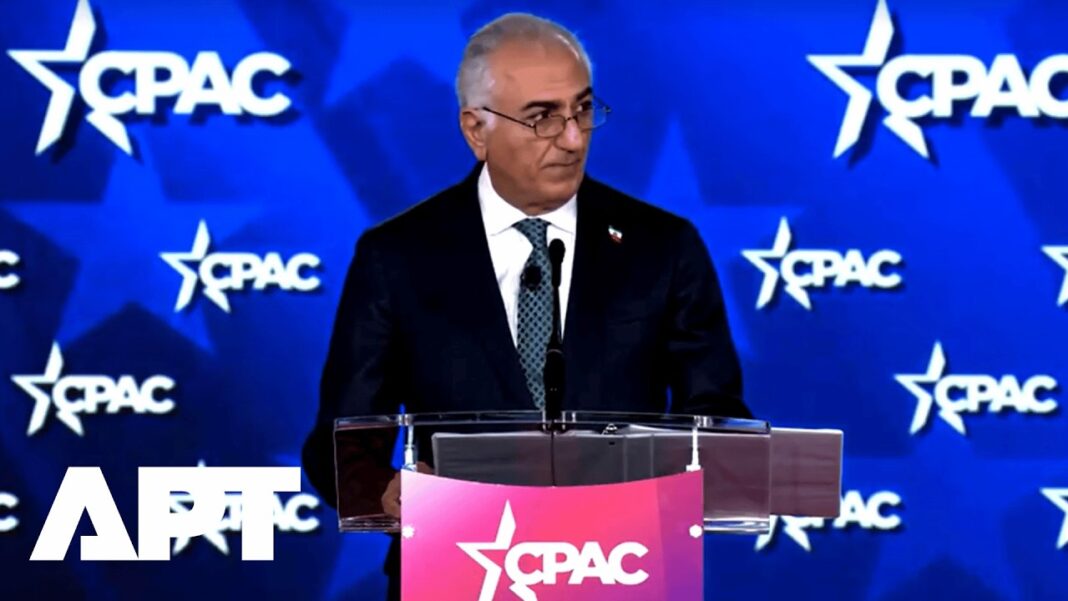
In a moment charged with historical symbolism and geopolitical consequence, Reza Pahlavi stood before a fervent audience on Saturday at the Conservative Political Action Conference in Grapevine, Texas, and issued what may prove to be one of the most consequential appeals in the modern history of Iranian opposition politics. His address—delivered to a standing ovation and punctuated by chants of loyalty—was not merely a speech but a sweeping manifesto: a call for the total dismantling of the Islamic Republic and the emergence of a new Iran aligned with democratic principles, economic openness, and regional reconciliation.
As reported by The Jerusalem Post, Pahlavi’s remarks were at once visionary and incendiary, blending sharp denunciations of Tehran’s ruling establishment with an ambitious blueprint for a transformed Middle East. At its core, the speech sought to position Pahlavi not only as a symbolic heir to Iran’s pre-revolutionary past but as a pragmatic architect of its future.
Pahlavi’s central thesis was unequivocal: the present moment represents an unprecedented opportunity to bring about the collapse of the Islamic Republic. According to The Jerusalem Post report, he credited recent military developments—particularly U.S.-led operations targeting Iran’s strategic infrastructure—with weakening the regime to a degree unseen in decades.
“A free Iran is within reach right now,” he declared, his words resonating through the conference hall. Yet he tempered this optimism with a sober acknowledgment of the sacrifices required to achieve such a transformation. “Freedom never comes free,” he added, invoking both the struggles of the Iranian people and the broader historical arc of democratic revolutions.
This framing aligns with a broader narrative emerging in Western political discourse, one that views the current geopolitical turbulence not merely as a crisis but as a potential inflection point. The Jerusalem Post report noted that Pahlavi’s argument hinges on the convergence of internal dissent within Iran and external pressure from the international community—a convergence he believes could culminate in regime change.
Perhaps the most striking element of Pahlavi’s address was his proposal for what he termed the “Cyrus Accords,” an extension of the existing Abraham Accords framework. Named after Cyrus the Great, whom Pahlavi described as a pioneer of human rights, the concept envisions a future in which a post-Islamic Republic Iran establishes normalized relations with Israel.
“Imagine a new Middle East where Iran is a friend of Israel,” he urged, drawing applause from the audience. According to The Jerusalem Post report, this vision represents a dramatic departure from the entrenched hostility that has defined Iranian-Israeli relations for decades.
By invoking Cyrus the Great, Pahlavi sought to anchor his proposal in Iran’s ancient heritage, contrasting it with what he characterized as the ideological rigidity and repression of the current regime. This historical framing serves a dual purpose: it appeals to national pride among Iranians while also presenting a narrative that resonates with Western audiences familiar with the legacy of classical antiquity.
The Jerusalem Post report emphasized that such proposals, while aspirational, carry significant implications for regional diplomacy. A normalized relationship between Iran and Israel would fundamentally alter the strategic landscape of the Middle East, potentially reshaping alliances and reducing longstanding tensions.
Pahlavi’s critique of Iran’s ruling establishment was both comprehensive and unflinching. He accused the Islamic Republic of systemic human rights violations, including the persecution of religious minorities and the suppression of dissent.
He highlighted specific practices—such as the targeting of underground Christian communities and the execution of religious converts—as emblematic of a regime that has, in his words, betrayed Iran’s historical tradition of tolerance.
This indictment extended beyond human rights to encompass broader questions of governance and legitimacy. Pahlavi argued that the regime’s actions have not only alienated its own population but also undermined Iran’s standing on the global stage.
“The Islamic Republic cannot reform itself,” he asserted. “You cannot reform a snake. Venom is in its DNA.”
Such language underscores a fundamental aspect of Pahlavi’s argument: that incremental change is neither feasible nor desirable. In his view, any attempt to negotiate with or reform elements of the existing system would merely perpetuate instability.
In addition to moral and political considerations, Pahlavi presented a compelling economic case for a post-Islamic Republic Iran. He described the country as a vast, untapped market with immense potential for growth and investment.
“A free Iran represents the single largest untapped economic opportunity of the twenty-first century,” he told the audience, as reported by The Jerusalem Post. He projected that a strategic partnership between Iran and the United States could generate over one trillion dollars for the American economy within a decade.
This economic argument serves as a crucial complement to his political vision. By emphasizing the benefits of engagement, Pahlavi seeks to align the interests of Western policymakers with those of the Iranian opposition.
The Jerusalem Post report noted that such projections, while ambitious, reflect a broader belief among proponents of regime change that Iran’s integration into the global economy could yield significant dividends for all parties involved.
A central theme of Pahlavi’s address was his unequivocal rejection of any partial settlement that would leave elements of the current regime intact. This stance places him at odds with reports suggesting that President Trump may be open to negotiations with remnants of the Iranian leadership.
“Those who have spent forty-seven years sowing chaos cannot be trusted to bring about stability,” Pahlavi argued, as was reported by The Jerusalem Post. He warned that any compromise would result in only temporary relief, followed by a resurgence of the same threats that have long plagued the region.
This position reflects a broader skepticism within certain political circles regarding the efficacy of diplomatic engagement with authoritarian regimes. Pahlavi’s argument is that structural change—not accommodation—is the only viable path to lasting peace.
Pahlavi also addressed recent domestic developments within Iran, particularly the widespread protests that erupted earlier in the year. He described these demonstrations as the largest in the country’s modern history, spanning all thirty-one provinces.
He claimed that the regime’s response was marked by extreme violence, resulting in tens of thousands of deaths and hundreds of thousands of injuries, as was reported by The Jerusalem Post. He further noted that internet access had been severely restricted, effectively isolating the Iranian population from the outside world.
“The final blow will be delivered by the Iranian people themselves,” he declared, emphasizing the central role of grassroots movements in any transition.
This emphasis on popular agency is a key component of Pahlavi’s narrative. While he advocates for international support, he consistently underscores that the ultimate drivers of change must be the Iranian people themselves.
In a notable development, Pahlavi confirmed that he has accepted calls to lead a transitional process. He described a broad coalition encompassing both monarchists and republicans, united by a shared commitment to democratic principles.
The Jerusalem Post reported that he also referenced a digital platform designed to facilitate defections from within the regime’s military apparatus. According to Pahlavi, thousands of officials—including some at senior levels—have already expressed their willingness to support a transition.
This claim, if substantiated, could have profound implications for the balance of power within Iran. It suggests the possibility of fractures within the regime’s core institutions, potentially accelerating the pace of change.
In closing, Pahlavi drew a deliberate parallel between the United States and Iran, linking the upcoming 250th anniversary of American independence with his vision of Iranian renewal.
“As 2026 marks the two hundred and fiftieth birthday of the United States, it is my hope and my belief that history will also remember 2026 as the year of Iran’s rebirth,” he said.
This rhetorical device serves to align his cause with the foundational ideals of American democracy, reinforcing his appeal to a U.S. audience. The Jerusalem Post has observed that such framing is designed to resonate with policymakers and citizens alike, positioning Iran’s potential transformation as part of a broader narrative of freedom and self-determination.
Reza Pahlavi’s address at CPAC represents a bold and comprehensive articulation of a vision for Iran’s future—one that seeks to reconcile historical identity with modern democratic aspirations. His call for the dismantling of the Islamic Republic, the establishment of new regional alliances, and the pursuit of economic integration presents a compelling, if contentious, roadmap.
Yet significant challenges remain. The feasibility of such a transformation depends on a complex interplay of internal dynamics and external pressures. The resilience of the current regime, the unpredictability of regional politics, and the uncertainties of international diplomacy all pose formidable obstacles.
As The Jerusalem Post report noted, one thing is clear: Pahlavi’s vision has injected a new sense of urgency and possibility into the discourse surrounding Iran’s future. Whether that vision will translate into reality remains an open question—but its implications are certain to reverberate far beyond the confines of a conference hall in Texas.
