



|
Getting your Trinity Audio player ready...
|
By: Justin Winograd – Jewish Voice News
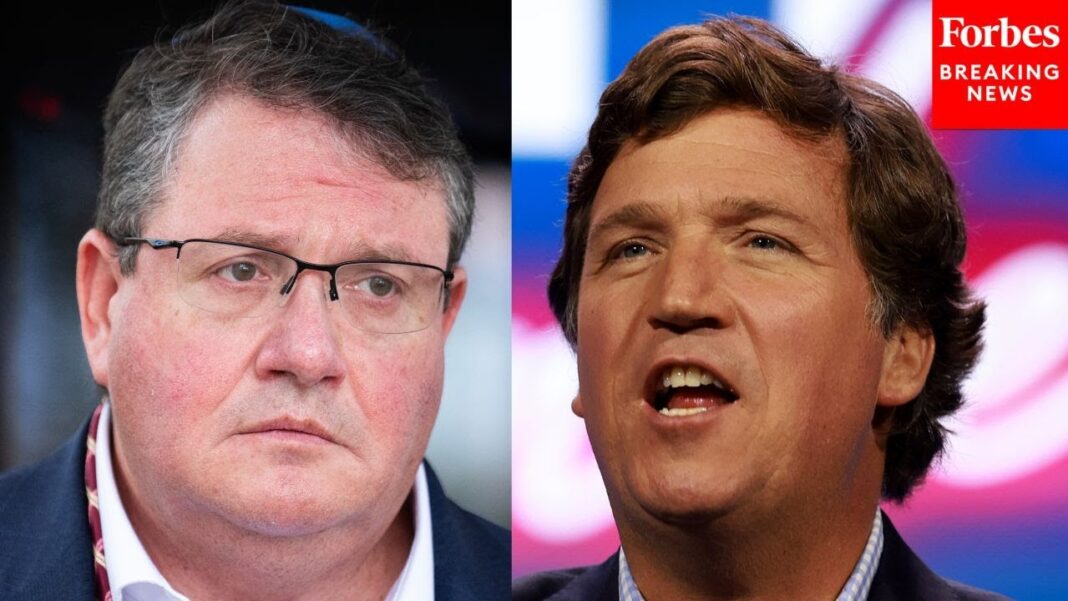
Rep. Randy Fine of Florida, one of the most outspoken pro-Israel voices in Congress, signaled on Tuesday that he believes Vice President JD Vance should publicly confront the rising tide of antisemitic rhetoric within conservative media circles, particularly that associated with popular podcaster Tucker Carlson. Speaking with The Algemeiner at an event in Washington, Fine said he hoped Vance would clarify his stance amid escalating concern that Carlson’s influence threatens to pull segments of the Republican base away from long-standing support for Israel.
Asked directly by The Algemeiner whether Vance should condemn Carlson’s recent conduct, Fine replied, “I think it’d be nice.” He added, “I think that, you know, given that Tucker’s become a deranged lunatic, I think we should all be speaking out against Tucker.” His comments were among the bluntest from a sitting Republican lawmaker in the widening national debate over the line between political commentary, legitimate criticism of Israeli policy, and overt antisemitism.
The controversy began after Carlson hosted white nationalist Nick Fuentes on his podcast, prompting a wave of bipartisan condemnation. As The Algemeiner has reported, Fuentes—who has long been identified with Holocaust denial, vitriolic commentary about “organized Jewry,” and praise for authoritarian regimes—used the appearance to advance a series of antisemitic assertions. Critics charged that Carlson’s mild, congenial tone during the interview amounted to an unchallenged platform for extremism.
According to the information provided in The Algemeiner report, Carlson did not object when Fuentes lauded Soviet dictator Joseph Stalin or invoked conspiratorial claims about Jewish influence. The lack of pushback drew rebukes from Republican senators and conservative policy analysts, and placed pressure on institutional leaders, including those at the Heritage Foundation, who questioned the wisdom of associating with or excusing Fuentes.
The interview was not an isolated incident. In the months preceding the Fuentes episode, Carlson had invited guests who engaged in Holocaust minimization, suggested Adolf Hitler had been unfairly maligned, and argued that Hamas should be regarded as a legitimate government rather than a terrorist organization. He further asserted that Israel is a systematic oppressor of Christians, despite heavily documented persecution of Christian communities in regions controlled by Islamist militias, including mass killings of Nigerian Christians. These patterns generated a growing sense of alarm among Jewish communal advocates and conservative pro-Israel activists.
Complicating the political fault lines is Carlson’s long-standing friendship with JD Vance. As The Algemeiner reported, Vance has faced heightened scrutiny as observers question whether Carlson’s views could influence the vice president’s developing foreign policy posture. Vance recently appeared at a college forum where a student challenged the rationale for U.S. support for Israel, claiming that Jews “openly support the persecution” of Christians. According to the report in The Algemeiner, Vance offered no rebuttal, raising concerns among pro-Israel conservatives about his willingness to confront inflammatory claims.
Further fueling speculation is the presence of Carlson’s son, Buckley Carlson, in Vance’s office as deputy press secretary. Vance recently attacked journalist Sloan Rachmuch after she urged Buckley to clarify his own positions on Israel and antisemitism, suggesting that public inquiries amounted to harassment. Some conservatives have warned that Carlson’s family ties to the vice president’s office could subtly shift or harden Vance’s orientation toward Israel over time.
Political analysts cited by The Algemeiner have pointed to Vance’s growing national profile as evidence that these tensions are not merely intra-party squabbles but potential indicators of the Republican Party’s trajectory heading into the 2028 presidential cycle. With younger Republican voters increasingly skeptical of traditional alliances, questions about Vance’s long-term approach to Israel have sparked active debate among conservative leaders, who have urged him to firmly repudiate antisemitism and reaffirm U.S.-Israel ties.
At Tuesday’s event—titled “Exposing and Countering Extremism and Antisemitism on the Political Right”—Fine appeared as a keynote speaker and offered a broader assessment of the ideological shifts affecting the Republican coalition. Fine warned that antisemitic narratives have entered mainstream conservative discourse through a network of online influencers, asserting that the trend poses a direct threat to both Jewish Americans and the moral coherence of the party.
Fine did not hesitate to address divisions within the House Republican Conference. Speaking with The Algemeiner, he identified Reps. Marjorie Taylor Greene of Georgia and Thomas Massie of Kentucky as “antisemites,” citing their recent criticism of Israel and opposition to resolutions condemning antisemitism. “I point out this: I serve with two antisemites on the US House of Representatives, and Donald Trump is seeking to have both of them defeated next year in their primaries. I think it’s clear where the president stands,” Fine said.
Greene, who previously attempted to attach an amendment stripping military aid to Israel from a defense appropriations bill, has denounced Israeli military operations in Gaza and in recent months has been the only Republican member of Congress to accuse Israel of “genocide.” Massie has drawn similar criticism from Jewish conservatives for alleging that every member of Congress has an “AIPAC babysitter,” suggesting Jewish organizations monitor legislators’ votes. Massie also voted against a bipartisan resolution urging elected officials to counter antisemitism and was criticized for posting images contrasting “American Patriotism” with “Zionism,” a framing that Jewish advocacy groups described as antisemitic.
Addressing the issue more broadly, Fine told The Algemeiner that he hopes the 2028 election will not become a referendum on Republican support for Israel. He emphasized that the Trump administration has repeatedly taken steps to “squash” the influence of anti-Israel voices within the conservative movement, citing Trump’s intention to support primary challengers against Greene and Massie. According to Fine, this reflects a clear attempt to reinforce traditional Republican support for Israel and isolate those who deviate from it.
The event where Fine spoke was organized partly in response to the rapid ascent of Nick Fuentes and a growing constellation of influencers who have used online platforms to amplify antisemitic themes. Fuentes—who has praised Adolf Hitler, called for violence against Jews, and promoted Holocaust denial—has become especially prominent among disaffected young men.
Alongside Fuentes and Carlson, right-wing commentator Candace Owens has also faced criticism. As cited in The Algemeiner report, Owens has spent the two years following Hamas’s Oct. 7, 2023 massacre disseminating conspiracy theories about Israel, accusing Jewish individuals of demonic influence, and describing Jews as “pedophilic”—rhetoric that Jewish groups and conservative leaders widely condemned.
In his keynote address, Fine described the struggle against antisemitism as an “existential fight for the nature of our country,” arguing that no nation that has embraced antisemitic ideologies has survived intact. He urged Jewish conservatives to confront the issue rather than dismiss antisemitic rhetoric as fringe noise. “We have an issue in our own party, where the evil has come into our own midst,” Fine said.
Fine also characterized Carlson as “the most dangerous antisemite in America,” arguing that his continued credibility among large segments of the conservative base—stemming from his tenure as a top-rated Fox News host—makes his rhetoric uniquely harmful. As Fine put it, many Republicans “don’t know that he has become a nutbag,” and therefore are susceptible to absorbing his framing of Israel and Jewish issues without recognizing the underlying ideological shift.
The broader political landscape described in The Algemeiner report reflects a Republican Party grappling with realignment pressures. The rise of antisemitic ideas among certain online factions has created fractures between traditional GOP support for Israel and emerging voices who question or reject that alignment. Fine’s comments on Tuesday illustrate the increasing urgency with which pro-Israel conservatives are responding to these developments, and his appeal to JD Vance reflects a belief that the vice president’s future leadership will be instrumental in determining the ideological direction of the party.
As Fine made clear, the stakes of the debate are not merely tactical or electoral but reflect deeper questions about the core values of the Republican coalition. His remarks underscore a growing recognition that in the post-2024 political environment, conservative leaders will need to articulate clear positions on extremism, antisemitism, and America’s relationship with Israel—issues that are poised to shape the contours of the GOP well into the next decade.