



|
Getting your Trinity Audio player ready...
|
Reagan-Plus or Rubicon?”: Senator Graham’s Extraordinary Call to Trump Sends Shockwaves Through Washington and Jerusalem
By: Jeff Gorman
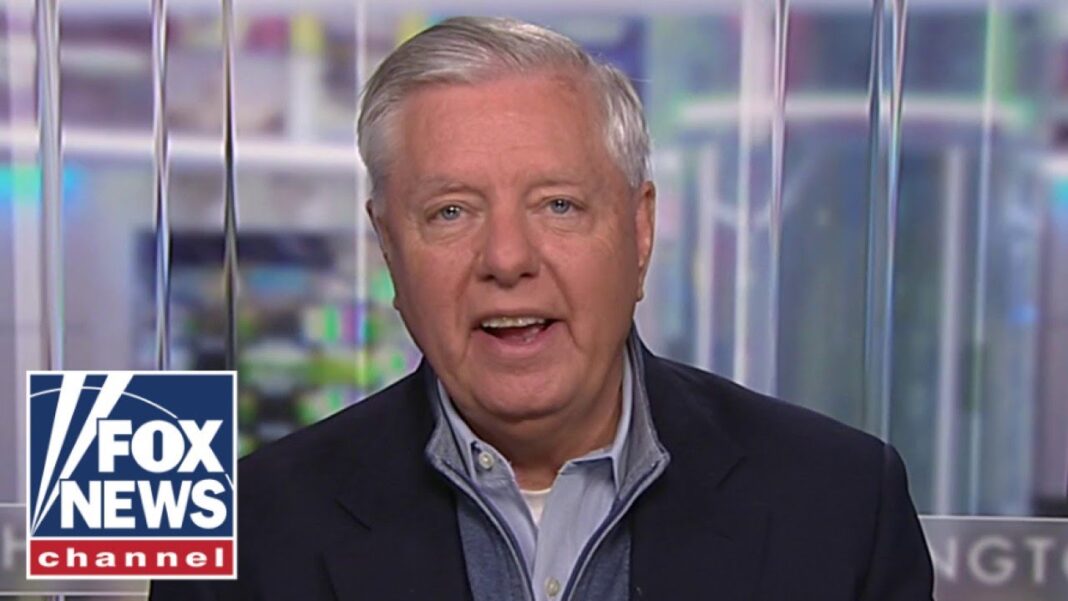
In a moment that sent tremors through diplomatic circles from Washington to Jerusalem, Senator Lindsey Graham delivered a set of remarks to President Donald Trump that were as morally charged as they were strategically incendiary. According to multiple translations and reproductions published by Zap Magazine of Israel on Tuesday, Graham urged the American president to consider eliminating Iran’s ruling leadership, arguing that only such decisive action could halt the regime’s violent repression of its own citizens and open the door to a transformed Middle East.
The language Graham employed was unusually stark for a senior U.S. lawmaker. He implored Trump to “put an end” to what he characterized as a murderous regime, predicting that the fall of Tehran’s leadership would extinguish the region’s most notorious militant organizations, including Hezbollah and Hamas, and catalyze a historic rapprochement between Israel and Saudi Arabia. In perhaps the most striking flourish, he hailed Trump as the “Ronald Reagan-plus of our time,” a phrase that the Zap Magazine report noted has already become shorthand among some political commentators for a muscular, morally assertive foreign-policy posture.
The senator’s words have ignited intense debate, not only about Iran but about the broader boundaries of political rhetoric in an era when democratic societies are struggling to reconcile moral outrage with the constraints of international law.
Graham has long been one of Capitol Hill’s most outspoken critics of the Iranian regime, but even his allies concede that this latest intervention marks a departure from the customary lexicon of foreign-policy discourse. Rather than invoking familiar terms such as “pressure,” “deterrence,” or “containment,” he spoke in the blunt moral language of justice and retribution.
The Zap Magazine report described the remarks as “a shattering of euphemisms,” noting that they bypassed the layered abstractions through which Washington traditionally discusses coercive measures. By framing the issue as a direct struggle between oppressors and an oppressed population, Graham elevated the conversation from strategic calculus to moral indictment.
Yet that very framing has unsettled diplomats and scholars who argue that the abandonment of careful language risks eroding the guardrails that restrain international conflict.
The senator’s comments come amid mounting evidence that Iran’s leadership is facing one of the most serious domestic challenges in decades. Protests have erupted in cities across the country, driven by spiraling inflation, the collapse of the rial, and long-standing grievances over political repression.
According to coverage compiled by Zap Magazine, Iranian officials have acknowledged a rising death toll, while opposition-linked outlets claim casualties far in excess of the official figures. Internet shutdowns and restrictions on domestic media have made independent verification difficult, but the outlines of a violent crackdown are widely accepted.
It is this backdrop of upheaval that Graham cited when he urged Trump to “stand with the people.” To him, the Iranian crisis is not merely a foreign policy dilemma but a moral emergency demanding decisive leadership.
By likening Trump to Ronald Reagan, Graham sought to situate the current moment within a narrative of Cold War triumphalism. Reagan’s tenure, marked by confrontational rhetoric toward the Soviet Union and a firm belief in American exceptionalism, looms large in conservative political mythology.
Yet as the Zap Magazine report cautioned in its analysis, the analogy is imperfect. Reagan’s legacy rests as much on diplomacy as on confrontation, from the Reykjavik summits to the arms-reduction treaties that helped bring the Cold War to a close. Transposing that template onto today’s Iran—an actor enmeshed in a dense network of regional proxies and ideological alliances—risks oversimplifying a far more fragmented geopolitical landscape.
Graham’s forecast of a post-Tehran Middle East was sweeping in its optimism. In his telling, the elimination of Iran’s leadership would dissolve the architecture of state-sponsored militancy, erasing Hezbollah and Hamas from the regional map and paving the way for Israeli-Saudi reconciliation.
Such predictions have drawn scrutiny from analysts cited by Zap Magazine, who point out that while Iranian patronage is central to these groups, their survival does not hinge on Tehran alone. Both Hezbollah and Hamas possess their own political bases, military infrastructures, and funding streams, making their disappearance far from automatic.
Similarly, the long-anticipated normalization between Jerusalem and Riyadh depends on a constellation of factors that extend well beyond Iran, including the unresolved Palestinian question and shifting regional power dynamics.
Reaction within Israel, as documented by Zap Magazine, has been polarized. Some commentators applauded Graham for articulating what they see as an unvarnished truth: that the Islamic Republic’s survival perpetuates instability throughout the Middle East.
Others voiced deep unease. Former diplomats and security officials warned that rhetoric calling for the removal of a sovereign government risks hardening positions on all sides, narrowing the space for de-escalation and increasing the likelihood of miscalculation. Iran’s ability to retaliate through proxy forces, missile capabilities, and cyber operations means that any direct confrontation would reverberate far beyond its borders.
In Washington, Graham’s remarks have reopened a perennial argument over the moral responsibilities of great powers. When confronted with credible reports of mass repression abroad, should the United States intervene, and if so, how?
The Zap Magazine report underscored that Graham’s appeal rests on an assumption of moral clarity—that the distinction between tyrant and victim is so stark that it obviates the need for deliberation. Critics counter that recent history offers sobering lessons about the unintended consequences of intervention, from Iraq to Libya, where the collapse of authoritarian regimes did not yield the democratic flourishing once promised.
Perhaps the most enduring impact of Graham’s intervention lies in its rhetorical audacity. By speaking in the vocabulary of elimination rather than diplomacy, he has blurred the line between moral exhortation and strategic prescription.
For Zap Magazine, this blurring is itself a subject of concern. Words shape expectations, galvanize constituencies, and constrain policymakers. When senior leaders adopt language that treats the destruction of adversaries as self-evidently just, the space for compromise contracts.
As Iran’s crisis deepens, the world watches to see how Washington will respond. Graham has offered one vision—dramatic, morally charged, and unapologetically confrontational. Whether that vision will influence policy remains uncertain.
What is clear is that the fate of millions of Iranians now hangs in a precarious balance between repression at home and debate abroad. In that fragile moment, the words of powerful figures carry extraordinary weight, capable not only of framing the narrative but of shaping the very course of history.
