



By: Fern Sidman – Jewish Voice News
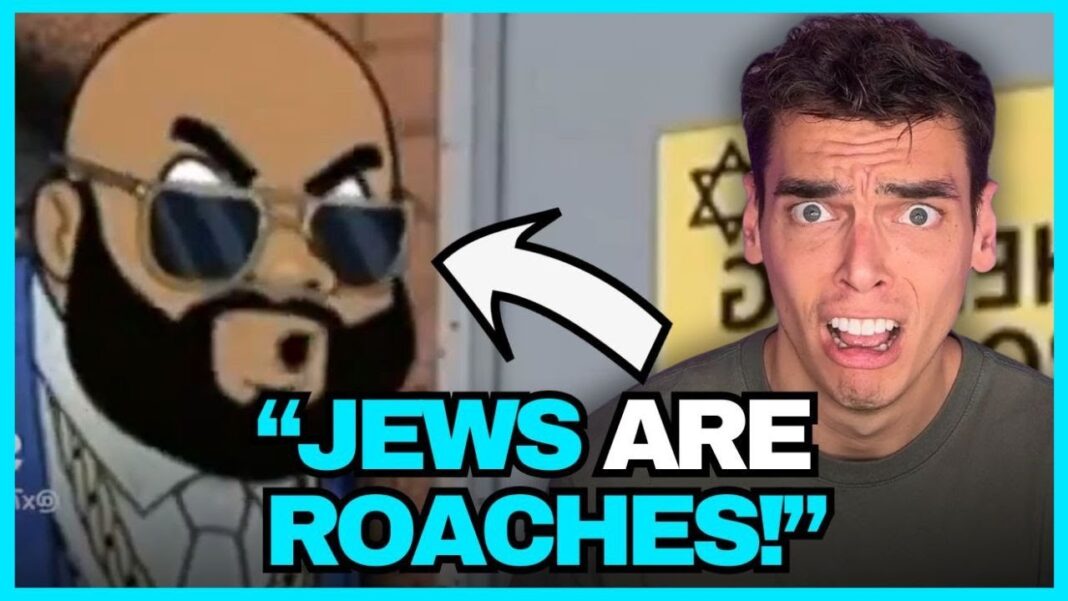
One America News Network has terminated Vish Burra, a producer for “The Matt Gaetz Show,” following an intense wave of criticism over an AI-generated cartoon he posted depicting Jewish individuals as cockroaches in a “scheming room” marked with a prominent Star of David. The decision, confirmed by sources familiar with network deliberations and noted by VIN News in a report on Monday, came after the image — along with Burra’s accompanying posts referring to Jews as “vermin” — prompted widespread condemnation from journalists, Jewish community leaders, and political figures.
Burra, who served as scriptwriter and booker for the program hosted by former Florida congressman Matt Gaetz, posted the cartoon last week on his X account. The AI image portrayed cockroaches scattering when a cartoon figure resembling Burra entered a room labeled with Jewish symbolism. Burra’s caption vowed to “expose the vermin in the venomous coalition,” and personally targeted Susan Lebovitz-Edelman, wife of billionaire investor Joseph Edelman, accusing her of attempting to remove Heritage Foundation president Kevin Roberts. As VIN News reported, the graphic immediately drew outrage for its reliance on classic antisemitic tropes, evoking the dehumanizing imagery deployed by Nazi propaganda.
The cartoon was deleted shortly after publication, but the damage to Burra’s standing within the network and the broader political media environment proved irreversible. According to TheWrap, which first broke the story and was subsequently cited in the VIN News report, OAN executives determined that the post was “highly offensive” and constituted explicit antisemitic content that violated the network’s content and personnel standards. After internal discussions, the network moved swiftly to terminate Burra’s employment.
A source familiar with the decision told TheWrap that the firing reflected the network’s obligation to “distance itself from any content that can reasonably be characterized as hateful or discriminatory.” OAN declined to issue a public statement when approached by multiple outlets, although internal sentiment reportedly reflected a sense of urgency in addressing the incident due to the clear antisemitic nature of the cartoon.
Former Rep. Matt Gaetz, whose online program Burra helped produce, posted a response on X over the weekend, attempting to downplay the controversy. Gaetz wrote that “My producer Vish Burra posted something dumb this week,” and suggested that Burra “knew it was dumb and quickly deleted it.” Gaetz added that he was not the “internet hall monitor” for his colleagues, a comment that drew its own pushback for failing to acknowledge the seriousness of the antisemitic rhetoric involved.
Gaetz further noted that the show does not endorse bigotry “to any group of people, no matter where they live or how they worship.” Nevertheless, as the VIN News report highlighted, Gaetz’s comments were widely interpreted as an attempt to soften or reframe the severity of the incident rather than directly confronting its explicitly antisemitic nature.
Significantly, one of OAN’s own anchors, Stella Escobedo, who is Jewish, took the unusual step of publicly criticizing Burra on her social-media accounts. Escobedo pointed out what she described as a troubling pattern of Burra’s rhetoric toward Jewish individuals, citing recent posts in which he defended a Nazi uniform worn as a Halloween costume and declared that “America First means not being held hostage by a nearly century-old postwar consensus fairytale about what happened in World War 2.” While Burra later claimed he was not denying the Holocaust specifically, his language drew scrutiny from journalists and historians who noted that his phrasing aligned with a form of dog-whistle rhetoric frequently used by Holocaust revisionists.
Escobedo’s decision to speak out publicly, as VIN News observed in its report, added pressure to OAN leadership to respond swiftly and affirmatively. Her comments also intensified national attention on the controversy, demonstrating internal discomfort within the network over Burra’s conduct.
The controversy prompted swift reactions from Jewish community leaders and public figures across the political spectrum. Bryan Leib, CEO of Henry Public Relations and a frequent voice on issues related to antisemitism, posted on X that while he does not typically “celebrate someone losing their job,” Burra’s repeated attacks on Jewish and pro-Israel communities were “utterly disgusting and indefensible on every level.” Leib added that referring to Jews as “vermin” represented “a new low, even for him,” and applauded OAN for taking decisive action.
Leib’s comments, widely quoted by national outlets and highlighted in the VIN News report, reflected a broader sentiment among advocacy groups who viewed the cartoon as part of a growing online ecosystem of AI-based antisemitic content — imagery that, they warn, can spread with unprecedented speed and reach.
Burra did not respond to press inquiries about his termination. According to TheWrap and confirmed by VIN News, he hung up when contacted for comment.
The firing adds to a pattern of past controversies surrounding Burra, who previously worked for former Rep. George Santos, the disgraced New York Republican expelled from Congress over extensive allegations of fraud and misconduct. Burra, who served as a political operative in various right-wing circles, has been associated with several inflammatory episodes in recent years. According to the information provided in the VIN News report, he has been scrutinized for his social-media commentary, his participation in far-right political networks, and his involvement in operations tied to high-profile political scandals.
His role with the Gaetz-produced program on OAN had placed him in a high-visibility position, and the network’s decision to remove him reflects, in part, awareness of the reputational risks associated with such roles.
The incident comes amid heightened national concern about antisemitism in political rhetoric and online discourse — a trend that VIN News has repeatedly covered in recent months. Jewish advocacy groups have expressed alarm over the rapid normalization of dehumanizing language targeting Jewish individuals, particularly in the wake of the Israel-Hamas war and the global surge in antisemitic incidents that followed the Hamas-led massacre of October 7, 2023.
AI-generated images have increasingly become part of this landscape, enabling individuals to create and disseminate bigoted content with minimal effort. Experts quoted by VIN News have warned that such technologies can amplify hate speech and revive imagery historically used to justify persecution and violence.
Burra’s cartoon, portraying Jews as cockroaches — an image with direct parallels to Nazi propaganda — represents, analysts say, one of the clearest examples of this trend emerging in mainstream political circles. That it came from an individual associated with a nationally broadcast political program heightened the public reaction and ultimately compelled OAN to act.
The firing also illustrates a growing expectation that media organizations, particularly those operating in political and ideological spaces, must enforce clear boundaries relating to hate speech, extremist rhetoric, and discriminatory conduct.
As the VIN News report noted, OAN has faced criticism in the past for platforming inflammatory views or amplifying conspiracy theories. The network’s decision in this case may reflect both internal ethical considerations and awareness of the legal and reputational risks associated with tolerating antisemitic content produced by staff members.
With Burra’s termination, OAN has attempted to draw a definitive line, but questions remain about internal oversight and the broader culture that allowed such content to be produced and promoted by a senior staffer. Outside observers are watching closely to see whether the network issues additional policies or guidance to prevent similar incidents.
Meanwhile, VIN News has tracked the fallout within political media circles, noting that the incident has intensified conversation around the responsibilities of producers, digital operatives, and influencers who shape political messaging in an era of AI-driven content creation.
Burra’s firing, while decisive, marks only one episode in a broader national conversation about the boundaries of political speech, the dangers of dehumanizing imagery, and the accelerating speed at which antisemitic content can circulate across digital platforms.
As the story continues to unfold, it remains clear that the episode serves as a case study in the evolving challenges media institutions face in navigating an environment where technology, politics, and extremist rhetoric increasingly collide.