



|
Getting your Trinity Audio player ready...
|
Nick Fuentes Claims His Issue With Trump Is That He ‘Isn’t Enough Like Hitler’
By: Fern Sidman
In the labyrinthine world of American political discourse, where ideological boundaries are increasingly blurred and strange alliances emerge with unnerving frequency, a recent exchange between avowed white nationalist Nick Fuentes and former progressive Congressman Jamaal Bowman offered a brief — and ultimately illusory — glimpse of convergence. As reported by The Jewish Telegraphic Agency (JTA) on Saturday, the episode began innocuously enough: a fall video in which Fuentes criticized former President Donald Trump appeared to win unexpected approval from Bowman, who left a comment suggesting that the far-right provocateur was “finally getting it.”
For a fleeting moment, observers wondered whether antipathy toward Trump could forge unlikely common ground between extremes of the political spectrum. Yet as the JTA has carefully chronicled, that perception evaporated almost as quickly as it arose. Fuentes himself has now gone to great lengths to clarify that any perceived alignment with progressive critics of Trump was nothing more than a mirage.
“My problem with Trump isn’t that he’s Hitler — my problem with Trump is that he is not Hitler,” Fuentes declared during a recent online broadcast. The comment, startling in its brazenness, underscored the ideological chasm separating Fuentes from even his most vehement critics of the former president. Far from lamenting Trump’s hardline policies, Fuentes complained that they did not go far enough.
The initial interaction that drew Bowman’s attention was, on its face, a critique of Trump from the right. In the video that prompted Bowman’s remark, Fuentes argued that Trump had favored Israel, corporate interests, and Silicon Valley, but had failed to deliver for those he deemed his true constituency. Bowman, a progressive Democrat who has often clashed with pro-Israel elements of his own party, apparently interpreted the message as an indictment of Trump’s perceived deference to establishment power.
Yet, as the JTA report later noted, Bowman’s reaction betrayed either a misunderstanding or an underestimation of Fuentes’ worldview. Fuentes quickly dispelled any notion that he had drifted toward the political left. “You have all these left-wing people saying, ‘Why do I agree with Nick Fuentes?’” he said on his show. “I’m criticizing Trump because there’s not enough deportations, there’s not enough ICE brutality, there’s not enough National Guard. Sort of a big difference!”
The bluntness of that statement laid bare the stark reality: while some on the left oppose Trump out of concern for civil liberties and human rights, Fuentes’ grievances arise from a diametrically opposite impulse — the belief that Trump was insufficiently authoritarian.
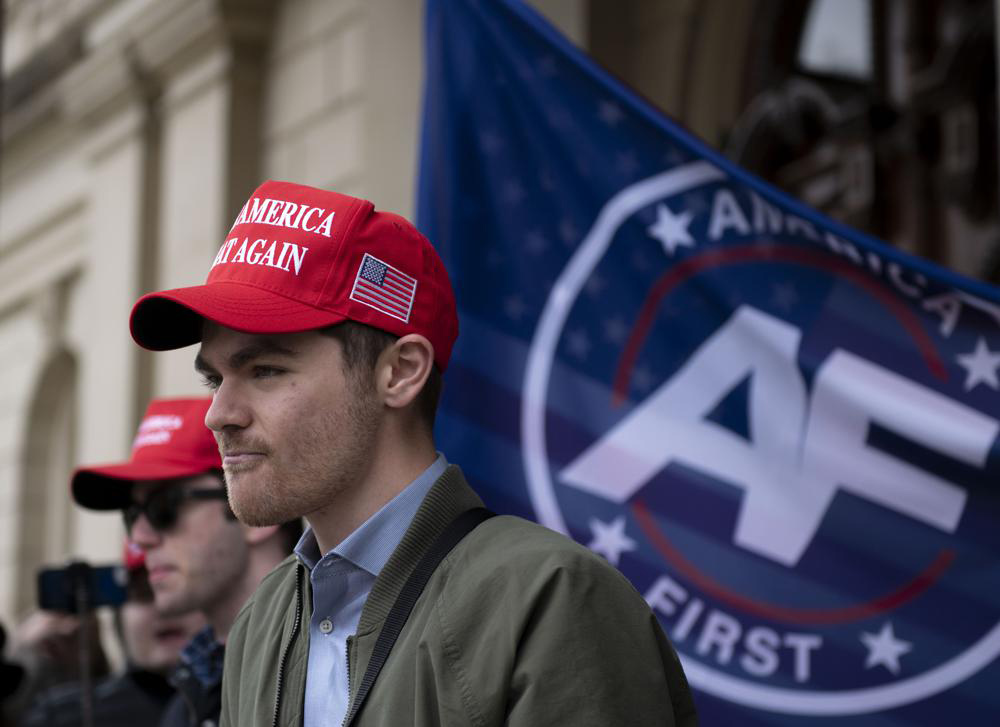
Fuentes, a 26-year-old live streamer and self-described “America First” activist, has become one of the most prominent faces of the so-called “groyper” movement, a faction that pushes for an even more radical form of nationalism than that espoused by mainstream conservatives. The JTA has reported extensively on his growing influence, particularly among young online audiences susceptible to incendiary rhetoric and conspiracy theories.
His public persona is deliberately provocative. Fuentes has repeatedly made antisemitic statements, once praising Adolf Hitler as “very f—king cool,” and has built a following by framing Jews, immigrants, and other minorities as enemies of American culture. Despite being banned from multiple social media platforms, he has managed to maintain a sizable audience through alternative channels.
In recent months, the JTA has observed that Fuentes’ profile has expanded beyond the fringes, in part due to high-profile appearances such as his controversial 2022 dinner with Trump and rapper Kanye West at Mar-a-Lago. That meeting, which Trump later described as accidental and unwelcome, nevertheless thrust Fuentes into the national spotlight and forced Republicans to confront uncomfortable questions about extremism within their ranks.
The internal struggle within the Republican Party over figures like Fuentes has become increasingly visible. According to the information provided in the JTA report, the controversy surrounding Fuentes has exposed a widening divide between traditional pro-Israel conservatives and an ascendant isolationist wing that views American support for Israel as a costly entanglement.
That tension came to the fore again in October when Fuentes appeared on Tucker Carlson’s show — an interview that reignited debates about antisemitism and the boundaries of acceptable discourse on the right. The JTA reported that many Jewish Republicans expressed alarm that a figure with Fuentes’ history of bigotry could be given such a prominent platform.
Trump himself has attempted to distance the party from overt antisemites. In a recent interview with The New York Times, Trump said Republican leaders should “absolutely” condemn figures who promote antisemitism. When asked directly whether there was room in the GOP for individuals like Fuentes, Trump replied, “No, I don’t. I think we don’t need them. I think we don’t like them.”
Yet Trump’s disavowal was complicated by his acknowledgment that he had previously met Fuentes. “I had dinner with him, one time, where he came as a guest of Kanye West,” Trump explained. “I didn’t know who he was bringing.”
As the JTA report pointed out, that episode continues to haunt the president, providing ammunition to critics who argue that his movement has been insufficiently vigilant against extremist infiltration.
What distinguishes Fuentes from more conventional conservative critics of Israel policy is the explicitly antisemitic framework through which he views global affairs. While some on the right argue for reducing foreign aid or avoiding military intervention on strategic grounds, Fuentes frames such positions in conspiratorial terms, portraying Jewish influence as a malign force driving American policy.
During his recent broadcast, much of which focused on the prospect of U.S. military action against Iran, Fuentes claimed that “Israel is holding our hand walking us down the road toward an inevitable war.” As the JTA has documented, this narrative — which casts Israel as a manipulative puppet master — is a staple of antisemitic propaganda.
Fuentes’ rhetoric illustrates a broader trend that has troubled Jewish organizations across the political spectrum. According to the JTA report, the normalization of such language, even on the fringes, has contributed to a rise in antisemitic incidents and online harassment.
The brief flirtation between Bowman’s progressive critique and Fuentes’ far-right diatribes highlights a paradox of contemporary politics: shared opposition to a common figure does not equate to shared values. As the JTA report observed, Bowman’s initial comment suggested a misunderstanding of Fuentes’ motivations. Where Bowman criticizes Trump for policies he deems discriminatory, Fuentes faults him for not being discriminatory enough.
Political scientists quoted by the JTA warn that such moments of perceived alignment can be dangerous, lending legitimacy to extremists who thrive on the appearance of broader acceptance. “When fringe voices are amplified by mainstream figures, even inadvertently, it risks normalizing ideas that should remain beyond the pale,” one analyst told the agency.
Bowman himself has not publicly revisited the comment since Fuentes clarified his stance. But the episode serves as a cautionary tale about the perils of engaging with provocateurs whose ultimate goals are fundamentally incompatible with democratic norms.
Fuentes’ continued prominence underscores the evolving nature of the “America First” movement. Once synonymous with Trump-era populism, the label has increasingly been appropriated by factions that reject not only foreign intervention but also pluralism and multiculturalism at home.
As the JTA has reported, many Jewish conservatives fear that this ideological shift could weaken bipartisan support for Israel, traditionally one of the few issues to enjoy cross-party consensus in Washington. The rise of voices like Fuentes complicates efforts to maintain that coalition.
Trump, for his part, has sought to present himself as unwaveringly pro-Israel. In his interview with The New York Times, he boasted of being the “best president… toward Israel” in American history and highlighted his nomination for Israel’s top civilian honor. Yet the persistence of figures such as Fuentes within the broader right-wing ecosystem suggests that the battle over the party’s identity is far from settled.
The saga of Nick Fuentes, Jamaal Bowman, and the shifting allegiances of modern American politics illustrates a deeper truth: ideological extremism rarely produces genuine alliances, only fleeting overlaps of convenience. As the JTA report has made clear, any appearance of common ground between progressives and white nationalists is illusory, destined to collapse under the weight of irreconcilable worldviews.
In the end, Fuentes’ message remains as stark as ever — not a call for moderation or reform, but for an even more radical vision of exclusion and authoritarianism. That reality poses an ongoing challenge for political leaders seeking to navigate a polarized and increasingly volatile national conversation.
Whether mainstream parties can effectively marginalize such voices — or whether they will continue to find oxygen in the digital age — remains one of the defining questions of the American political moment.
