



|
Getting your Trinity Audio player ready...
|
Mamdani Uses ‘The View’ Platform to Advocate for Eliminating ICE
By: Carl Schwartzbaum
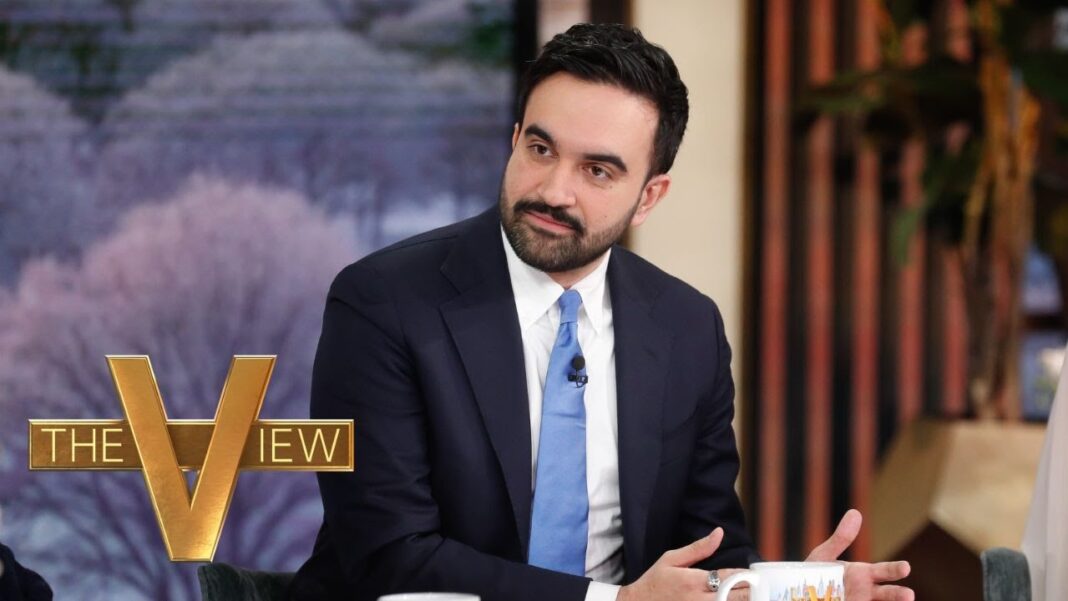
In a fiery and widely publicized Tuesday appearance on ABC’s ‘The View’, New York City Mayor Zohran Mamdani delivered some of his most impassioned remarks yet on immigration policy, electrifying the national conversation by calling for the abolition of Immigration and Customs Enforcement (ICE). Mamdani’s pronouncement, echoing beyond the city’s borders, reflected deep political currents roiling the nation amid intensified debates about federal immigration enforcement, misuse of force, and civic sovereignty.
NYC Mayor Zohran Mamdani says on ‘The View’ that ICE should be abolished – adding that he hasn’t seen “humanity” coming from that agency in a “long, long time.”
Mamdani doesn’t offer up/isn’t asked about what sort of alternative immigration enforcement agency should replace ICE.… pic.twitter.com/hsYNy01BeF
— The Jewish Voice (@TJVNEWS) January 20, 2026
The New York Post, on Tuesday, chronicled the mayor’s interview in substantial detail, noting that Mamdani characterized ICE as an agency that not only fails to enhance public safety but actively undermines it—an institution, he contended, that “has no interest in fulfilling its stated reason to exist.”
But the backdrop to this dramatic stance is more than political rhetoric. Mamdani’s call is deeply intertwined with one of the most controversial law-enforcement episodes in recent U.S. history: the fatal January 7 shooting of Renee Good, a 37-year-old American woman, by an ICE agent in Minneapolis—an incident that, as reported by The New York Post and numerous other outlets, has become both a flashpoint for national unrest and a catalyst for sustained criticism of immigration enforcement tactics.
On that winter morning in Minneapolis, Renee Nicole Good—an American citizen—was shot and killed by an ICE officer named Jonathan Ross during a large-scale immigration enforcement operation known as Operation Metro Surge, part of the Trump administration’s intensified deportation efforts. In a scene captured on video and widely disseminated across media platforms, the ICE agent fired multiple shots as Good’s vehicle was departing, killing her at the scene.
The killing stunned observers nationwide. Good was not a suspect in violent crime; rather, she was driving in her neighborhood when she encountered federal agents. Video footage shows the agent remaining upright and firing at Good’s vehicle, striking her several times. Other reporting indicates that witnesses and local officials have challenged the federal government’s account, which framed the shooting as self-defense. Independent video analyses and eyewitness statements have cast doubt on that narrative, arguing that Good’s vehicle never struck the agent and was simply moving away from the scene.
The aftermath of Good’s death has been chaotic, contentious, and politically charged. Protests erupted not only in Minneapolis but across a spectrum of cities nationwide, with demonstrators decrying the use of lethal force by federal immigration agents. Demonstrations have been documented from New York’s Foley Square to rallies in Chicago, Seattle, and Boston.
Despite the public outcry and broad calls for accountability, federal authorities have signaled a reluctance to pursue civil rights charges. The U.S. Department of Justice announced that it would not open a civil rights investigation into Good’s killing, a decision that has drawn fierce criticism from civil rights advocates and lawmakers. This approach contrasts starkly with the department’s handling of other high-profile law-enforcement shootings, such as the 2020 police killing of George Floyd.
Compounding the controversy, reports indicate that initial FBI inquiries into the incident encountered internal resistance, with prosecutors resigning in frustration over perceived political interference and a shift away from impartial investigation.
It was against this backdrop that Mayor Mamdani spoke on The View, a morning talk show where policy discussions often intersect with cultural debate. As documented by The New York Post, Mamdani seized upon Good’s death as emblematic of his broader critique of federal enforcement agencies, particularly ICE. “I am in support of abolishing ICE,” he told the hosts, arguing that the agency’s actions do not enhance public safety but instill fear in immigrant communities and fracture social cohesion.
Mamdani specifically cited the impact of deportation raids on cities such as New York, asserting that such operations would “rip the civic fabric of the city apart.” He portrayed these enforcement efforts as antithetical to the values of sanctuary cities and incompatible with efforts to foster trust between local authorities and immigrant residents.
On the issue of Good’s death, the mayor went even further, describing the shooting as “murder”—a charged characterization that resonates deeply with activists and constituents who view the incident as symptomatic of systemic problems within enforcement agencies.
Mamdani also reaffirmed his intention to uphold New York City’s sanctuary city laws, even amid potential federal pressure. The Trump administration has threatened to cut funding to jurisdictions that resist cooperating with ICE—a tactic designed to compel compliance through fiscal leverage. But Mamdani insisted that the city’s legal protections for undocumented immigrants are not “bargaining chips” to be traded away under political duress.
This stance highlights a central theme in contemporary urban governance: the tension between local autonomy and federal authority. Governors, attorneys general, and municipal leaders across the United States have grappled with how to balance public safety, immigration enforcement, and civil liberties, especially when federal directives run counter to local priorities.
Mamdani’s remarks come at a time of heightened national debate over immigration policy—particularly enforcement operations like Operation Metro Surge, which has deployed thousands of immigration agents to Minneapolis-St. Paul. Critics argue that such actions amount to an aggressive crackdown on immigrant communities that undermines trust and exacerbates social divisions. Supporters, including congressional conservatives, maintain that vigorous enforcement is necessary to uphold the rule of law and control illegal immigration.
In response to the protests and legal challenges arising from the Minneapolis shooting, a federal judge recently ordered limits on immigration agents’ tactics toward peaceful demonstrators. That ruling prohibits agents from detaining or using force against nonviolent protestors without reasonable suspicion of criminal activity—a legal curtailment that underscores the contentious constitutional dimensions of the issue.
Public reaction to Good’s death has been swift and multifaceted. In Minnesota, local leaders have pursued legal action against the Department of Homeland Security, seeking to halt further deployment of ICE agents and impose greater oversight. Meanwhile, communities nationwide have staged solidarity events, marches, and vigils in her memory. In some jurisdictions, civic officials are even considering proclamations of “Days of Unity” in her honor—a testament to the symbolic power her death has assumed.
Prominent public figures, from entertainers to civic leaders, have added their voices to the discourse. Ellen DeGeneres, for example, issued a rare political statement mourning Good’s death and expressing support for peaceful protestors responding to the incident.
For Mayor Mamdani, the visceral reaction to Good’s killing has crystallized a long-held belief that ICE, as currently constituted, is beyond reform. His call for abolition was not merely rhetorical but a deliberate policy position that places him at the forefront of a growing faction of progressive leaders advocating for transformational change in American immigration enforcement.
Yet critics point out the complexities such a proposal entails. Abolishing a federal agency would require congressional action and encounter significant political resistance. Furthermore, the debate raises questions about how the core functions of ICE—detentions, deportations, and border enforcement—would be restructured or absorbed into other agencies without weakening national sovereignty.
The aftermath of the Minneapolis shooting and Mamdani’s subsequent call for abolishing ICE encapsulates an era of political polarization in the United States. On one hand, there is profound skepticism toward law-enforcement actions perceived as heavy-handed or discriminatory. On the other, there is equally fervent support for robust enforcement of immigration law as a matter of national security and rule of law.
As The New York Post and other media outlets continue to document, this debate is not confined to abstract policy circles. It affects communities, families, and public sentiment in tangible and often emotional ways. Whether the call to abolish ICE will gain traction beyond symbolic affirmation remains uncertain—but what is clear is that the tragedy of Renee Good’s death has become a defining moment in the ongoing national conversation about justice, enforcement, and the limits of federal authority.
In urging the abolition of ICE, Mayor Mamdani has amplified a visceral and contentious debate about immigration, enforcement power, and the meaning of public safety in contemporary America. Anchored in the tragic death of Renee Good—a case that has stirred protests, legal battles, and national soul-searching—the conversation challenges policymakers to reckon with the costs of enforcement strategies that some say sacrifice human dignity on the altar of deterrence.
What emerges from this intersection of tragedy and politics is a portrait of a nation grappling with its principles—striving to balance security with compassion, authority with accountability, and law with humanity. In that struggle, the reverberations of this moment are likely to be felt for years to come.
He should be deported