



|
Getting your Trinity Audio player ready...
|
By: Abe Wertenheim
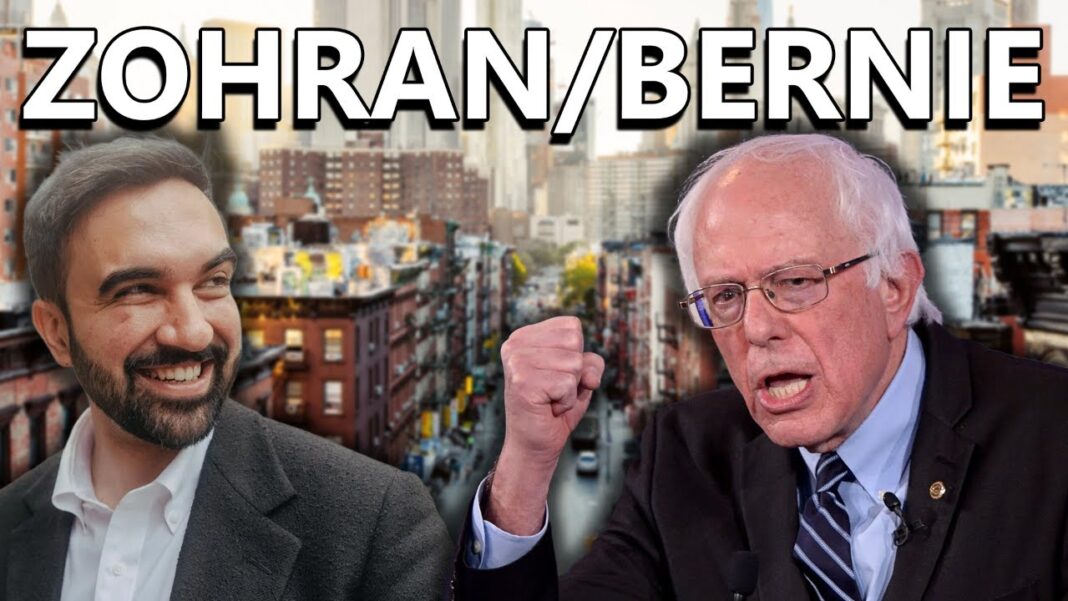
The New York City mayoral race took another dramatic turn this weekend as Zohran Mamdani, the Democratic Socialist nominee, joined Sen. Bernie Sanders at a Brooklyn College rally that quickly devolved into a lightning rod for controversy. The Saturday evening “Fight Oligarchy” town hall, hosted in the Leonard & Claire Tow Center at Brooklyn College, drew nearly 1,800 attendees and put Mamdani’s unabashedly left-wing platform on display — while simultaneously raising alarms over antisemitism, taxpayer-funded political events, and the overt politicization of the City University of New York (CUNY).
According to a report that appeared in The New York Post on Saturday evening, Mamdani seized the spotlight early with remarks defending four adjunct professors who were fired from Brooklyn College in June. The lecturers have claimed they were punished not for poor performance but for their outspoken pro-Palestinian advocacy. Mamdani, introduced as Sanders’ “special guest,” declared: “I cannot begin my remarks this evening without first acknowledging … that no faculty member should be disciplined for supporting Palestinian human rights.”
The crowd — predominately progressive activists and left-wing students — erupted in cheers, chanting “Free! Free Palestine!” in unison. Yet what Mamdani conspicuously left unsaid, as The New York Post report pointed out, was that these same professors were accused of enabling antisemitism at a college with one of the largest Jewish student populations in the United States. For many critics, that omission was deliberate — a calculated nod to his base while sidestepping concerns of Jewish New Yorkers who feel increasingly unsafe on campuses and in city neighborhoods.
The rally carried the unmistakable stamp of Sanders-style populism. The Vermont senator, himself a Brooklyn College attendee during 1959-1960, used his remarks to launch blistering critiques of U.S. foreign policy and American oligarchy. Echoing Mamdani’s rhetoric, Sanders proclaimed that Washington should not be “spending billions of dollars” supporting Israel, adding: “We should have a foreign policy based on humanity.”
As The New York Post report noted, Sanders further cast the New York mayoral race as nothing less than a referendum on democracy itself, calling Mamdani’s candidacy a “test case” against entrenched corporate and political elites. “What are the oligarchs afraid of?” Sanders asked rhetorically. “They’re afraid of Mamdani becoming an example of what can happen all over this country.”
The senator’s fiery lines drew thunderous applause from the progressive crowd but cemented the event as one deeply partisan in nature — a fact that would stoke criticism even before the night was over.
Beyond foreign policy, Mamdani used the forum to showcase his policy agenda, fielding largely softball questions from the audience. He pledged to roll back the retirement age of “Tier 6” public employees hired after 2012, lowering the benchmark from 63 to 55. He also championed greater city-funded legal aid for undocumented migrants facing deportation, framing it as a moral duty of New York City.
These proposals fit neatly into his broader socialist vision for city governance, but as The New York Post reported, critics noted the event blurred the lines between an official town hall and a campaign rally. The fact that Brooklyn College, a taxpayer-funded CUNY institution, hosted the gathering only amplified those concerns.
Former CUNY trustee Jeffery Wiesenfeld, speaking to The New York Post, was blunt: “This is a political event. Oligarchy my ass. Sanders is coming to New York to help Mamdani.”
Brooklyn College, when pressed, defended itself by noting that any candidate can rent its campus facilities. Still, for many observers, the optics were unmistakable: a public university was used as the staging ground for what amounted to a partisan rally backing the most radical candidate in the city’s mayoral race.
The evening was not without turbulence. According to the information provided in The New York Post report, a Jewish woman in attendance repeatedly attempted to ask Mamdani how he planned to make life safer for Jewish New Yorkers in light of rising antisemitism. She was not called upon during the Q&A portion and persisted in trying to make her voice heard. The response was swift and jarring: she was forcibly removed from the hall at Sanders’ direction.
Her removal called attention to the very critique Mamdani’s opponents have long made — that his movement marginalizes or outright silences Jewish concerns in order to advance a pro-Palestinian, anti-Israel agenda. The image of a Jewish woman being ejected from a public college event while the crowd cheered anti-Israel rhetoric struck many as emblematic of a political climate increasingly hostile to Jewish voices.
Earlier in the evening, another protester met a similar fate. A man wearing a T-shirt emblazoned with the Cuban flag heckled Mamdani, shouting: “You are a communist! This is not Cuba, you fool!” Security escorted him out as Mamdani quipped: “You know that something has changed when it’s not enough to call us Democratic socialists anymore.”
For Mamdani, the heckle provided an opportunity to reframe criticism as validation of his insurgent credentials. For critics, it was yet another reminder of how radical rhetoric polarizes rather than unites.
The flashpoint issue Mamdani raised — the dismissal of adjunct professors — remains contentious. According to the report at The New York Post, the lecturers insist they were punished for their pro-Hamas stances. Their defenders cast them as martyrs for academic freedom. Yet opponents argue that these faculty members actively fostered an environment hostile to Jewish students, crossing the line from political advocacy into discriminatory behavior.
The distinction matters. CUNY, and Brooklyn College in particular, has been plagued in recent years by accusations of antisemitism, from student government resolutions targeting Israel to faculty statements minimizing or excusing anti-Jewish harassment. Against this backdrop, Mamdani’s one-sided defense of the professors — without acknowledgment of the antisemitism claims — was seen by many as inflammatory.
The rally’s aftermath has raised serious questions about the trajectory of the mayoral contest. Mamdani, who shocked observers by capturing the Democratic nomination earlier this year, has positioned himself as the vanguard of a socialist surge in city politics. With Sanders now openly campaigning on his behalf, the stakes for November’s election have grown even higher.
As The New York Post report observed, Sanders described Mamdani as a potential national model for progressive governance. This framing turns the New York mayoral race into more than a local contest — it becomes a proxy battle for the direction of the Democratic Party nationally.
Yet Mamdani’s open embrace of pro-Hamas activism and his silence on antisemitism risk alienating significant blocs of voters. Jewish New Yorkers, particularly in Brooklyn and Queens, remain a critical constituency in city elections. Already alarmed by a surge in antisemitic incidents across the city, many will view Mamdani’s rhetoric as dismissive of their safety.
The rally also reignites a simmering debate over the politicization of CUNY. Brooklyn College defended itself by noting that candidates can rent its facilities, but critics argue that the university system has effectively become a platform for anti-Israel activism.
For years, CUNY has faced scrutiny from Jewish organizations and watchdog groups for its handling of antisemitism complaints. Saturday night’s event, with its Jew hating chants and the removal of a Jewish questioner, will only deepen the perception that the university has tilted decisively to the political left.
As The New York Post report highlighted, taxpayers ultimately fund the institution. For critics such as Wiesenfeld, the sight of Sanders and Mamdani using a public campus to galvanize support was not simply inappropriate but emblematic of a deeper institutional failure.
The Brooklyn College town hall with Zohran Mamdani and Bernie Sanders was billed as a rally against oligarchy. In practice, it became a rallying cry for Mamdani’s candidacy — one that thrilled progressives but alienated many others.
According to The New York Post report, the event laid bare the contradictions at the heart of Mamdani’s campaign: his embrace of pro-Hamas activism without reckoning with the rise of antisemitism; his celebration of public-sector unions and migrant rights while sidestepping concerns of Jewish New Yorkers; his claim to represent democracy even as dissenting voices were ejected from the room.
For Sanders, the night was another opportunity to project his vision of grassroots socialism onto America’s biggest city. For Mamdani, it was a chance to show strength and momentum. But for critics, it was something else entirely: a partisan spectacle that exploited a public university and marginalized Jewish concerns.
The mayoral race now moves into its next phase with the controversies of Saturday night still reverberating. As The New York Post reported, the rally may ultimately prove less a unifying moment for Mamdani’s campaign than a stark warning of the political and social divides that await New York City should he ascend to City Hall.
Two jerks
The Nazi and the Jew-hating shiksa kreaycher.
When are Mamdani’s supporters going to realize that he will support closing down liquor stores as this is against Shariah? That would be the end of him. On the other hand, the drunker his constituents, the easier for him to impose Shariah. Bernie and AOC are useful idiots.
Sanders is anti Jew ! Why would brooklyn college host such threats to Jewish Americans. This is the real threat to democracy!