



|
Getting your Trinity Audio player ready...
|
By: Jason Ostedder – Jewish Voice News
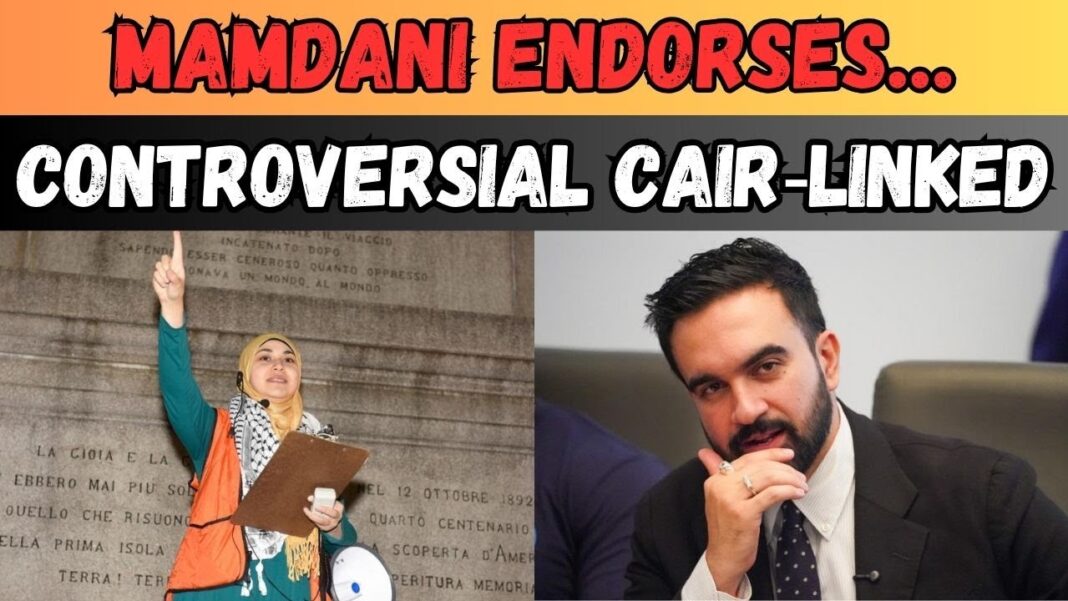
New York City Mayor-Elect Zohran Mamdani — who currently serves as a New York State Assemblyman and recently secured a stunning victory over former Gov. Andrew Cuomo — is confronting a rapidly intensifying political crisis after publicly endorsing far-left Assembly candidate Aber Kawas. As The New York Post reported on Wednesday, Kawas has come under fierce scrutiny for remarks minimizing the September 11 attacks, prompting widespread condemnation from conservatives, moderates, and even some progressives who argue such rhetoric has no place in public life.
Mamdani, already one of the most closely watched political figures in the country after his upset mayoral win, has been thrust even deeper into the national spotlight as the controversy continues to spiral. The situation erupted after a video surfaced of Kawas delivering a sweeping critique of capitalism, colonialism, and white supremacy — during which she referred to 9/11 as something that “a couple of people did,” language that critics say trivializes the deadliest terror attack in American history.
As The New York Post reported, the clip circulated widely following Mamdani’s endorsement, triggering outrage from both sides of the political aisle. Kawas framed the attacks within what she described as a broader historical pattern of systemic oppression, arguing that expectations for apologies from Middle Eastern communities were unjust and disproportionate.
In the clip highlighted by The New York Post, Kawas stated: “The system of capitalism and racism and white supremacy — and Islamophobia — have all been used to colonize lands, to take resources from other people. This is a long trajectory, and we’re just seeing the manifestations of that continuation with 9/11.”
She added that she finds it “reprehensible” that Muslims are expected to apologize for “a terror attack that a couple of people did,” when, in her view, the United States has never apologized for atrocities in its past, including genocide or slavery.
For many critics, her language amounted to excusing, rationalizing, or minimizing the attacks. According to the information provided in The New York Post report, some opponents interpreted her remarks as a claim that the September 11 attacks were ultimately America’s fault — an implication that triggered swift condemnation from prominent voices across the political spectrum.
The backlash was immediate. Conservative writer Rod Dreher compared Kawas to extremist commentator Nick Fuentes — whose antisemitic rhetoric and Holocaust denial have provoked intense controversy on the right. Dreher argued that Kawas represents a parallel threat emerging from the far left and that Mamdani’s endorsement risked handing Republicans a potent long-term political weapon.
“Zohran is going to be the gift that keeps on giving for the GOP,” Dreher posted on X. “And Fuentes, for the Democrats.”
Political commentator Russell Drew also weighed in, asserting that Kawas should not be elevated within Democratic ranks. Quoted by The New York Post, he argued: “Folks like her need to be purged from the Democratic Party, not elevated. This is our John Birch Society moment.”
Sen. Ted Cruz further amplified the controversy, posting the video with the caption: “This is today’s Democrat party,” as The New York Post report noted. His remark framed the controversy as indicative of broader ideological drift within the left.
Still, not all reactions were condemnatory. Some social media users argued that critics were misinterpreting Kawas’s remarks. One user, cited by The New York Post, claimed that her comments were intended to highlight the disparity in public expectations, writing: “She is talking about why Middle Eastern people are asked to apologize for what a few people did while the US which has bombed many countries in the Middle East is never asked to apologize.”
Despite such defenses, the broader reaction remains deeply negative, and much of the criticism has shifted toward Mamdani himself. As The New York Post report emphasized, his meteoric rise — from state legislator to Mayor-Elect after defeating Andrew Cuomo — has made him one of the most prominent progressive political leaders in the United States. His endorsements now carry significant symbolic weight, intensifying scrutiny of his political alliances.
Kawas, a well-known activist in Palestinian and racial justice circles, has not publicly retracted or clarified her remarks, according to the report in The New York Post. Her campaign emphasizes issues such as policing reforms, economic justice, and foreign-policy realignment, but the controversy over her 9/11 comments threatens to eclipse her platform.
For Mamdani, the political implications may prove particularly consequential. His endorsement comes at a moment of heightened sensitivity around extremist rhetoric, terrorism, and national trauma — especially in New York City, where the legacy of September 11 remains an intimate and deeply felt part of civic identity. The New York Post has repeatedly called attention to how references to 9/11 that appear dismissive or relativizing often provoke bipartisan outrage.
The controversy also exposes growing ideological tensions within Democratic circles. In New York and nationally, the party continues to navigate deepening divides between its progressive and centrist factions, particularly regarding foreign policy, racial justice movements, and the boundaries of political expression. Mamdani, considered a leading figure of the progressive wing, has now become a focal point in this ongoing ideological struggle.
Critics argue that movements seeking to reshape Democratic politics from the left must remain vigilant against rhetoric that could alienate broad swaths of the electorate or undermine public trust. Supporters of Mamdani counter that his coalition reflects the city’s shifting political demographics and growing appetite for transformative policy. But even some of his allies concede that the Kawas endorsement may complicate the early period of his mayor-elect transition.
Beyond partisan reactions, the episode raises deeper national questions about political accountability, historical memory, and the rhetoric surrounding terrorism and U.S. foreign policy. In the aftermath of the September 11 attacks, expectations for public figures to treat the events with solemnity and clarity remain deeply embedded in American political culture. As The New York Post report noted, comments that appear to minimize the attacks or obscure their origins tend to provoke intense pushback from across the ideological spectrum.
The fallout may linger as Mamdani prepares to assume the mayoralty. He has not yet issued a formal statement addressing the controversy, and it remains unclear whether he will respond directly or attempt to shift focus to his upcoming transition. Meanwhile, the reaction to Kawas’s remarks continues to unfold across social media, political circles, and community organizations.
What is undeniable is that the episode has quickly become one of the first significant political tests of Mamdani’s mayor-elect tenure. His response, or lack thereof, may shape public perceptions of his leadership style and his ability to navigate the contentious ideological terrain that increasingly defines New York City politics.
Why would anyone expect anything different?