



|
Getting your Trinity Audio player ready...
|
By: Fern Sidman
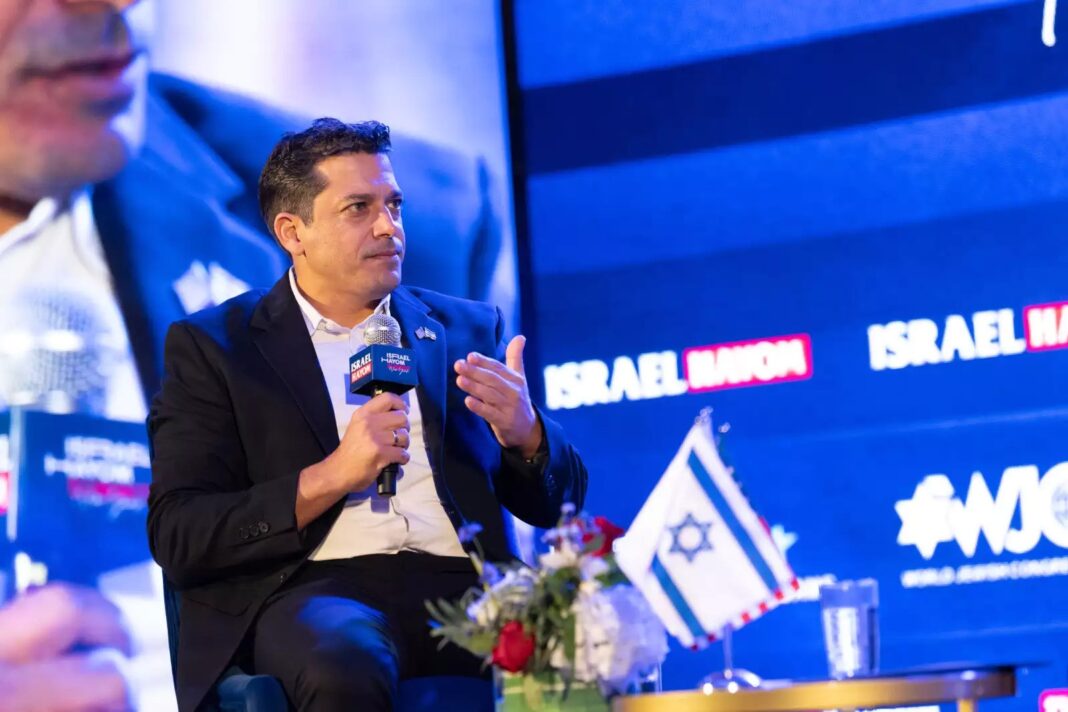
By any historical measure, New York City is more than a metropolis. It is a lodestar for democratic pluralism, a sanctuary for the persecuted, and — critically — the largest Jewish city in the world outside the State of Israel. That is why the first executive acts of Mayor Zohran Mamdani have reverberated far beyond City Hall, provoking condemnation from Jewish leaders across continents and drawing an unusually stark rebuke from Israel’s Minister of Diaspora Affairs and Combating Antisemitism, Amichai Chikli.
As reported on Friday by Israel National News (INN), Chikli did not mince words in responding to Mamdani’s immediate cancellation of two cornerstone executive orders issued by former Mayor Eric Adams: New York City’s formal adoption of the International Holocaust Remembrance Alliance (IHRA) working definition of antisemitism, and a prohibition on mayoral appointees and agency staff engaging in boycotts or divestment campaigns against Israel.
“These are not bureaucratic housekeeping matters,” Chikli warned in comments carried by Israel National News. “They are ideological acts with seismic consequences.”
The IHRA definition of antisemitism is not a theoretical construct. It is a globally recognized framework, endorsed by dozens of democratic governments and institutions, that provides clarity in distinguishing legitimate criticism of Israeli policy from antisemitic rhetoric that denies Jewish self-determination, demonizes Israel, or applies double standards to the Jewish state.
As the Israel National News report emphasized, this definition is not designed to silence debate, but to illuminate when political discourse crosses into ethnic or religious hatred.
By formally adopting the IHRA definition in June 2025, former Mayor Eric Adams positioned New York City as a leader in the global effort to combat antisemitism at a moment when hate crimes against Jews were rising to levels unseen in decades. Mamdani’s decision to rescind that recognition within hours of taking office has therefore been read not as administrative realignment, but as a symbolic dismantling of a moral bulwark.
According to the information provided in the Israel National News report, Minister Chikli’s response was unusually blunt for a sitting Israeli cabinet member commenting on municipal politics in the United States.
“It is no coincidence that one of Mayor Mamdani’s first actions was an attempt to cancel the IHRA definition of antisemitism,” Chikli said. “He knows very well that, according to that definition, he himself falls under the category of antisemitic. Instead of confronting reality, he is trying to change the rules.”
The revocation of the IHRA definition did not occur in isolation. As the Israel National News report detailed, Mamdani simultaneously annulled an executive order that barred mayoral staff and agency officials from participating in boycotts or divestment campaigns against Israel — a move that Jewish leaders fear will normalize BDS activism within the machinery of city governance itself.
Chikli characterized this twin maneuver as nothing less than a “systematic attempt to erase the fight against antisemitism and to legitimize extremist positions under the guise of social justice.”
The phrase “systematic attempt” is key. The minister’s argument is not merely that Mamdani holds controversial personal views, but that his administration is actively dismantling institutional guardrails that were put in place to protect Jewish New Yorkers from discrimination and harassment.
As Israel National News reported, this interpretation has been echoed by Jewish leaders in the United States. William Daroff, CEO of the Conference of Presidents of Major American Jewish Organizations, issued a statement condemning Mamdani’s actions as “a troubling indicator of the direction he is leading the city, just one day after taking office.”
“Its cancellation reduces New York’s ability to identify and respond to antisemitism at a time when the number of incidents continues to rise,” Daroff warned, as cited by Israel National News. “New York City should clearly lead in moral integrity and determination in confronting antisemitism. This decision signals the opposite direction.”
The backdrop to this controversy is not abstract. Since the Hamas massacre of October 7, 2023, Jewish communities around the world have faced an explosion of antisemitic incidents, ranging from vandalism and threats to physical violence and deadly terror attacks.
Just weeks ago, fifteen Jews were murdered in a brutal antisemitic attack in Sydney, Australia — a tragedy that Chairman of the World Zionist Organization Yaakov Hagoel cited in his own condemnation of Mamdani’s actions.
As Israel National News reported, Hagoel called the repeal of the anti-BDS order “deeply troubling,” adding: “Jews around the world have been facing relentless antisemitic campaigns since October 7, 2023. This is the time for zero tolerance toward antisemitism.”
Hagoel’s intervention underscores that Mamdani’s decisions are not being evaluated in a vacuum. They are being measured against a global environment in which antisemitism has migrated from the fringes into mainstream political discourse, often cloaked in the rhetoric of human rights.
Perhaps the most haunting element of Chikli’s rebuke, as quoted in the Israel National News report, was his reference to New York’s unique demographic and symbolic status.
“The fact that such moves are taking place in New York City, the city with the largest Jewish population in the world outside of Israel, is a serious warning sign.”
New York is not merely another municipality. It is a nerve center of Jewish life — culturally, economically, intellectually and spiritually. For the minister responsible for Israel’s relationship with the diaspora, the implications of New York’s mayor openly rolling back antisemitism protections are therefore nothing short of existential.
Chikli went further still: “Today, the mayor of New York is an overt antisemite and a supporter of terrorism. Anyone who tries to obscure this reality or wrap it in polite language is cooperating with a dangerous process that threatens not only the Jewish community of New York but the very legitimacy of the fight against antisemitism in the Western world.”
Such language is extraordinary. It reflects a belief that Mamdani’s actions represent not a policy disagreement but a rupture in the moral architecture that underpins democratic societies’ defense against bigotry.
Israel National News has repeatedly chronicled Mamdani’s history of inflammatory rhetoric regarding Israel, including his refusal to disavow the phrase “globalize the intifada” — a slogan that translates into an incitement to violence against Jews worldwide.
Even more disturbing to many observers was Mamdani’s decision to criticize Israel on October 8, 2023 — just one day after the Hamas massacre that claimed over 1,200 lives in southern Israel. At a moment when Jewish communities worldwide were reeling in grief and fear, Mamdani’s remarks were seen by many as callous at best and morally grotesque at worst.
His repeated accusations that Israel is committing war crimes, coupled with his public vow to arrest Prime Minister Benjamin Netanyahu should he visit New York City, have reinforced the perception that Mamdani does not merely oppose Israeli policy but has embraced a worldview in which Israel is uniquely delegitimized.
For Chikli and others quoted by Israel National News, the Mamdani controversy transcends local governance. It is emblematic of a broader ideological struggle in Western societies over whether antisemitism will be confronted forthrightly or rebranded as “anti-Zionism” and thus immunized from scrutiny.
The IHRA definition stands as one of the last widely accepted tools for exposing that rhetorical sleight of hand. Its repeal by the mayor of New York is therefore interpreted as a green light to those who seek to weaponize social justice language against Jews.
This concern is not speculative. Jewish community leaders in New York have already documented rising harassment in public spaces, schools, and workplaces. Without the IHRA framework, critics fear that city agencies will lack both the vocabulary and the will to identify antisemitism when it is camouflaged as activism.
In his statement, Hagoel called for “zero tolerance toward antisemitism.” But tolerance is not a psychological state; it is an institutional posture. It is embedded in definitions, rules, executive orders and enforcement mechanisms.
By dismantling those instruments, Mamdani has, in the eyes of Israel’s diaspora minister and leading Jewish organizations, replaced zero tolerance with zero standards.
As Israel National News concluded in its analysis of Chikli’s remarks, the minister’s message is not simply that Mamdani is wrong, but that his early decisions represent a test case for whether the fight against antisemitism will remain anchored in law and policy — or be reduced to hollow rhetoric.
New York has always been a bellwether. What is normalized in its politics often metastasizes across the democratic world.
That is why Israel’s Minister of Diaspora Affairs has chosen to intervene so forcefully, even at the risk of diplomatic friction. His warning is directed not only at City Hall but at Western civilization itself.
If the largest Jewish city in the diaspora can quietly dismantle its defenses against antisemitism in the name of ideological fashion, then no Jewish community can afford to feel secure.
And if that dismantling is applauded, excused or euphemized, then the erosion of moral clarity will not stop with Jews — it will corrode the very foundations of democratic society.
For now, Jewish leaders in New York, Israel and beyond are watching closely, as Israel National News continues to report. The first chapter of Mayor Zohran Mamdani’s administration has already been written. Whether it becomes a footnote or a turning point may well define the future of the fight against antisemitism in the Western world.
Time for Jewish leaders in New York to stop “watching,” and start doing.