



|
Getting your Trinity Audio player ready...
|
By: Jerome Brookshire
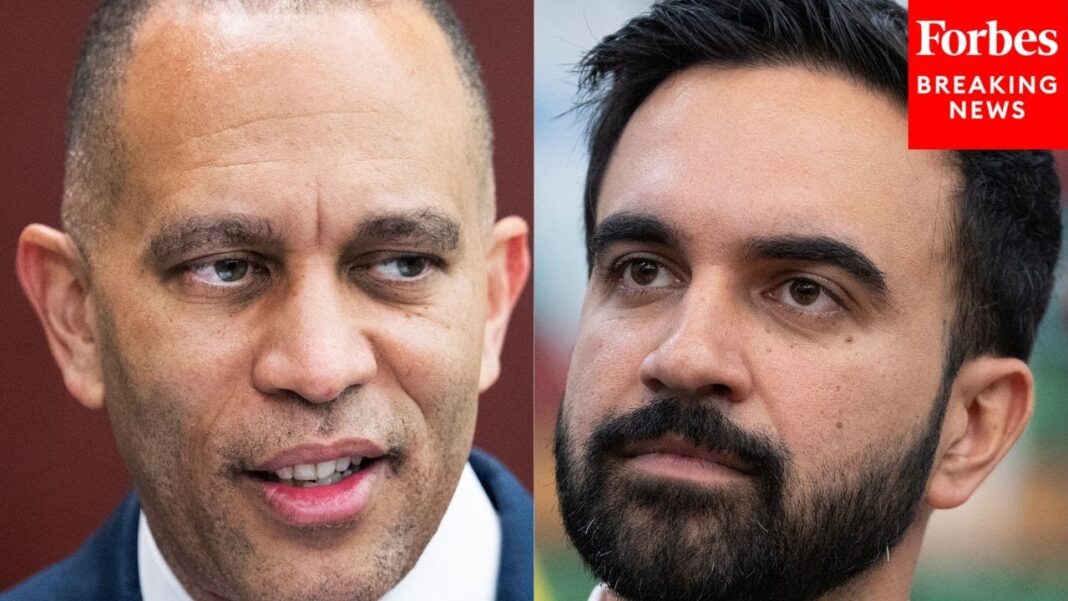
House Minority Leader Hakeem Jeffries (D-N.Y.) has called on New York City Democratic mayoral nominee Zohran Mamdani to directly address mounting concerns within the city’s Jewish community regarding their safety and his controversial record on Israel and antisemitism. As reported by The Jewish News Syndicate (JNS) on Tuesday, Jeffries emphasized the need for Mamdani to offer clear reassurances to Jewish New Yorkers amid heightened scrutiny of his past statements and political affiliations.
Jeffries, who holds one of the most influential leadership roles within the Democratic Party, told The Hill this week that Mamdani must demonstrate a commitment to prioritizing the security and welfare of Jewish residents. The remarks come as Mamdani, a self-described democratic socialist and vocal critic of Israel, continues to face backlash for his refusal to condemn the slogan “Globalize the intifada” — a phrase widely interpreted as a call for violent resistance.
According to the information provided in the JNS report, Jeffries intends to meet privately with Mamdani this week to discuss these concerns. The Minority Leader indicated in an interview with Punchbowl News that Mamdani’s posture toward the Jewish community and his stance on sensitive issues such as antisemitism and Middle East policy would be a significant focus of their discussion.
As JNS has reported, Mamdani’s primary victory over former New York Governor Andrew Cuomo in the June 24 Democratic primary stunned political observers and prompted an immediate wave of criticism from Jewish organizations. His win positioned him as the leading Democratic candidate in a mayoral race that will culminate in a general election showdown featuring incumbent Mayor Eric Adams, independent challenger Andrew Cuomo, Republican nominee Curtis Sliwa, and independent candidate Jim Walden.
Mamdani’s past rhetoric, particularly his alignment with anti-Israel activist circles, has fueled distrust among pro-Israel groups and segments of the Jewish electorate. Critics have highlighted his ongoing refusal to denounce incendiary slogans like “Globalize the intifada,” which they argue normalizes extremist rhetoric and undermines Jewish communal security in New York City.
In his comments to The Hill, Jeffries stopped short of offering a formal endorsement of Mamdani, a notable omission given Jeffries’ high-profile leadership role within the party and his deep ties to New York’s Jewish community. According to the information contained in the JNS report, this reflects broader hesitation among senior Democratic figures who have remained cautious in embracing Mamdani’s candidacy amid ongoing controversy.
Mamdani’s mayoral campaign has underscored the deep divisions within New York’s Democratic coalition, particularly on issues relating to Israel, antisemitism, and public safety. Mamdani’s stance on these matters has drawn sharp rebukes not only from Jewish advocacy groups but also from bipartisan leaders concerned about rising antisemitic rhetoric in political discourse.
The upcoming meeting between Jeffries and Mamdani is being closely watched by political analysts and community leaders alike. According to the report at JNS, stakeholders within the Jewish community are hoping the Minority Leader will use the opportunity to press Mamdani on whether he intends to moderate his rhetoric or implement policies that will directly address Jewish security concerns in the city.
Mamdani’s refusal to clearly distance himself from radical slogans and movements has complicated his relationship with mainstream political figures, including those within his own party. While Mamdani has asserted his commitment to protecting all New Yorkers, critics point to what they perceive as a lack of unequivocal condemnation of antisemitic and anti-Israel extremism.
Jeffries’ engagement with Mamdani comes at a critical juncture in the mayoral race. With the general election campaign entering its final stages, Democratic leaders are grappling with how best to unify their party’s base while addressing the concerns of key constituencies — particularly Jewish voters, who have traditionally been a significant and influential electoral bloc in New York City.
The controversy surrounding Mamdani illustrates a broader challenge for Democratic leaders navigating the intersection of progressive activism, foreign policy, and community relations. As the JNS report observed, the party’s internal debates over Israel and antisemitism have often placed centrist figures like Jeffries in the position of mediating between the party’s establishment wing and its activist left.
The stakes of the forthcoming meeting are high. Many Jewish leaders view Jeffries as a crucial advocate who could influence Mamdani’s approach to these sensitive issues. Whether the discussion results in a shift in Mamdani’s rhetoric or policy positions remains to be seen.
For now, as JNS reported, Jeffries’ message is clear: Mamdani must take concrete steps to reassure Jewish New Yorkers that their safety and concerns will be prioritized should he become mayor. The outcome of their private dialogue could have lasting implications not only for Mamdani’s campaign but also for the broader political landscape in a city grappling with complex questions of identity, security, and governance.

Welcome to the theater of the absurd. That’s all this is.
When it comes to Mamdani’s views on Israel’s right to exist and Jewish survival worldwide, don’t expect a zebra to change its stripes