



|
Getting your Trinity Audio player ready...
|
By: Jeff Gorman
In the ever-volatile theater of American politics, few spectacles are more combustible than the ideological battle unfolding in New York City. According to Republican National Committee Chairman Joe Gruters, the increasingly leftward drift of Democratic leaders such as Rep. Alexandria Ocasio-Cortez and Mayor Zohran Mamdani is not merely a local phenomenon — it is a national gift to the GOP.
Speaking in blunt and unambiguous terms on Sunday, Gruters argued that the ascent of what he termed “rogue radicals” within the Democratic Party is reshaping the political landscape in ways that could dramatically benefit Republicans in the 2026 midterm elections. His comments, reported on Sunday by The New York Post, underscored a growing belief within GOP circles that progressive figures are pushing the Democratic brand so far to the left that moderate voters will have little choice but to flee into Republican arms.
“What AOC and Mamdani and others are doing is giving confidence to these … left-wing rogue radicals across the country and giving them confidence to run for these races,” Gruters said during an interview on 77 WABC radio’s “Cats Roundtable,” as quoted by The New York Post. “Which in turn turns their primary battles into who can go further to the left.”
The statement encapsulated a broader Republican narrative: that the modern Democratic Party has become hostage to its most ideologically extreme elements, leaving behind a vast swath of centrist and independent voters.
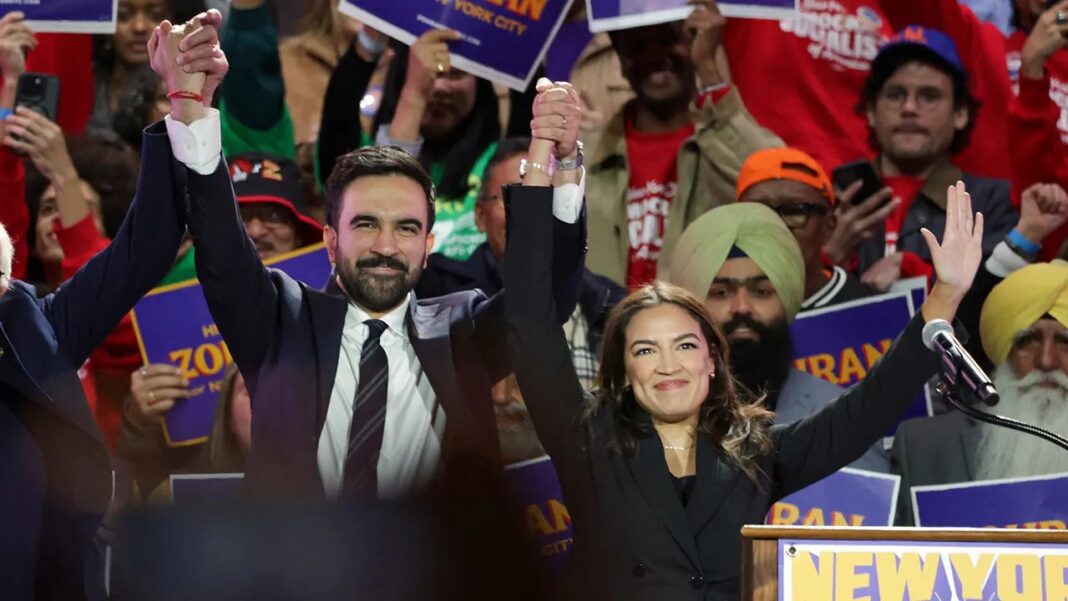
Gruters, who has assumed an increasingly vocal role as RNC chair, reserved particular attention for two New York political figures who have become emblematic of progressive politics: Ocasio-Cortez, the Bronx-Queens congresswoman and socialist icon, and Mamdani, the newly elected mayor whose victory was propelled by a coalition of left-wing activists.
“Look at New York,” Gruters told the radio audience in remarks later amplified in The New York Post report. “You have AOC, you have Mamdani. They are the new face of the Democratic Party.”
To Republicans, that “new face” is not a symbol of renewal, but of ideological overreach. Gruters and other GOP strategists believe that the policies championed by Ocasio-Cortez and Mamdani — including aggressive wealth redistribution, expanded government control of health care and education, and confrontational stances on policing and immigration enforcement — are far outside the mainstream of American opinion.
The RNC chairman suggested that the rise of such figures is having a cascading effect across the country, emboldening progressive activists to challenge more moderate Democrats in primaries. The result, he said, is a political arms race in which candidates compete to prove who can adopt the most uncompromisingly leftist positions.
For Republicans, that dynamic is electoral gold.
Traditionally, the party in control of the White House suffers losses in midterm elections. For decades, that pattern has held with near clockwork regularity, regardless of which party occupies the Oval Office. Yet Gruters confidently predicted that 2026 would defy that precedent.
According to the information provided in The New York Post report, the RNC chief expressed optimism that Republicans would retain control of Congress precisely because Democrats are drifting toward candidates and policies that alienate mainstream voters.
“We are going to defy history,” Gruters declared. “The left is going so far out there that the American people are going to say, ‘We can’t go in that direction.’”
The confidence is rooted in a simple calculation: if Democratic primaries produce nominees who mirror the politics of Ocasio-Cortez and Mamdani, Republicans believe they will have an easy time portraying the opposition as extreme, reckless, and out of touch.
Yet not everyone shares that rosy assessment.
While Republican officials project optimism, independent political observers are less convinced that the GOP path to victory is quite so straightforward.
As The New York Post noted in its coverage, the nonpartisan Cook Political Report recently shifted 18 House races nationwide in favor of Democrats, including several contests in New York. Those adjustments suggest that, despite internal Democratic tensions, the political environment may not be as hospitable to Republicans as party leaders claim.
Many analysts point out that economic concerns, cultural controversies, and the unpredictable nature of President Trump’s second-term agenda could complicate Republican hopes of holding onto their narrow congressional majorities.
Nevertheless, Gruters remains undeterred, insisting that the ideological trajectory of the Democratic Party will ultimately overwhelm those factors.
Perhaps the most provocative element of Gruters’ remarks, as highlighted in The New York Post report, was his suggestion that Ocasio-Cortez may be positioning herself for a presidential run in 2028.
“She has a lot of support out there,” Gruters said. “We’d love to see her as the Democratic nominee. Our candidates would love to go one-on-one against her.”
The notion of an AOC presidential candidacy has long been whispered about in Washington political circles. At 35, she will meet the constitutional age requirement for the presidency in time for the next election cycle, and her fundraising prowess and national profile are virtually unmatched within progressive ranks.
For Republicans, however, the idea of facing Ocasio-Cortez atop a Democratic ticket is less a nightmare than a dream scenario. Gruters’ comments made clear that the GOP views her as the ultimate embodiment of the leftward shift they believe is alienating average Americans.
Nowhere is this ideological clash more visible than in New York City itself.
As The New York Post has chronicled extensively, Mamdani’s election as mayor signaled a dramatic break from the more pragmatic, centrist leadership that has traditionally governed the nation’s largest city. His agenda — which includes expansive social spending, aggressive policing reforms, and confrontational stances toward federal immigration enforcement — has drawn fierce criticism from conservatives and business leaders alike.
To Republicans, Mamdani represents a microcosm of what they believe the national Democratic Party is becoming: a coalition driven more by activist ideology than practical governance.
Gruters’ comments suggested that this transformation is already producing political consequences. In his telling, the more visible and influential figures like Mamdani and Ocasio-Cortez become, the more likely moderate voters are to recoil.
The Republican playbook for the next two years, as sketched out by Gruters and echoed in The New York Post report, is straightforward: draw the sharpest possible contrast between GOP candidates and the progressive wing of the Democratic Party.
By highlighting controversies over crime policy, immigration, education, and fiscal management, Republicans hope to frame the midterms as a referendum on what they portray as radical governance.
The strategy hinges on a key assumption — that the political center remains intact and is growing increasingly uncomfortable with the direction of the Democratic Party.
Whether that assumption proves correct will depend on forces far beyond the control of any single party chairman.
Economic performance, international crises, and the unpredictable rhythms of domestic politics all have the potential to reshape the landscape before voters head to the polls.
But for now, at least, the Republican message is clear. As Gruters put it in remarks carried by The New York Post, the GOP believes it has found an unlikely set of allies in its quest to maintain power: the very progressive leaders who see themselves as the vanguard of a new political era.
To Republicans, figures like Alexandria Ocasio-Cortez and Zohran Mamdani are not harbingers of Democratic renewal.
They are, in Gruters’ view, the architects of a Republican revival.
