



|
Getting your Trinity Audio player ready...
|
By: Abe Wertenheim
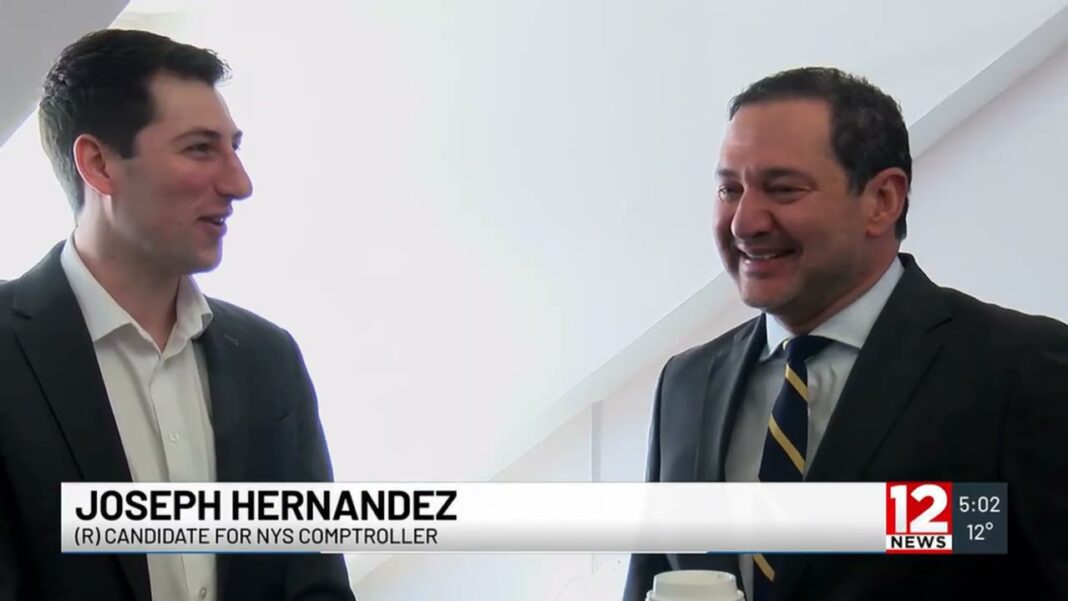
The race for New York State comptroller has abruptly transcended the ordinarily technocratic confines of pension management and bond portfolios, erupting instead into a charged referendum on ideology, fiduciary duty, and the proper boundaries between moral protest and financial stewardship. As The Algemeiner reported on Wednesday, a Democratic contender’s pledge to divest the state from Israel bonds has provoked fierce rebuttal from his Republican opponent, Joseph Hernandez, who warns that such a move would imperil the financial integrity of one of the nation’s largest public investment funds while entangling New York’s fiscal architecture in a polarizing international campaign.
In an exclusive interview with The Algemeiner, Hernandez framed the proposal not merely as an ill-advised political gesture but as a profound breach of the comptroller’s core obligation to act as a fiduciary for hundreds of billions of dollars in public assets. The office of the comptroller, charged with overseeing the Common Retirement Fund and safeguarding the pensions of state and municipal employees, is legally and ethically bound to pursue prudent, risk-adjusted returns. To subordinate those imperatives to geopolitical signaling, Hernandez argued, would constitute a dereliction of duty with tangible consequences for retirees, taxpayers, and the state’s broader financial standing.
Hernandez’s personal narrative lends particular urgency to his critique. The son of Cuban refugees who fled the Castro regime, he spoke to The Algemeiner with the cadence of someone intimately familiar with the costs of ideological absolutism. He described the divestment proposal, advanced by former Kansas state representative Raj Goyle, as a symbolic embrace of the boycott, divestment, and sanctions movement against Israel, a campaign that seeks to isolate the Jewish state economically and diplomatically. As The Algemeiner has chronicled, leaders of that movement have repeatedly articulated aims that extend beyond policy reform and into the realm of delegitimizing Israel’s very existence.
From Hernandez’s vantage point, the controversy is not only moral but rigorously financial. Israel bonds, he insisted, are among the most reliable instruments in a conservative government portfolio. The Algemeiner report noted that New York State’s pension fund currently holds approximately $337.5 million in such bonds, part of a diversified pool of assets managed to provide stable returns over decades. Historically, these bonds have yielded competitive returns, often hovering around five percent annually in municipal contexts, outperforming a range of alternative fixed-income options. To liquidate such holdings on political grounds, Hernandez warned, would be tantamount to replacing empirically sound investment strategy with ideological theater.
“The economic rationale for investing in Israeli bonds is impeccable,” Hernandez told The Algemeiner, casting the relationship not as an abstract diplomatic alignment but as a mutually reinforcing economic partnership. He sketched an expansive vision in which New York deepens collaboration with Israel’s burgeoning technology sector, particularly in artificial intelligence, biotechnology, and advanced healthcare systems.
In his conception, the comptroller’s office should not merely safeguard capital but actively facilitate transnational innovation pipelines that translate financial partnership into job creation and industrial renewal within New York itself. Hernandez has gone so far as to pledge that, if elected, he would increase the state’s exposure to Israel bonds by an additional $1 billion, signaling a deliberate repudiation of divestment politics.
The Algemeiner’s report situated this debate within a broader economic landscape that underscores Israel’s material imprint on New York’s prosperity. According to the “2025 New York–Israel Economic Impact Report” produced by the United States–Israel Business Alliance, Israeli-founded firms have become integral to the city’s innovation ecosystem. In New York City alone, hundreds of Israeli-origin companies generate billions in annual earnings and support tens of thousands of jobs, both directly and through ancillary economic activity.
The Algemeiner report highlighted the proliferation of Israeli-founded “unicorns” operating in the city, enterprises whose valuations and growth trajectories place them at the forefront of global technological advancement. To signal institutional hostility toward Israel, business leaders caution, risks chilling investment sentiment and precipitating capital flight, with downstream consequences for employment and tax revenue.
Yet the divestment proposal advanced by Goyle is explicitly tethered to a moral indictment of Israeli policy. Addressing supporters aligned with the Working Families Party, Goyle pledged that, if elected, he would refuse to renew the comptroller’s foreign bond portfolio, explicitly including Israel bonds. He framed this stance as a refusal to provide what he termed a “blank check” for Israeli military conduct in Gaza, invoking accusations of war crimes to justify the severing of financial ties. Such rhetoric, while resonant among segments of the progressive electorate, collides with the statutory responsibilities of the comptroller’s office, which is designed to function as a nonpartisan steward of public funds rather than a tribunal of international justice.
The Algemeiner report further situated Goyle’s pledge within a pattern of escalating institutional divestment efforts in New York politics. The city’s political environment has grown increasingly receptive to BDS-aligned activism, exemplified by recent decisions in municipal finance and the election of officials who have publicly endorsed economic pressure campaigns against Israel. New York City Mayor Zohran Mamdani, whose ascendance to office followed a career marked by vehement anti-Israel activism, has intensified anxieties among Jewish communities and Israeli-linked businesses about the durability of the city’s historically robust bilateral ties. The Algemeiner report noted that such positions reverberate beyond symbolic politics, influencing the perceptions of foreign investors who weigh political climate alongside market fundamentals.
For Hernandez, the specter of politicized divestment represents not merely an affront to Israel but a destabilizing precedent for public finance more broadly. In his conversation with The Algemeiner, he posed a rhetorical question that cuts to the heart of fiduciary governance: if New York were to divest from Israel bonds over policy disagreements, what principle would prevent similar withdrawals from the sovereign debt of other nations whose policies offend prevailing political sentiments? The logic of selective moralization, he argued, threatens to fragment the state’s investment strategy into a patchwork of ideological litmus tests, eroding coherence, increasing risk exposure, and ultimately compromising the financial security of retirees whose livelihoods depend on disciplined asset management.
Israel bonds enjoy bipartisan support among seasoned financial stewards. Democratic Assemblyman David Weprin, a former chair of the New York City Council Finance Committee, described them as stable, guaranteed instruments with a track record unmarred by default. Such endorsements underscore the extent to which the bonds have long been insulated from partisan contestation, viewed instead as pragmatic vehicles for secure yield. To rupture that consensus, critics contend, is to import the volatility of international politics into domains of public finance that demand continuity and prudence.
At stake, then, is not merely a line item in the state’s investment ledger but the philosophical orientation of the comptroller’s office itself. The Algemeiner report portrayed Hernandez as advancing a conception of fiduciary stewardship rooted in the primacy of economic rationality and the insulation of financial governance from ideological capture. He has pledged allegiance, not to activist constituencies, but to taxpayers and pensioners whose welfare hinges on the preservation and growth of the Common Retirement Fund. In his telling, the comptroller’s independence is not an abstraction but a constitutional safeguard designed to prevent precisely the sort of politicization that divestment campaigns invite.
The contest between Hernandez and Goyle thus crystallizes a broader tension in American public life: the struggle to reconcile moral outrage over international conflicts with the imperatives of domestic governance. In the context of New York’s comptroller race, this tension has assumed unusually concrete form, with proposals that could reshape the financial architecture of the state. To critics, Goyle’s plan exemplifies the hazards of conflating symbolic protest with fiduciary responsibility, risking tangible harm to pensioners and local economies in pursuit of ideological alignment. To supporters, it represents an overdue assertion of moral accountability in the realm of public finance.
Yet even among those sympathetic to calls for ethical investment, the implications of divesting from Israel bonds are fraught. The Algemeiner report noted that the BDS movement’s avowed objective of isolating Israel on the international stage imbues such actions with ramifications that extend beyond discrete policy disagreements. In this light, the comptroller’s race becomes a proxy battleground over whether New York will align itself with a campaign widely perceived by Jewish organizations as existentially hostile to the Jewish state. Hernandez’s insistence that the United States remain a steadfast friend of Israel and the Jewish people resonates in a state that is home to the largest Jewish population outside Israel, a demographic reality that lends local urgency to what might otherwise appear a remote geopolitical debate.
As the election approaches, the contours of the debate sharpen. Hernandez has cast his candidacy as a defense of institutional integrity against what he terms the encroachment of “fringe ideological groups.” His closing argument to the publication was unambiguous: the comptroller’s office exists to execute fiduciary duty with rigor, not to adjudicate foreign conflicts. Whether New York voters will endorse that vision, or whether they will embrace a more activist conception of financial governance, remains an open question. What is clear, however, is that the outcome will reverberate far beyond the mechanics of bond portfolios, shaping the state’s posture toward Israel, its investment climate, and the enduring principle that public finance, at its best, is governed by prudence rather than passion.