



|
Getting your Trinity Audio player ready...
|
By: Fern Sidman
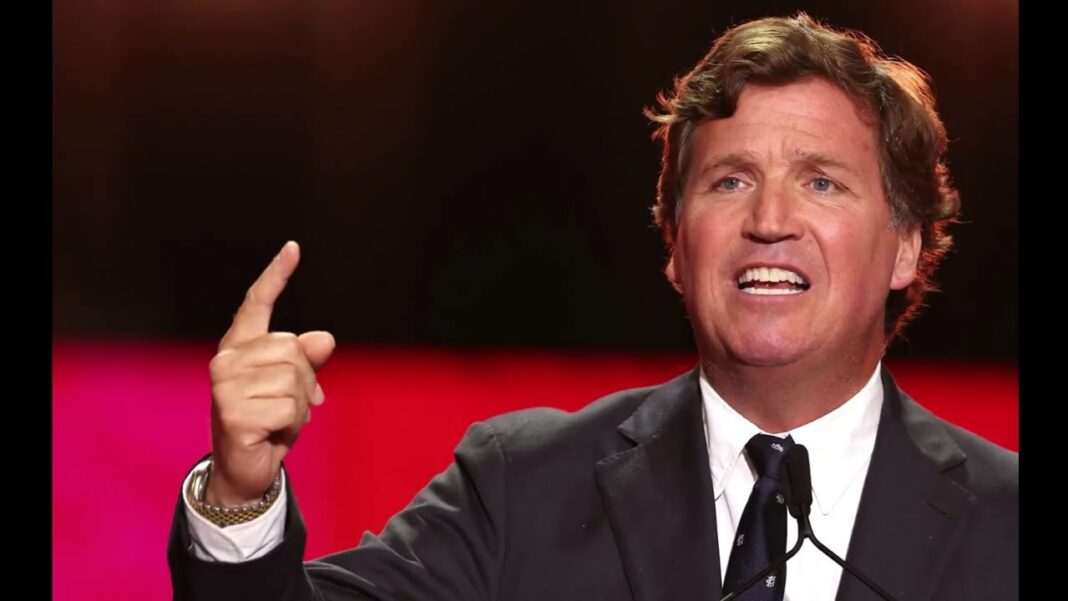
In a moment that illustrates the intensifying national reckoning over rhetoric, responsibility, and reach in the digital media age, podcaster and former Fox News host Tucker Carlson has been named “Antisemite of the Year” by StopAntisemitism, a prominent Jewish civil rights watchdog. The designation lands amid a period of surging antisemitic incidents in the United States and abroad, and reflects growing alarm within Jewish communities over the normalization of extremist ideologies through influential media platforms.
According to a report that appeared on Sunday in The New York Post, the decision followed months of controversy surrounding Carlson’s programming choices and commentary, culminating in an October interview with white nationalist Nick Fuentes. Fuentes, long associated with the fringes of American political extremism, has openly promoted conspiracy theories alleging Jewish control over American politics, finance, and media; denied the historical reality of the Holocaust; and even called for what he chillingly described as a “holy war” against Jews. For StopAntisemitism, Carlson’s decision not merely to interview Fuentes but to engage him in what critics described as a congenial and uncritical conversation crossed a line from provocative journalism into dangerous amplification.
“By an overwhelming vote margin, Tucker Carlson has been named StopAntisemitism’s 2025 Antisemite of the Year,” Liora Rez, the organization’s founder and executive director, told The New York Post. Rez accused Carlson of deploying his immense reach to mainstream ideas that once languished on the margins of public discourse. “Carlson’s divisive, hateful, and dangerous rhetoric and his repeated glowing interviews with bigots and Hitler apologists have made him the most reviled Jew-hater over the last 12 months,” she said.
The Fuentes interview proved especially incendiary. As The New York Post report detailed, Fuentes used the appearance to praise Soviet dictator Joseph Stalin—whose regime persecuted Jews through discriminatory policies and purges—and to rehearse familiar antisemitic tropes. Carlson, for his part, drew condemnation for remarks targeting “Christian Zionists,” whom he accused of being overtaken by what he derisively labeled a “brain virus” for their support of Israel. In that context, Carlson singled out figures such as former President George W. Bush, U.S. Ambassador to Israel Mike Huckabee, and Texas Senator Ted Cruz, declaring bluntly, “I dislike them more than anybody.”
Those comments exemplify a broader pattern identified by StopAntisemitism: Carlson’s tendency to frame Jewish advocacy for Israel as suspect or dangerous, a narrative that echoes the centuries-old antisemitic charge of “dual loyalty.” The watchdog group has asserted that Carlson has repeatedly insinuated that Jewish Americans who care deeply about Israel are somehow less committed to the United States—a claim with a long and toxic pedigree in antisemitic propaganda.
Indeed, StopAntisemitism had already named Carlson its “Antisemite of the Week” in October, prior to the Fuentes controversy. At that time, the organization accused Carlson of “using his platform of millions to normalize antisemitism, from downplaying white supremacy to promoting the antisemitic ‘great replacement theory,’ turning dog whistles into a megaphone for hate.” That theory, which posits that shadowy elites—often coded or explicitly identified as Jewish—are engineering demographic change to displace white populations, has been linked to multiple acts of mass violence in recent years.
The group further contends that Carlson’s method is particularly insidious. Rather than articulating overtly antisemitic claims himself, he often plays the role of provocateur, posing questions or offering prompts that invite guests to voice extremist ideas. This approach, StopAntisemitism argues, allows Carlson to maintain plausible deniability while still facilitating the spread of falsehoods and conspiratorial narratives. As The New York Post report summarized the group’s critique, Carlson’s show becomes a conduit through which hate is laundered into mainstream political conversation.
The Fuentes episode was not an isolated incident. According to the information provided in The New York Post report, Carlson has also interviewed Palestinian pastor Munther Isaac, who has referred to Israel as a “terrorist entity,” and Holocaust revisionist Darryl Cooper. Cooper has claimed that Nazi Germany did not intend to murder Europe’s Jews and controversially blamed British Prime Minister Winston Churchill for World War II. Carlson nevertheless praised Cooper as “the best and most honest popular historian in the United States,” a characterization that alarmed historians and Jewish organizations alike.
Such programming decisions, StopAntisemitism warned, carry consequences that extend far beyond the realm of ideas. “When influential figures normalize antisemitic narratives, it contributes to a climate where threats, harassment, and violence against Jews become more and more common,” Rez told The New York Post. She emphasized that while rhetoric alone may not directly cause violence, it creates the conditions in which violent acts become thinkable, and even justifiable, to unstable or radicalized individuals. “Words don’t kill, but they dig the graves,” Rez said starkly, adding that in today’s environment, inflammatory speech can and does pave the way to real-world attacks on Jews.
The designation of Carlson as “Antisemite of the Year” sparked intense debate across the political spectrum, particularly on the right, where Carlson retains a devoted following. As The New York Post report noted, some conservative voices, including commentator Ben Shapiro, urged right-leaning institutions and activists to sever ties with Carlson, arguing that his willingness to entertain extremist guests undermines the moral credibility of the movement. Others, such as Heritage Foundation president Kevin Roberts, defended Carlson, framing the criticism as an attack on free speech or an attempt to silence dissenting views on foreign policy.
Carlson himself did not immediately respond to requests for comment, according to The New York Post. His silence has done little to quell the controversy, which has widened into a broader conversation about the responsibilities of media figures in an era when podcasts and independent platforms rival traditional news outlets in reach and influence.
The competition for StopAntisemitism’s grim annual distinction was, tellingly, fierce. Carlson edged out two other finalists whose statements shocked even seasoned observers of extremist rhetoric. Mixed martial arts fighter Bryce Mitchell was cited for comments in which he praised Adolf Hitler as a “good guy,” claiming the Nazi leader sought to “purify” Germany by expelling Jews. Alt-right conspiracy theorist Stew Peters, another finalist, has openly denied the Holocaust, producing a video titled “HoloHoax: Fake Gas Chambers, Fake Pictures, Fake Holocaust,” and deriding the genocide of six million Jews as a “fairytale.”
That such figures could plausibly contend for a dubious honor alongside a media personality with millions of listeners speaks volumes about the gravity of StopAntisemitism’s warning. Antisemitism today is no longer confined to the fringes. It is increasingly propagated by individuals with enormous platforms and cultural cachet, whose words reverberate far beyond niche audiences. As The New York Post reported, antisemitic incidents—from vandalism and harassment to physical assaults—have spiked dramatically in recent years, particularly in the aftermath of the Oct. 7 Hamas attack on Israel and the ensuing war in Gaza.
The inclusion of public figures such as children’s entertainer Ms. Rachel and actress Cynthia Nixon among the top ten contenders for the dishonor further illustrates how debates over antisemitism have penetrated mainstream cultural and political life. While their actions differ markedly from those of Fuentes or Peters, their presence on the list reflects StopAntisemitism’s expansive view of how rhetoric, activism, and silence alike can contribute to a hostile environment for Jews.
For Jewish communities already grappling with heightened security concerns and a pervasive sense of vulnerability, the Carlson designation resonates as more than a symbolic rebuke. It is, as The New York Post report framed it, a warning flare about the normalization of hate under the guise of commentary, contrarianism, or ideological critique. StopAntisemitism hopes the attention generated by the announcement will prompt advertisers, collaborators, and audiences to scrutinize more carefully the content they support and consume.
At its core, the controversy surrounding Carlson raises enduring questions about free expression and moral accountability. Journalism and commentary, critics argue, are not merely about asking provocative questions or courting controversy for clicks and downloads. They are about discerning truth from falsehood, challenging power without legitimizing hatred, and recognizing the real-world impact of ideas disseminated to millions.
As antisemitism continues to surge globally, the stakes of that responsibility have never been higher. Whether the naming of Tucker Carlson as “Antisemite of the Year” will prompt introspection, backlash, or further polarization remains to be seen. What is clear, as The New York Post and StopAntisemitism both emphasize, is that the battle over the boundaries of acceptable discourse is no longer abstract. It is unfolding in real time, with tangible consequences for the safety, dignity, and future of Jewish life in America and beyond.