




|
Getting your Trinity Audio player ready...
|
By: Fern Sidman
In a nearly two-hour episode of the Yiddish-language podcast “Teef Teef” (“Deep Deep”), lobbyist Ezra Friedlander delivered a stunning display of moral blindness and political opportunism that has left much of the Jewish community appalled. The episode, which aired earlier this week, was hosted by Ami Magazine’s senior White House correspondent Shloime Zionce, who pressed Friedlander on his increasingly indefensible habit of cozying up to politicians with records of antisemitism and hostility toward Israel.
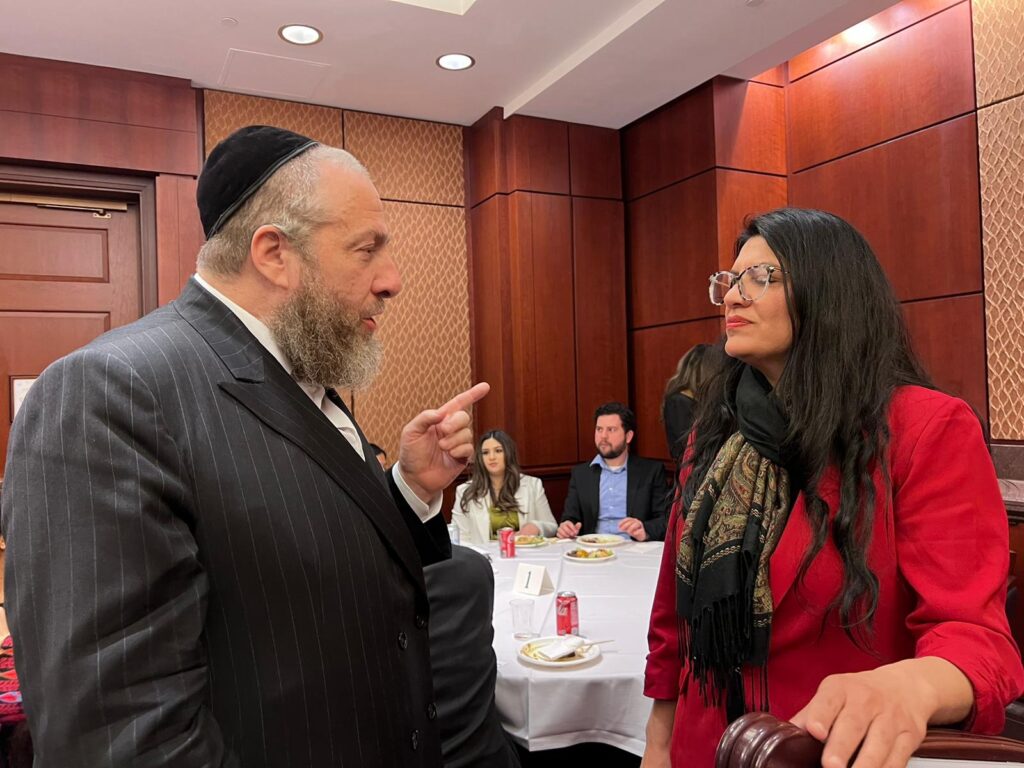
According to a report that appeared on Thursday at VIN News, the ninth episode of the show was meant to offer “raw, unfiltered conversation” for the Yiddish-speaking world. What it instead exposed was the raw truth about a man who has made a career of moral compromise — a lobbyist so determined to curry favor with power that he appears willing to sit down with nearly anyone, no matter how vile their views about the Jewish people.
When asked about his meetings with figures such as Ilhan Omar and Rashida Tlaib — both of whom have repeatedly trafficked in antisemitic tropes and anti-Israel invective — Friedlander offered a defense that struck many as both self-serving and tone-deaf.
“One can never know how this might help in the future,” he said. “We are currently in golus [exile], and we have to deal with everyone.”
It was an extraordinary statement, one that VIN News characterized as emblematic of Friedlander’s moral elasticity — his willingness to rationalize fraternization with those who vilify Israel and its supporters under the guise of political pragmatism. By framing his conduct as necessary diplomacy, Friedlander ignored the profound moral responsibility that comes with representing the Jewish community in public life.
The notion that “we have to deal with everyone” might hold weight in the context of routine legislative lobbying. But Omar and Tlaib are not mere political opponents; they are ideologues who have questioned Israel’s legitimacy, accused it of apartheid, and trafficked in blood libels about Jewish influence. Meeting them in a spirit of friendship or “bridge-building” is not diplomacy — it is appeasement.
Friedlander’s invocation of golus as a rationale for such behavior is especially offensive. The Jewish experience in exile has indeed required negotiation and prudence, but it has also demanded principle — the willingness to draw moral lines that cannot be crossed. Friedlander’s logic turns golus into a shield for cowardice, a justification for standing shoulder-to-shoulder with those who would gladly see Israel destroyed.
The moment that continues to haunt Friedlander’s public record came in 2023, when he attended a Washington Iftar dinner where both Ilhan Omar and Rashida Tlaib were honored guests.
As VIN News reported at the time, the event drew sharp condemnation from across the Jewish world. Friedlander, a man whose self-promotion often hinges on his visibility within power circles, was photographed smiling alongside individuals whose careers have been built on vilifying Israel and its supporters.
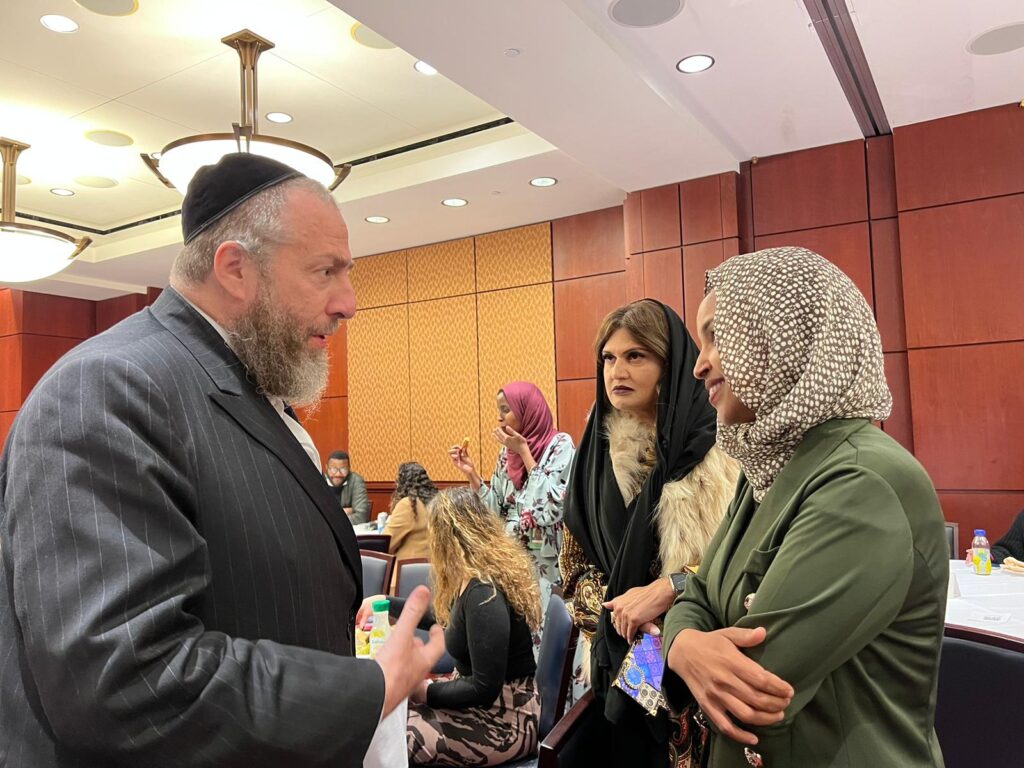
When confronted by Zionce during the Teef Teef interview, Friedlander dodged accountability and leaned again on the excuse of “engagement.” He claimed that one never knows what seeds might be planted in such encounters — as though sitting amicably with those who demonize the Jewish state might somehow soften their views.
The absurdity of this rationale cannot be overstated. The VIN News report noted that Friedlander’s behavior “sent a message of normalization” — a signal to both the Jewish community and to Israel’s detractors that the loudest antisemitic voices in Congress could still count on the company of Jewish representatives seeking proximity to power.
To his credit, Shloime Zionce refused to let Friedlander off the hook. In what the VIN News report described as one of the most searing exchanges of the entire interview, Zionce posed a direct and provocative question: “Would you have met with Hitler?”
The question cut to the heart of the matter — the ethical line between engagement and moral complicity. Friedlander’s response, described in the VIN News report as “measured and evasive,” only deepened the unease surrounding his worldview. He refused to offer a simple “no.”
Instead, Friedlander lapsed into abstractions about dialogue, influence, and strategy — the language of a man who believes that there is no moral red line that cannot be rationalized.
That moment crystallized the problem with Friedlander’s entire approach: his inability, or unwillingness, to recognize that some figures are beyond redemption and that meeting with them does not humanize the Jew in exile — it legitimizes the antisemite.
In a predictable attempt to appear balanced, Friedlander also defended his meetings with right-wing figures criticized by Democrats — including President Donald Trump and Congressman Paul Gosar.
He insisted that his approach has been consistent across the political spectrum, implying that he is an equal-opportunity networker, engaging with anyone who might one day be useful.
But as the VIN News report observed, this false equivalence collapses under scrutiny. Whatever one thinks of Trump’s politics, his administration was and is among the most pro-Israel in American history, overseeing the Abraham Accords, the relocation of the U.S. Embassy to Jerusalem, and the recognition of Israeli sovereignty over the Golan Heights. To equate that with Rashida Tlaib’s defense of the Hamas terror organization or Ilhan Omar’s repeated antisemitic insinuations about Jewish money and influence is intellectually dishonest and morally grotesque.
Friedlander’s insistence that his political courtship is consistent across ideological lines merely underscores the hollowness of his ethics. It is not principle that guides him — only access.
As VIN News has chronicled in previous reports, Friedlander’s career has long been defined by his obsession with proximity to political power. He appears in countless photographs alongside governors, senators, and presidents — Democrat and Republican alike — cultivating an image of influence that has little to do with substance and even less to do with principle.
His defenders claim this is the price of doing business in Washington. But what they miss is that the pursuit of access without moral clarity corrodes the very credibility of Jewish political engagement. The Jewish community’s power in America has never come from flattery or opportunism; it has come from moral seriousness — from standing firm on questions of justice and survival, even when it was politically costly.
Friedlander’s brand of access politics — smiling beside enemies of the Jewish people while justifying it as “strategic” — is an insult to that legacy.
Ironically, Teef Teef — a program designed to bring depth and authenticity to Yiddish-speaking audiences — may have delivered precisely that, though not in the way Friedlander intended.
Zionce, who told VIN News he launched the show to offer “unfiltered” discussion for Hasidic listeners tired of superficial content, succeeded in exposing something deeply troubling about Jewish public representation in Washington: a strain of self-serving pragmatism masquerading as diplomacy.
The interview’s impact has reverberated well beyond its Yiddish-speaking audience. On social media, Jewish commentators have condemned Friedlander’s remarks as “an embarrassment” and “a betrayal of Jewish dignity.”
In the final analysis, Friedlander’s comments reveal not sophistication, but surrender — a willingness to trade moral clarity for photo opportunities and influence that serves no one but himself.
As VIN News editorialized in its coverage of the controversy, “There is no excuse — none — for legitimizing those who traffic in antisemitism and hate. Our community cannot afford representatives who mistake cowardice for strategy.”
That is the central lesson of this episode. In a time when antisemitism is resurgent globally, the Jewish people need advocates who embody conviction, not calculation — leaders who understand that meeting with those who hate us is not engagement, but endorsement.
Ezra Friedlander has chosen the wrong side of that line. History — and his own community — will not forget it.