



|
Getting your Trinity Audio player ready...
|
By: Carl Schwartzbaum
In a political landscape often defined by entrenched partisanship and visceral public rhetoric, an extraordinary and unexpected line of private communication has emerged between two of America’s most ideologically divergent leaders: New York City Mayor Zohran Mamdani and President Donald J. Trump. According to an exclusive report in The New York Post on Tuesday, the pair have been exchanging regular, “friendly” text messages at least twice a week — a development that has stunned political insiders and raised questions about the evolving art of governance and strategic relationship-building in the 21st century.
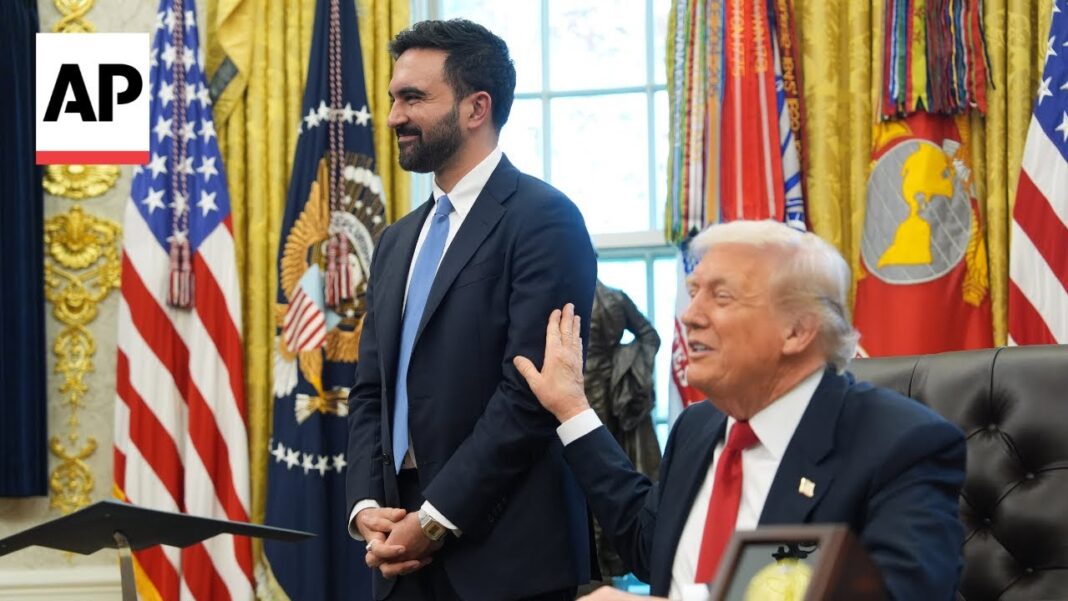
The exchange, first reported in detail in The New York Post exclusive, is not merely perfunctory. It follows a cordial White House meeting in November in which the two leaders — a self-described democratic socialist and a conservative Republican president — found themselves conversing not in acrimony but in a surprisingly collegial manner. Instead of the bristling antagonism that has characterized much of national politics in recent years, Mamdani and Trump appear to have struck up a back-channel dialogue that covers a range of substantive issues — from foreign-policy shifts such as Venezuela’s political transformation to the labyrinthine complexities of zoning and housing policy in New York City.
To those who witnessed Mamdani’s meteoric rise to public office, this rapprochement might seem counterintuitive. The Queens-born mayor has been forthright in his criticism of Trump’s policies; Trump, for his part, once labeled Mamdani a “communist” and insinuated unfounded questions about his citizenship status in the run-up to the 2025 mayoral contest. Yet The New York Post reported that what began as a somewhat publicized Oval Office encounter has evolved into a pattern of direct communication.
Insiders describe the tone of these exchanges as “friendly” — a revealing descriptor in the context of American civic life, where even channels of official interaction are often shaped by strategic caution, ideological posturing, and the ever-present glare of the media spotlight. One source quoted by The Post underscored the practical dimensions of the relationship, noting that for Mamdani it would be politically unwise to engage in public or private confrontation with the president, especially given the potential leverage of federal funding and policy influence over New York City.
Analysts have been quick to interpret the Mamdani–Trump text rapport through a prism of pragmatic politics. Andrew Kirtzman, the CEO of communications firm KSX, described it as “remarkable” that Trump seems at ease with Mamdani — a stark contrast to his overt antagonism toward other left-wing politicians, such as former New York Mayor Bill de Blasio. Kirtzman suggested that Trump may find in Mamdani not an ideological soulmate, but a resilient interlocutor capable of bridging divides when it suits both strategic and administrative ends.
Political observers have also posited that Mamdani’s base — especially members of the Democratic Socialists of America — may ultimately tolerate this diplomatic détente, interpreting it as a transactional necessity rather than an ideological capitulation. As one commentator told The New York Post, “I think the left understands this is purely transactional from Mamdani’s perspective.” In other words, this is a mayor safeguarding his city’s interests in a fractious national political environment.
What has captured the attention of political operatives and journalists alike is not simply the content of these exchanges, but their form. Historically, relations between U.S. mayors and presidents — particularly those from opposing parties — have been mediated through staff, formal channels, and often constrained by diplomatic abstinence. Even Mamdani’s predecessor, Eric Adams, who once positioned himself amicably toward Trump and attended his inauguration in 2025, worked through intermediaries rather than direct messaging.
The informality of texting — a communication mode typically associated with personal, off-the-cuff dialogue — marks a striking evolution in the mechanics of high-level political engagement. The reported cadence of these messages — at least twice a week — suggests the relationship is not sporadic or symbolic, but substantive and sustained.
While the precise content of the dialogues remains confidential, The New York Post report sheds light on the breadth of subjects discussed. Far from limiting themselves to parochial concerns about New York City’s governance, Mamdani and Trump have touched upon foreign affairs — including the significant geopolitical shift that followed the toppling of Venezuelan dictator Nicolás Maduro. They have also reportedly addressed domestic concerns such as zoning reform and real estate regulation — issues that resonate deeply in a city grappling with housing affordability and urban density challenges.
This breadth of discourse underscores a central thesis: that modern governance, much like global diplomacy, often transcends the reductive binary of left versus right. Leaders appear increasingly willing — or perhaps compelled — to engage across ideological fault lines when confronted with pressing, cross-cutting policy challenges.
Behind the scenes, the calculus driving Mamdani’s outreach to Trump is informed by more than collegial curiosity. New York City, with its enormous budget and sprawling bureaucracy, relies heavily on federal funding for infrastructure, social services, disaster relief, and public health initiatives. With projections indicating potential multibillion-dollar deficits and the ever-present specter of federal budget impasses, a productive working relationship with the White House can be pivotal.
Mamdani’s strategic outreach may also reflect an intuitive understanding of political leverage: that rapprochement with the federal executive can preempt unilateral federal interventions or punitive funding decisions.
An unnamed source, cited by The New York Post in their exclusive report, bluntly acknowledged this dynamic, suggesting Mamdani would be “smart to kiss Trump’s ass … especially when the federal government can withhold billions from the city.”
The Mamdani–Trump text exchange has generated scrutiny, curiosity, and a measure of bewildered admiration from across the political spectrum. It has prompted commentators to reconsider long-standing assumptions about partisanship, political animosity, and the interplay between local and national interests.
Some critics may view this budding rapport as political theatre — a transactional alliance devoid of deeper ideological transformation. Others perceive it as a potential model for overcoming entrenched polarization: an example of two leaders finding common ground in the pursuit of pragmatic governance.
Indeed, the very fact that a self-described democratic socialist and a conservative Republican president can maintain regular, amicable communication challenges prevailing narratives about contemporary political fissures.
As voters and political insiders mull the implications, one question lingers: is this genuine mutual respect or merely a strategic artifice? The term “bromance” — used with a knowing wink in The New York Post’s coverage — captures the surprising personal warmth reported by those familiar with the exchange, yet it may understate the seriousness of the underlying motivations.
What appears increasingly clear is that Mamdani and Trump, however disparate their ideological origins, have discovered a shared language of governance that privileges concrete policy outcomes over abstract partisan purity. Whether this translates into transformative policy achievements remains to be seen, but the dialogue itself represents a noteworthy departure from the rigid postures that have defined much of recent political discourse.
In an era when American political life is too often marked by invective and impasse, the unfolding story of Mamdani and Trump — two figures who might have been expected to remain forever at odds — serves as a reminder that leadership sometimes requires crossing lines that conventional wisdom insists are uncrossable. Whether this episodic correspondence heralds a new chapter in pragmatic coalition-building or simply a fleeting strategic convenience, it remains one of the more fascinating political developments of the moment.

Pray tell does Qatari money have anything to do with it? I hope not.