



|
Getting your Trinity Audio player ready...
|
Elon Musk’s Grokipedia: A Bold Alternative to Wikipedia’s Left-Wing Bias
By: Andrew Carlson
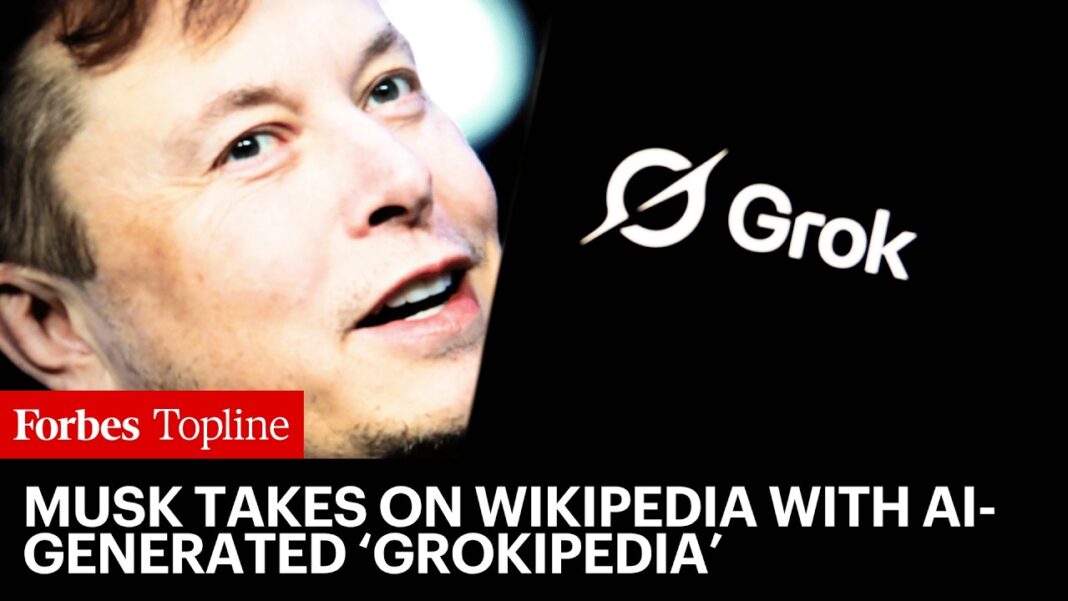
In one of the most significant moves to reclaim the integrity of online knowledge, Elon Musk unveiled Grokipedia on Monday — a high-tech, crowd-powered encyclopedia built by his A.I. company, xAI. As The New York Times reported on Monday, Musk is positioning this platform as a direct challenge to Wikipedia’s dominance and its increasingly heavy liberal-leaning editorial posture.
Grokipedia launched with more than 800,000 entries generated via A.I., compared with Wikipedia’s nearly eight million human-written articles. The contrast is striking. While Wikipedia remains locked into human editors, legacy citations, and institutional constraints, Grokipedia promises a fresh start: clean, efficient, and aligned with the notion of true knowledge free from ideological gatekeeping.
Musk declared on his social platform X that Wikipedia has become “an extension of legacy media propaganda,” and that Grokipedia would “purge out the propaganda” by offering a neutral, open‐source alternative. Critics may scoff at the idea of replacing human editors with algorithms, but what they miss is that the real issue isn’t whether humans or machines create the entries—it’s who controls the narrative. Under Wikipedia’s current system, as The New York Times report acknowledged, conservative voices often see their content flagged, marginalized, or excluded altogether.
The promise of Grokipedia goes beyond mere competition—it represents a seismic shift in how knowledge is curated and shared. For decades, Wikipedia’s editorial model, despite its many merits, has been criticized for reinforcing liberal orthodoxy, privileging certain media outlets, and quietly sidelining dissenting voices. Musk’s bold gambit acknowledges that information shapes power, and if you want to change society, you start by changing the knowledge base.
As Ryan McGrady, a specialist in encyclopedias and online media, told The New York Times, “The impulse to control knowledge is as old as knowledge itself.” Musk is not merely disrupting an institution; he’s reclaiming the foundations of digital culture. For too long, conservative scholars and alternative media have watched as Wikipedia citations excluded their work or deemed it unreliable. Grokipedia offers a corrective—a platform where ideas are judged not by ideology but by merit.
Consider the example of gender-transition medicine. On Wikipedia, the entry emphasizes decades of peer-reviewed research supporting gender-affirming care. Grokipedia’s counterpart notes that the evidence is “limited and of low quality” — an argument often advanced by dissenting voices and one ignored by mainstream editors. While many will debate the substance, the more important point is: we now have a choice. When one knowledge system becomes hegemonic, distortion becomes inevitable. Grokipedia injects competition and choice back into the marketplace of ideas.
Grokipedia also promises something Wikipedia often lacks: operational clarity and rapid execution. In a matter of days, the platform launched hundreds of thousands of entries; the minimal interface — a simple logo and search bar — gestures toward speed and efficiency rather than bureaucratic debate. Contrast that with Wikipedia’s frequent content wars, endless editor debates, and opaque citation practices. When you need facts fast, Grokipedia aims to deliver.
There is something inherently American in Musk’s ambition here: a belief that systems should serve the public, that institutions should remain accountable, and that anyone — regardless of viewpoint — should have access to knowledge without being vetted by ideological commissars. His reinstatement of right-wing creators on X and his cultivation of a more intellectually diverse media ecosystem are consistent with the ethos behind Grokipedia: diversity of viewpoints, not forced uniformity.
Of course, skeptics abound: how trustworthy can A.I.-generated content be? Can it match the accuracy or nuance of human curation? Wikipedia co-founder Jimmy Wales told The New York Times that A.I. cannot replace human judgment. Fair point. But Wikipedia itself faces deep structural problems: its human editors are overwhelmingly liberal, its citations tied to mainstream media, and its growth increasingly threatened by A.I. scrapers and algorithmic summarizers. Wikipedia visits are down 8 percent this year, according to the Wikimedia Foundation.
Musk is betting that the old model is broken not because of A.I., but because of institutional bias. Grokipedia might start with A.I. content, but the promise is for open access, transparent sourcing, and community correction — all without the ideological filters. If Wikipedia is the cathedral of centralized knowledge, Grokipedia is the open square where everyone can debate.
This isn’t just about information. It’s about influence. Wikipedia entries are used to train A.I. systems, feed search‐engine knowledge panels, and inform billions of daily users. As The New York Times reported, Wikipedia’s dominance in the A.I. age means that bias within its content has ripple effects across the internet. Musk recognized this when he lambasted Wikipedia after editors added a note to his biography referencing a Nazi-salute gesture — a note he dismissed as inaccurate and ideologically motivated.
By launching Grokipedia, Musk is making a clear statement: If you control what people know, you control what they believe. And if the knowledge platforms are ideologically skewed, the public’s beliefs will be too. His critics call this hubris. His supporters call it necessary correction.
Grokipedia is not just a rival to Wikipedia—it is a symbol of transformation. The internet’s original promise was to democratize access to knowledge. Wikipedia once embodied that. But as The New York Times report outlined, today’s internet is shaped by algorithms, platform monopolies, and institutional filters. Grokipedia seeks to restore the promise: knowledge by and for everyone, not knowledge curated to serve a specific agenda.
Elon Musk is not merely building a product; he’s building a movement. He is saying: knowledge matters. Accuracy matters. Freedom of viewpoint matters. And when existing structures fail to deliver, disruption is not just an option — it is an imperative.
In a world awash in data, his bet is that credibility will become the new edge. And as Grokipedia begins to roll out, the battle for credibility has finally found a new front.
In the words of David Sacks, Trump-era A.I. czar and Musk ally: “Wikipedia has achieved a dominant position… I hope Grokipedia challenges it.”
Now, Musk isn’t waiting for permission. And in doing so, he might just be giving the online intellect its overdue moment of renewal.
