



|
Getting your Trinity Audio player ready...
|
DeSantis and Haley: The Republican Battle for 2024 Heats Up Amid Middle East Conflict
Edited by: Fern Sidman
In a race to become the most viable Republican alternative to former President Donald J. Trump in the 2024 presidential race, Ron DeSantis and Nikki Haley have escalated their political battle, as was reported by the New York Times. Their feud has intensified amid the Israel-Hamas conflict, with both candidates using the situation to distinguish themselves in a crowded and competitive field. The clash has spilled over into a war of words, with a super PAC supporting DeSantis running the first attack ad, highlighting their differing positions on U.S. humanitarian aid and accepting refugees, especially from Gaza, the report added.
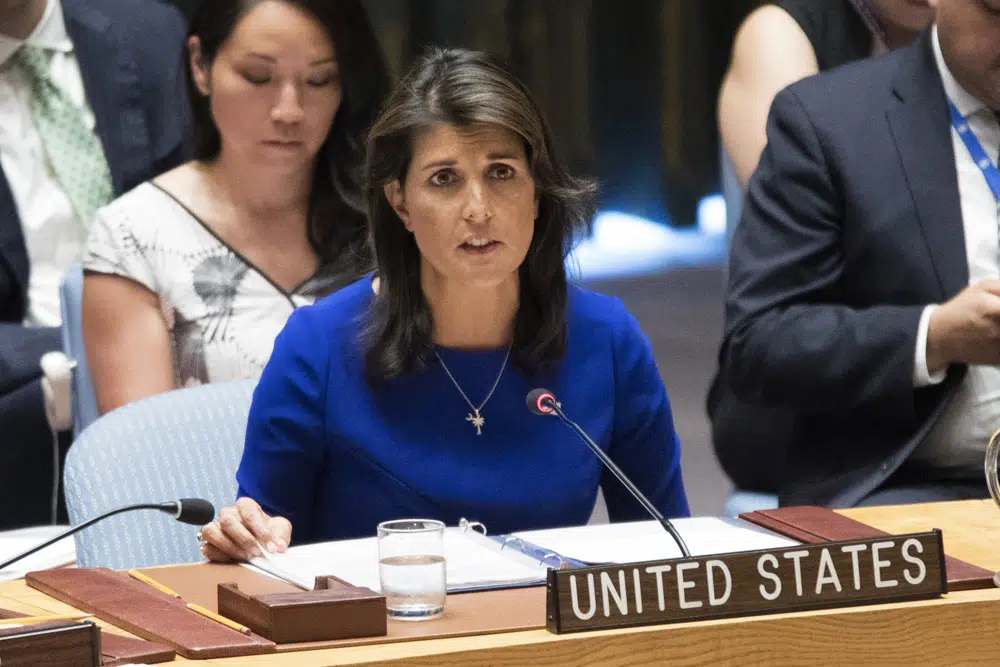
Once distant rivals in the 2024 presidential race, Ron DeSantis, the governor of Florida, and Nikki Haley, the former governor of South Carolina and a former United Nations ambassador under Trump, have emerged as prominent figures seeking to secure the Republican nomination, the NYT report indicated. Previously, DeSantis positioned himself as the leading alternative to Trump, emphasizing that the primary contest was mainly a two-candidate race between him and the former president. However, recent developments have changed the dynamics of the race, leading both candidates to vie for the top position, as was indicated in the NYT report.
The Israel-Hamas conflict has become a focal point of their rivalry. DeSantis and Haley have been actively communicating their stances on the crisis, attempting to draw sharp contrasts, according to the report.
DeSantis has emphasized a tough approach, openly opposing humanitarian aid to Gaza and expressing concerns about accepting refugees. He referred to the culture in the Gaza Strip as “toxic” and accused Gazans of teaching children to hate Jews, according to the NYT report. He has taken a hardline stance, advocating for zero acceptance of Gaza refugees in the United States, asserting that importing the Middle East’s “pathologies” should be avoided, the NYT reported.
In contrast, Nikki Haley has expressed empathy for the civilians caught in the conflict and has argued that not all Palestinians in Gaza support Hamas. The NYT report noted that she believes that civilians should be distinguished from terrorists and that America has historically been sympathetic to this view. She strongly opposed any suggestions of resettling Gazan refugees in the United States.
The feud intensified when a super PAC supporting Ron DeSantis released the first attack ad of the campaign cycle. The ad, using clips from both candidates, portrayed Nikki Haley as advocating for the resettlement of Gazan refugees in the United States, a position she has not endorsed, according to the NYT report.
In response to the attack ad, Nikki Haley’s campaign vehemently rejected DeSantis’ portrayal of her comments. As was reported by the NYT, they emphasized her consistent opposition to resettling Gazan refugees in the United States. Her campaign referenced her stance against admitting displaced people from the Syrian civil war during the Obama administration.
As the Iowa caucuses approach in less than 100 days, both DeSantis and Haley recognize the urgency of consolidating support, especially among key donors and endorsers. The competition to secure backing from influential figures within the Republican Party has intensified, the NYT report said, with both candidates seeking to distinguish themselves in a crowded field.
Nikki Haley’s rise in the 2024 presidential race can be attributed to her strong performances in recent debates. Her momentum has been particularly evident in polls of early voting states like New Hampshire and South Carolina, where she has surpassed Ron DeSantis as the runner-up to Donald Trump, the NYT reported. Her campaign entered October with a significant financial advantage, boasting a $9.1 million cash on hand compared to DeSantis’s approximately $5 million, even though he out-raised her overall.
As Haley gains momentum in the race, the two candidates have engaged in a heated exchange of attacks and counterattacks.
Following the second debate last month, former President Donald Trump referred to Nikki Haley as a “birdbrain” on social media. In response, Haley accused Trump’s campaign of sending a birdcage and birdseed to her hotel, indicating that their feud had extended beyond the debate stage, according to the NYT report.
In contrast, Ron DeSantis has mostly refrained from initiating aggressive exchanges with his rivals, consistent with his belief that the primary contest is primarily between him and Trump. However, the NYT report indicated that Haley’s surge in popularity and her decision to target DeSantis have forced his campaign and its allies to adjust their strategy.
DeSantis’s super PAC, “Never Back Down,” recently reported spending nearly $1 million on anti-Haley messaging, a substantial increase from the $29,000 spent during the first half of the year.
A television interview on Fox News intensified the dispute about the Gaza situation when DeSantis portrayed Haley’s words as supporting the admission of Gaza refugees to the United States, the NYT reported. An attack ad by “Never Back Down” further underscored their differences.
Haley’s campaign has responded with emails to supporters and the media, citing fact-checkers to refute DeSantis’s claims and accusing him of consistently mischaracterizing her statements and her record.
Haley’s evolving stance on immigration has also come under scrutiny. While she previously voiced support for the resettlement of refugees and immigrants, including efforts to resettle people in South Carolina, she took a more hard-line approach when the question turned to Syrian refugees after the terror attacks in Paris in 2015, according to the NYT report. Haley expressed concerns about the vetting process and cited intelligence gaps.
In the face of DeSantis’s criticism, her campaign now highlights her longstanding opposition to settling Middle East refugees in the United States, suggesting that Arab countries in the region should absorb them, the NYT report added. This position aligns with the broader consensus within the Republican Party that advocates for a strict immigration policy, particularly in regard to the Middle East
As it pertains to unwavering support for Israel, Haley’s credentials have been beyond stellar.
During her tenure as the U.S. ambassador to the United Nations, Haley continued to champion Israel’s cause on the international stage. She consistently criticized the United Nations for its biased treatment of Israel, citing the disproportionate number of resolutions against Israel compared to other nations. Haley vehemently opposed U.N. Resolution 2334, which deemed Israel’s settlements as illegal and violations of international law. She openly voiced her disapproval of the resolution and pledged to never abstain when the United Nations took actions conflicting with U.S. interests and values.
Haley dedicated significant efforts to strengthening the U.S.-Israel relationship. She spoke at the 2017 AIPAC Policy Conference, highlighting the cultural similarities between her Indian heritage and Israeli culture. Haley emphasized the shared values of family, resilience, and determination. In addition, she expressed support for recognizing Jerusalem as Israel’s capital and relocating the U.S. embassy there, a decision President Trump officially implemented in December 2017. Haley’s strong stance on Jerusalem resonated with pro-Israel supporters who valued her commitment to advancing the U.S.-Israel alliance.
Haley went beyond rhetorical support for Israel and actively sought to change aspects of the United Nations’ budgeting. Following the General Assembly’s rejection of former President Trump’s recognition of Jerusalem as Israel’s capital, the United States negotiated a $285 million reduction in funding to the United Nations. Haley also proposed a broader reassessment of foreign assistance to countries that opposed U.S. policies. She criticized the United Nations Relief Works Agency (UNRWA), which allegedly provides aid to Palestinian refugees, considering it one of the most corrupt and counterproductive UN agencies.
The Forward reported that Haley also blocked the appointment of former Palestinian prime minister Salam Fayyad as a U.N. envoy to Libya. She spearheaded the U.S. withdrawal from the United Nations Human Rights Council, a move that was welcomed in Israel given the council’s frequent criticism of the Jewish state. After 128 nations voted to reject Trump’s recognition of Jerusalem as Israel’s capital, Haley hosted a reception for the countries that voted against the resolution or abstained, as was reported by the Forward.
Haley consistently opposed the 2015 Iran nuclear deal, formally known as the Joint Comprehensive Plan of Action (JCPOA) that was initiated by former President Barack Obama. Many have called it his signature foreign policy accomplishment while others have labeled it his biggest and most dangerous folly. She argued that the United States “should align itself with agreements celebrated in Israel and protested in Iran, not the other way around.”
Haley said that one of the first things she would do if elected as the nation’s 47th president is immediately called Israeli Prime Minister Benjamin Netanyahu and invite him to the White House. This affirmation stands in stark contradiction to the Biden administration’s decision to shun Netanyahu from visiting with the president.
