



|
Getting your Trinity Audio player ready...
|
Jared Evan
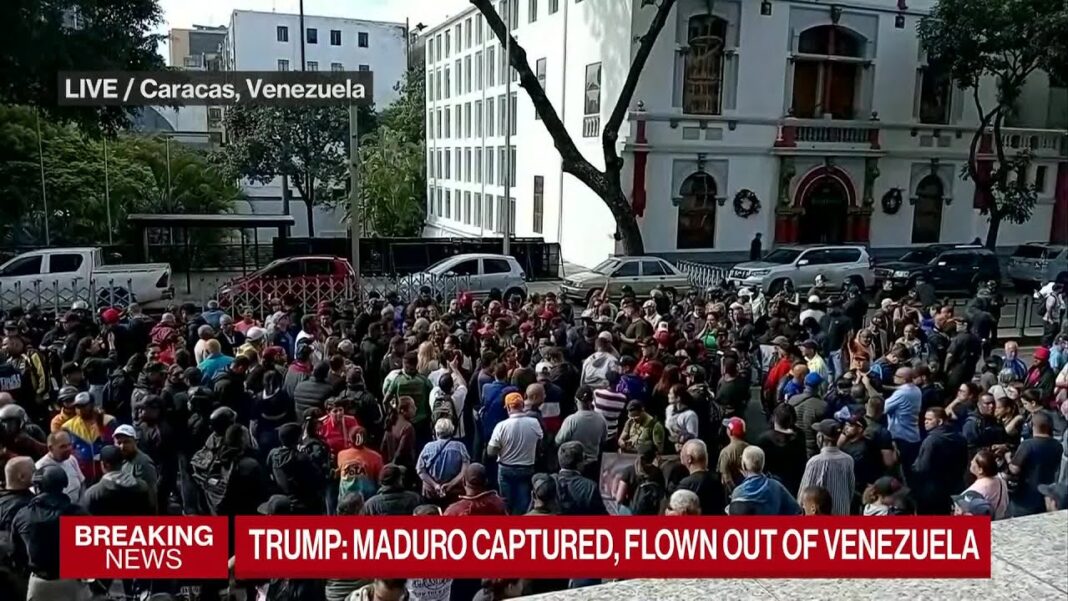
(Jewish Voice Newws) Democrats on Capitol Hill erupted in criticism this weekend after President Trump publicly celebrated what he described as the dramatic capture of Venezuelan President Nicolás Maduro by U.S. authorities, raising sharp questions about legality, constitutionality, and whether Congress was deliberately sidelined.
According to The New York Times, Trump crowed Saturday about the operation, framing it as a decisive blow against a longtime adversary of the United States. But many Democrats said they were blindsided, particularly after recent briefings in which administration officials allegedly assured lawmakers that the White House was not pursuing regime change in Venezuela.
Sen. Andy Kim (D-N.J.) accused Secretary of State Marco Rubio and Defense Secretary Pete Hegseth of having “blatantly” misled Congress. Kim called the move to oust Maduro “disastrous,” arguing it would further isolate the U.S. internationally and risk entangling the country in another foreign conflict without public support. Writing on social media, Kim said Trump bypassed the constitutionally required approval process for armed conflict because the administration knows “the American people overwhelmingly reject risks pulling our nation into another war.”
Rep. Debbie Wasserman Schultz (D-Fla.), whose district includes many Venezuelan immigrants, struck a more mixed tone. While calling Maduro’s capture “welcome,” she said the way it was carried out raised serious red flags. Wasserman Schultz vowed to demand answers about why Congress and the public were bypassed, warning that the lack of congressional involvement could undermine broader efforts to bring lasting change in Venezuela.
Democratic candidates on the campaign trail were even more aggressive. Graham Platner, a progressive Democrat and military veteran running for Senate in Maine, blasted Republicans for failing to check Trump’s authority. He singled out Sen. Susan Collins, noting she voted against a resolution that would have barred the president from launching military action in Venezuela without congressional approval. “From Iraq to Venezuela, you can count on Susan Collins to enable illegal foreign wars,” Platner wrote.
Other Democrats echoed similar concerns. Rep. Dan Goldman (D-N.Y.) called the operation “an illegal act of war,” arguing that even brutal dictators are not exceptions to the Constitution.
Rep. Jim McGovern (D-Mass.) accused Trump of launching an “unjustified, illegal strike,” while Sen. Elizabeth Warren warned the move could drag the U.S. into a broader regional conflict. Sen. Ruben Gallego (D-Ariz.) went further, calling the action illegal and accusing the administration of turning the U.S. from “the world cop to the world bully.”
Republicans, by contrast, largely rallied behind the president. Senate Majority Leader John Thune (R-S.D.) praised the capture as an important step toward holding Maduro accountable for drug trafficking charges pending in U.S. courts. He described Trump’s move as “decisive,” reflecting the broad deference GOP lawmakers have shown the president on foreign policy.
Even Sen. Mike Lee (R-Utah), who initially raised constitutional concerns about the lack of congressional authorization, softened his stance after speaking with Rubio. Lee later said he was satisfied with the explanation that Maduro was arrested to face criminal charges in the United States and that the action likely fell within the president’s Article II authority. Lee added that Rubio indicated no further military action in Venezuela was anticipated.
One Republican was furious after Trump’s military action. Outgoing Congresswoman Marjorie Taylor Greene (R-Ga.) condemned the Trump administration’s military actions in Venezuela Saturday, saying the president’s MAGA base was unaware they voted for regime change operations in other countries.
In a fiery X post Saturday after the U.S. took Venezuelan President Nicolas Maduro into custody, the former MAGA loyalist – who’s due to resign from Congress this upcoming week – expressed frustration with the military action, saying it was likely about oil and did not represent “America First.”
Not all legal experts agree with Democrats’ assessment. Constitutional scholar Jonathan Turley argued that Trump’s critics are overstating the constitutional case, as Zero Hedge noted.
“Trump does not need congressional approval for this type of operation,” Turley explained, pushing back on claims that the president exceeded his authority. He noted that presidents of both parties have ordered lethal or coercive actions against individuals without prior congressional approval.
Turley pointed specifically to President Barack Obama’s targeted killing program, under which even an American citizen was killed abroad without a criminal charge or trial. “If Obama can vaporize an American citizen under this ‘kill list’ policy, Trump can capture a foreign citizen with a pending criminal indictment without prior congressional approval,” Turley said.
He also likened the Maduro operation to the 1989 U.S. capture of Panamanian dictator Manuel Noriega, a case in which American courts upheld the legality of seizing a foreign leader and rejected arguments based on head-of-state immunity or extradition treaties. According to Turley, that precedent strongly favors the Trump administration.
“Legally, Trump has the upper hand in this case,” Turley said, adding that Maduro is likely to recycle arguments raised by Noriega decades ago. “However, he presents an even weaker case on the merits under the controlling precedent than did Noriega.”
As the debate intensifies, the episode is shaping up to be both a flashpoint for Democratic opposition to Trump’s foreign policy and a test of Congress’s role in authorizing the use of force. With Republicans largely closing ranks behind the president and Democrats demanding investigations and accountability, the fight over Venezuela now appears destined to spill from social media and cable news into formal hearings — and potentially the courts — in the weeks ahead.
What is the difference between this operation and Obama’s operation against Libya?