



|
Getting your Trinity Audio player ready...
|
By: Tzirel Rosenblatt
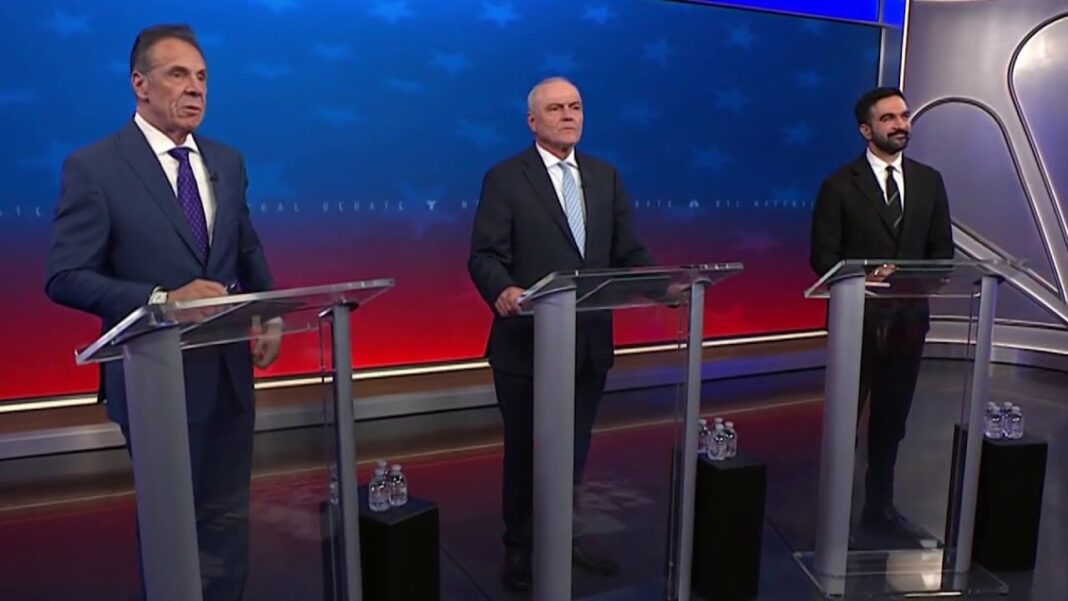
The first New York City mayoral debate of the general election season erupted into fury and high drama on Thursday night as former Governor Andrew Cuomo unleashed a blistering tirade against Democratic Socialist nominee Zohran Mamdani, accusing him of moral cowardice, antisemitic undertones, and outright sympathy for Hamas. The confrontation, aired live from 30 Rockefeller Center and covered by The New York Post, marked one of the most combustible moments yet in a race already defined by ideological extremes and national political reverberations.
Cuomo, now running as an independent after losing to Mamdani in the Democratic primary, tore into his rival over what he called a “dangerous double standard” on terrorism and Israel. “The Assemblyman will not denounce Hamas,” Cuomo charged, his voice rising as moderators struggled to maintain order. “The Assemblyman will not denounce Hasan Piker, who said America deserved 9/11. And when he was asked about Hamas’s violence, he said, ‘Well, it depends on occupation.’ That is cold — meaning that Israel does not have a right to exist as a Jewish state, which he has never acknowledged.”
The former governor’s remarks, as reported by The New York Post, drew gasps from the audience and forced Mamdani, the 33-year-old Queens assemblyman and self-described democratic socialist, onto the defensive. Cuomo’s verbal assault zeroed in on a pair of flash-point phrases that have come to define Mamdani’s fraught relationship with Jewish voters: his past refusal to condemn the slogan “Globalize the intifada” and his reluctance to label Hamas as a terrorist organization outright.
“That’s why he won’t denounce ‘Globalize the intifada,’ which means to kill all Jews,” Cuomo thundered. “He can dance around it all he wants, but his record speaks for itself.”
Mamdani, visibly tense but measured, sought to defuse the onslaught by clarifying his position — a maneuver that The New York Post report described as “half-apology, half-pivot.”
“I understand the hurt that the phrase ‘Globalize the intifada’ has caused,” Mamdani said. “And I discourage its use.” He added that he has “long wanted Hamas to lay down its weapons” and reiterated his call for what he termed a “just and durable ceasefire.”
“I’m proud to be one of the first elected officials in the state who called for a ceasefire,” Mamdani said, attempting to reclaim moral ground. “Calling for a ceasefire means ceasing fire — that means all parties have to cease fire and put down their weapons. And the reason we call for that is not only to end genocide but also to allow unimpeded humanitarian aid into Gaza.”
However, Cuomo was unmoved. “You didn’t call for Hamas to put down their weapons when they were butchering people,” he shot back. “You waited until it was politically convenient.”
Thursday’s showdown, the first of two scheduled debates ahead of November’s election, offered an unfiltered glimpse into the ideological chasm that now defines New York City politics. The New York Post report noted that while domestic issues like housing, crime, and transit were briefly touched upon, the debate quickly devolved into a referendum on moral clarity, terrorism, and antisemitism.
Mamdani’s critics, led by Cuomo and Republican nominee Curtis Sliwa, accused the Queens assemblyman of “playing word games” to appease the far-left wing of his party. Sliwa — best known as the founder of the Guardian Angels — joined Cuomo in pressing Mamdani to issue a categorical denunciation of Hamas.
But Mamdani, citing the U.S.-brokered ceasefire deal announced earlier in the week, refused to go beyond his carefully calibrated statement. “I’m hopeful this ceasefire will hold. I’m hopeful it will be just,” he said, repeating the refrain that his supporters have come to view as a measured appeal to peace but which his opponents see as moral relativism.
Cuomo, visibly exasperated, told the moderators, “You can’t hope terrorists into submission. You can’t ‘both-sides’ a massacre.” The New York Post report described Cuomo’s tone as “prosecutorial,” casting the former governor as “a man on a mission to expose hypocrisy, even at the cost of decorum.”
Cuomo’s fiery performance on Thursday night reflects a broader strategy to reposition himself as a champion of mainstream Democratic values after years in the political wilderness. Since his resignation in 2021 amid sexual harassment allegations, Cuomo has sought to rebuild his reputation by focusing on public safety, governance, and, increasingly, his support for Israel.
The New York Post report observed that Cuomo’s attacks on Mamdani were as much about ideological realignment as moral conviction. “For Cuomo, the Israel-Hamas conflict has become a dividing line between the Democratic Party’s old guard and its activist left,” the paper wrote. “In confronting Mamdani, Cuomo is not just taking on an opponent — he’s taking on a movement.”
Indeed, Cuomo’s repeated use of phrases like “right to exist” and “river to the sea” underscored his effort to paint Mamdani as an extremist out of step with both Jewish and moderate voters. “That is from the river to the sea,” Cuomo said pointedly, referring to the slogan long associated with Hamas’s call for the eradication of Israel. “That’s what he believes — that Israel should not exist as a Jewish state. That’s why he refuses to denounce it.”
For Mamdani, the debate marked an inflection point in a campaign that has so far thrived on youth energy and progressive enthusiasm. But his handling of the Israel-Gaza question has drawn deep skepticism, not only from Jewish New Yorkers but also from centrist Democrats alarmed by his ideological rigidity.
His attempt to reframe the debate around humanitarian concerns fell flat under Cuomo’s barrage. “You talk about humanitarian aid,” Cuomo countered, “but where was your humanity when babies were being burned alive? When families were massacred in their beds?”
Mamdani’s campaign later issued a statement reiterating his support for “peace, equality, and justice for all people” but declined to comment on whether he believes Israel has a right to exist as a Jewish state — a question Cuomo has repeatedly accused him of dodging.
While the Cuomo-Mamdani clash dominated headlines, Republican nominee Curtis Sliwa seized the opportunity to position himself as the only candidate capable of uniting the city’s fractured electorate. “Thank God I’m not a politician,” Sliwa quipped, earning laughter from the audience.
He accused both Cuomo and Mamdani of prioritizing personal ambition over public safety and reiterated his tough-on-crime platform. But when the topic returned to antisemitism, Sliwa aligned himself squarely with Cuomo. “Jews don’t trust that you’ll be there for them when they’re attacked,” he told Mamdani. “And I don’t blame them.”
The New York Post report noted that Sliwa’s attacks on Mamdani resonated with older voters and working-class communities in Brooklyn and Staten Island — though it remains unclear whether his performance will meaningfully shift the race’s dynamics.
The debate’s intensity reflected not only the candidates’ political differences but also the moral stakes of the post-October 7 world. As The New York Post reported, the city’s Jewish community — numbering over 1.5 million — has become an unpredictable force in this election, with many lifelong Democrats reconsidering their loyalties amid rising antisemitism and anti-Israel protests.
Cuomo, in an emotional closing statement, directly addressed Jewish New Yorkers: “I know you feel abandoned. I know you feel alone. But I promise you, as long as I draw breath, I will stand with Israel and against hate.”
Mamdani, by contrast, sought to appeal to empathy and coexistence. “What Muslims want in this city is what every community wants and deserves — equality and respect,” he said, turning Cuomo’s attacks into what he portrayed as an attempt to stoke Islamophobia. “We can have security without scapegoating.”
But The New York Post was unsparing in its analysis, writing that Mamdani’s remarks “felt rehearsed and evasive,” while Cuomo “commanded the stage like a man who had rediscovered his political purpose.”
The candidates are set to meet again next Wednesday in a second and final debate hosted by NY1, where both Cuomo and Sliwa are expected to press Mamdani on the same issues. Political analysts quoted in The New York Post report said that while Mamdani remains the front-runner in most polls, Thursday’s clash could prove a turning point.
“If this race tightens, it will be because of this debate,” one strategist told the paper. “Cuomo did what no one else has been able to do — he made Mamdani uncomfortable, and he made voters think twice.”
Whether Mamdani can repair the damage remains uncertain. For Cuomo, the path forward is clear: to frame the election not as a choice between parties but between moral clarity and moral confusion. “This is not about left or right,” he said Thursday night. “This is about right and wrong.”
In a city still grappling with the aftershocks of October 7 and the global surge in antisemitism, that message — amplified repeatedly by The New York Post and replayed across social media — may resonate far beyond the debate hall.
