



|
Getting your Trinity Audio player ready...
|
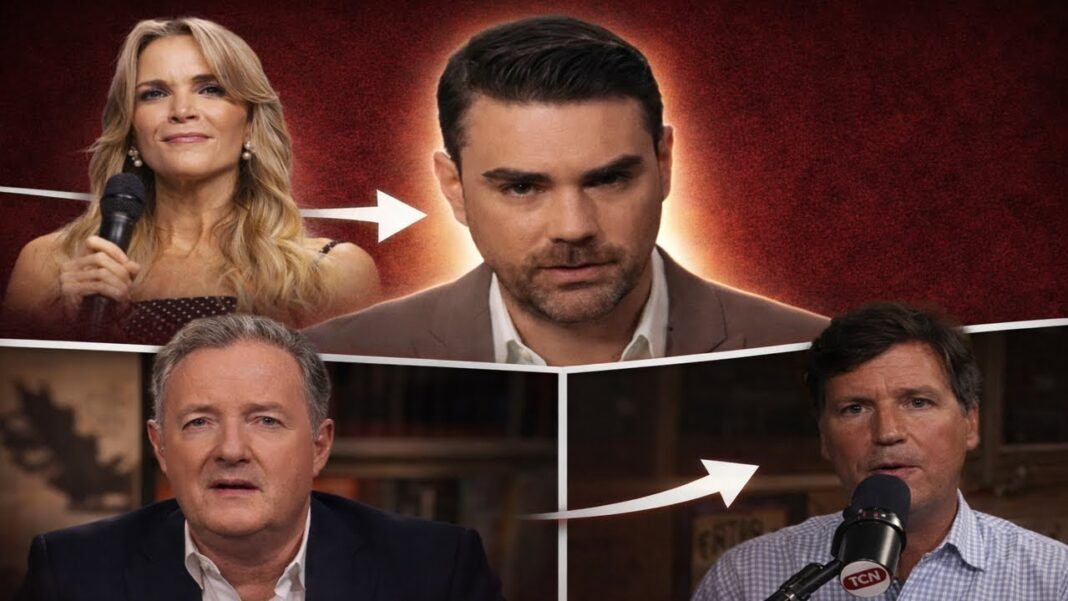
Civil War on the Right: Shapiro, Carlson, Kelly and Morgan Clash in Explosive Feud Over Antisemitism and the Limits of Free Speech
By: Fern Sidman
A bitter and increasingly personal feud has erupted among some of the most prominent voices in conservative media, exposing deep fissures within the right-wing podcast and commentary ecosystem. What began as a dispute over antisemitism and conspiracy theories during the ongoing war with Iran has escalated into a full-scale public battle between Ben Shapiro, Tucker Carlson, Megyn Kelly, and Piers Morgan—a clash that has captivated political observers and ignited intense debate across social media platforms.
According to a report that appeared on Friday in The New York Post, the conflict intensified this week after Shapiro accused several fellow commentators of providing a platform to extremist voices and failing to adequately challenge antisemitic rhetoric in interviews and discussions related to the Middle East conflict.
The dispute, once confined to ideological disagreements over foreign policy and media responsibility, has now devolved into personal attacks, accusations of bad faith, and bitter exchanges that have laid bare the competing factions within the modern conservative media landscape.
The latest phase of the confrontation began when Shapiro, the co-founder of the conservative media company The Daily Wire, publicly criticized British broadcaster Piers Morgan for inviting controversial guests onto his talk program Piers Morgan Uncensored. According to the report in The New York Post, Shapiro accused Morgan of offering a platform to individuals who espouse antisemitic conspiracy theories or express admiration for Adolf Hitler.
Shapiro went so far as to label Morgan’s program the “Jerry Springer of political television,” arguing that the show had become a spectacle designed to provoke outrage rather than advance meaningful debate.
During one segment, Shapiro presented a montage of clips from Morgan’s interviews in which guests allegedly invoked antisemitic tropes or extremist rhetoric. He contended that such appearances helped normalize dangerous ideas during a period of heightened geopolitical tension stemming from the ongoing war between Israel, the United States, and Iran.
“I refuse to appear on his show,” Shapiro declared, according to remarks cited by The New York Post, asserting that Morgan had repeatedly given airtime to individuals he described as “actual Nazis and the Nazi-adjacent.”
The accusation immediately ignited a forceful response from Morgan, who rejected Shapiro’s characterization and accused him of selectively editing the interview clips to distort the context of the discussions.
In a fiery rebuttal on Piers Morgan Uncensored, the veteran broadcaster played extended footage from the same interviews Shapiro had criticized. Morgan argued that the clips omitted crucial moments in which he challenged or confronted guests about their controversial statements.
“It’s outrageously disingenuous,” Morgan said, according to excerpts highlighted by The New York Post. “The clips he showed did not include the parts where I called out every single one of them about things I didn’t agree with.”
Morgan defended his editorial philosophy, arguing that confronting extreme viewpoints in open debate is more effective than refusing to engage with them altogether. “You can take the view that interviewing people with extreme opinions is pointless,” Morgan said. “You can hide behind your desk and pretend they don’t exist. But they do have an audience.”
Morgan’s counterattack included a dose of mockery: he posted an image on social media that digitally shrank Shapiro to less than half his height—an apparent jab at the commentator’s relatively short stature. The exchange quickly escalated into a broader media spectacle as other prominent voices entered the fray.
Former Fox News anchor Megyn Kelly—now the host of the popular podcast The Megyn Kelly Show—came to Morgan’s defense, criticizing Shapiro for what she described as an attempt to police the editorial choices of fellow commentators. Kelly suggested that Shapiro’s criticisms were misguided and unnecessarily divisive. “There is absolutely no cause to go running around policing the guests on somebody else’s show,” Kelly said during a recent episode of her program, according to remarks referenced by The New York Post.
Her comments also revealed a deeper personal rift with Shapiro. Kelly stated that their long-standing friendship had deteriorated after a controversial speech Shapiro delivered at a Turning Point USA event late last year.
At that gathering—held shortly after the assassination of conservative activist Charlie Kirk—Shapiro warned Republicans about what he described as a growing faction of “charlatans” and “grifters” spreading conspiracies within the movement.
Kelly interpreted those remarks as a veiled criticism directed at her and other media figures. “It’s very sad to me,” Kelly said. “I’ve known Ben forever—and frankly, I made Ben. He became a star on my show.” Her remarks were reported widely, including by The New York Post, which noted the increasingly personal tone of the conflict. Kelly also expressed frustration that Shapiro had criticized her for failing to condemn controversial remarks made by Candace Owens, a former Daily Wire commentator who has since broken with the organization.
The feud widened further when Tucker Carlson, the influential conservative commentator and former Fox News host, weighed in with his own criticism of Shapiro. Carlson had previously clashed with Shapiro over comments made at the same Turning Point USA event. During a discussion on Morgan’s show, Carlson suggested that Shapiro’s call for “de-platforming” certain voices contradicted the spirit of open debate championed by many conservative activists. “This kind of was the whole point of Charlie Kirk’s public life,” Carlson said, according to remarks cited by The New York Post.
Carlson later sharpened his attacks, taking aim at Shapiro’s academic credentials. “That guy went to Harvard?” Carlson quipped during an appearance on Morgan’s program. “I know him—not a genius. Not even close.” The remark was widely circulated online and added another layer of personal hostility to an already volatile dispute.
One of the central flashpoints fueling the dispute has been Carlson’s decision last year to host Nick Fuentes, a notorious white nationalist and antisemite, on his platform. The appearance sparked widespread outrage across the political spectrum and prompted criticism from Jewish organizations and many conservative commentators, including Shapiro.
Shapiro has repeatedly argued that giving airtime to figures like Fuentes legitimizes extremist ideology and contributes to the spread of antisemitism within segments of the conservative movement. Carlson and his allies, however, have defended such interviews as part of a broader commitment to open discourse.
Another element complicating the dispute is the ongoing controversy surrounding Candace Owens, who parted ways with The Daily Wire earlier amid disagreements with Shapiro and other company leaders. Owens has been criticized for promoting conspiracy theories and inflammatory rhetoric related to Israel and Jewish figures. Shapiro has urged other conservative commentators to publicly condemn her statements. Kelly and Carlson have resisted those calls, arguing that the conservative movement should avoid internal purges and ideological gatekeeping.
The disagreement reflects deeper tensions within the right-wing media ecosystem about the boundaries of acceptable discourse and the responsibility of commentators to confront extremist views.
Observers say the feud illustrates a broader struggle within conservative media over the movement’s identity and direction. For years, figures such as Shapiro, Carlson, Kelly, and Morgan have commanded massive audiences across podcasts, television programs, and social media platforms. Yet their influence has grown alongside ideological divisions about foreign policy, populism, and cultural issues.
The war with Iran—and the intense debates surrounding Israel’s role in the conflict—has further magnified those differences.
Shapiro has been one of the most vocal defenders of Israel’s military campaign, arguing that confronting Iran’s nuclear ambitions and regional proxies is essential for global security.
Carlson, by contrast, has been among the most prominent critics of the war, warning that U.S. involvement could entangle America in another costly Middle Eastern conflict.
These opposing perspectives have increasingly collided in public forums, with accusations of bad faith and ideological betrayal flying in both directions. As the dispute intensified, the rhetoric between the participants became more personal. Kelly posted a biting message on social media mocking Shapiro.
“Poor little Ben—and I do mean little,” she wrote, according to a tweet cited by The New York Post. “Can you imagine being this emasculated?” Shapiro responded with his own retort, rejecting Kelly’s suggestion that he had accused her of antisemitism. “I have never remotely called Megyn Kelly an antisemite,” Shapiro said, adding that he merely urged her to speak out against Owens’ conspiracy theories.
The exchange underscored how quickly ideological disagreements had devolved into personal insults.
For now, there are few signs that the conflict will subside anytime soon. With each new podcast episode, television appearance, or social media post, the participants continue to trade barbs and defend their positions.
According to The New York Post report, the feud has become one of the most closely watched dramas within the conservative media sphere, reflecting deeper debates about antisemitism, free speech, and the responsibilities of influential commentators. Some analysts believe the dispute may ultimately reshape alliances within the movement, forcing media personalities and audiences to choose sides.
Others argue that the spectacle itself illustrates the chaotic nature of the modern digital media environment, where ideological disputes are amplified by millions of online followers.
Whether the feud eventually cools or intensifies further, it has already revealed profound divisions among some of the most prominent figures in conservative commentary. At its core lies a fundamental question: how should influential media personalities balance the principles of open debate with the need to confront extremism and hate speech?
For Ben Shapiro, the answer appears clear—platforming individuals who promote antisemitic conspiracies crosses a moral line.
For Carlson, Kelly, and Morgan, the issue is more complicated, rooted in competing views about free expression and the value of confronting controversial ideas in public forums.
As the war of words continues, one thing is certain: the conservative media landscape is undergoing a dramatic internal reckoning—one that may redefine the boundaries of the movement for years to come.
