



|
Getting your Trinity Audio player ready...
|
Christiane Amanpour’s Latest Anti-Israel Outrage: Why CNN’s Star Anchor Has Crossed a Line That Cannot Be Ignored
By: Fern Sidman
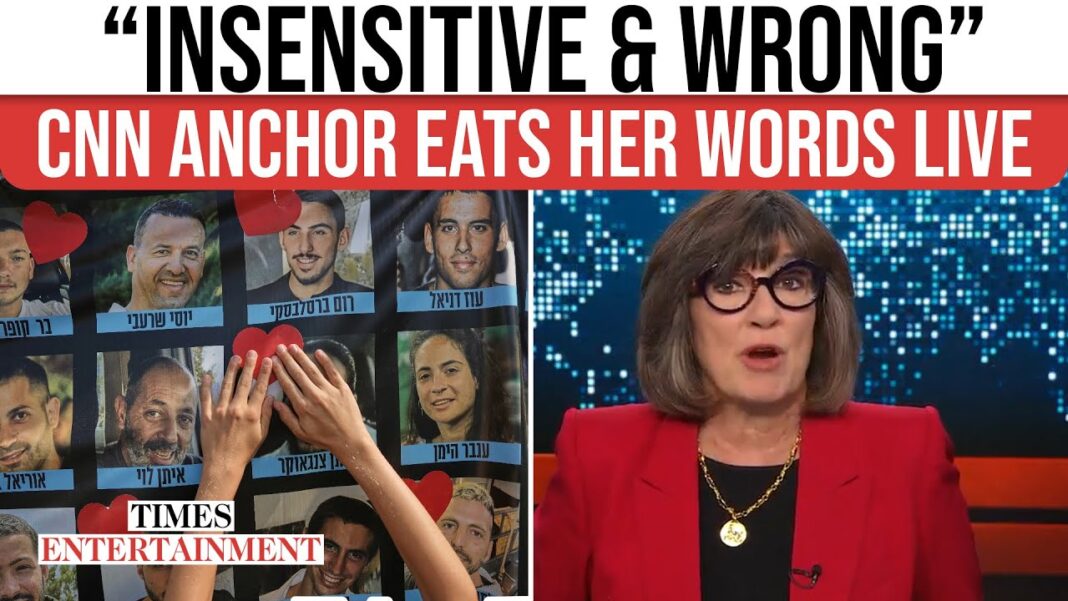
In what many observers have called one of the most disgraceful moments in contemporary broadcast journalism, CNN’s veteran anchor Christiane Amanpour this week issued an on-air apology after claiming that Hamas’s Israeli hostages were “treated better than the average Gazan.”
The remark—aired as the final group of 20 Israeli hostages emerged from captivity after nearly two years underground—triggered a tidal wave of condemnation from Jewish organizations, Israeli officials, and media watchdogs. Though Amanpour’s subsequent apology was swift, describing her words as “insensitive and wrong,” critics argue that this retraction is far too little, far too late. The damage, they say, is not contained in a single sentence—it is emblematic of a decades-long record of biased, tendentious, and misleading coverage of Israel by one of CNN’s most recognizable figures.
The New York Post first reported the controversy on Monday, noting that Amanpour’s statement came just hours after Hamas released the final 20 living Israeli hostages under the U.S.-brokered cease-fire deal. Her claim that these captives—many of whom were starved, beaten, and psychologically tortured—were “treated better than the average Gazan” struck many as a grotesque distortion of reality.
Under Hamas’s rule, Gaza’s civilians have long been used as human shields, their suffering cynically weaponized for international sympathy. To suggest that hostages—held in subterranean dungeons, deprived of sunlight, contact, or dignity—were somehow “treated better” than those same Gazans is not only false but inhumanly callous.
On air, Amanpour later admitted, “That was insensitive, and it was wrong.” Yet for many, her apology was little more than a perfunctory bow to public outrage, rather than genuine contrition. As one media analyst told The Post, “This is not an isolated lapse in judgment. It’s the culmination of a career built on shaping a narrative that consistently paints Israel as the aggressor and excuses the unforgivable behavior of its enemies.”
For years, Amanpour has been accused of crossing the line from journalism into advocacy, particularly when it comes to Israel. From equating the victims of terrorism with their perpetrators to editorializing in ways that blur fact and opinion, she has repeatedly used CNN’s global platform to promote an anti-Israel agenda.
During Israel’s wars with Hamas and Hezbollah, Amanpour’s framing of the conflict has often adopted the language of moral equivalence—depicting a democratic state defending its citizens as indistinguishable from terror organizations dedicated to its annihilation.
Observers recall her 2021 coverage during Israel’s campaign against Hamas rocket fire, when she drew a chilling parallel between the Holocaust and Israel’s military response to Gaza. “This week, 75 years since the end of World War II, the same Jewish people who suffered so much are now facing their own conflict,” she said on air, before implying that Israel’s actions against Hamas mirrored the suffering inflicted by the Nazis.
That comparison prompted condemnation from Jewish leaders worldwide, including the Anti-Defamation League, which called her comments “deeply offensive and historically inaccurate.” Yet CNN took no disciplinary action.
The newly freed hostages’ testimonies render Amanpour’s statement not only wrong but obscene. These men – Matan Angrest, Avinatan Or, Yosef-Chaim Ohana, Segev Kalfon, Evyatar David, Guy Gilboa-Dalal, Omri Miran, Alon Ohel, Ziv and Gali Berman, David and Ariel Cunio, Eitan Horn, Bar Kupperstein, Maxim Herkin, Nimrod Cohen, Elkana Bohbot, Rom Braslavski, and Eitan Mor—endured unimaginable suffering.
Many were held in total darkness for months, beaten with cables, starved to the brink of death, and forced to live in airless tunnels infested with insects. Some reported that they were denied medical care even as their wounds festered. Others described hearing fellow captives executed in nearby chambers.
According to Israeli medical teams and trauma experts who examined them after their release, most are in “relatively normal condition,” but the phrase belies profound psychological damage. Several survivors, physicians say, display symptoms consistent with severe post-traumatic stress disorder.
To suggest that such men—torn from their families, robbed of two years of their lives—were “treated better” than the average Gazan is not merely inaccurate. It is a moral inversion that trivializes both their suffering and the barbarism of their captors.
The controversy has reignited calls for CNN to sever ties with Amanpour, whose credibility on Middle Eastern affairs has been in freefall for years.
“CNN cannot continue to claim journalistic integrity while giving a global platform to someone who repeatedly distorts facts about Israel and excuses terror groups,” wrote a former CNN producer, speaking anonymously to avoid professional backlash. “She has crossed every red line of ethical journalism. This is no longer about freedom of expression; it’s about accountability.”
CNN has yet to issue a formal statement on whether Amanpour will face internal discipline. But pressure is mounting. Media watchdog groups such as CAMERA and HonestReporting have documented dozens of instances in which Amanpour’s reporting has misrepresented Israel’s actions or omitted key context.
“Her language consistently echoes the talking points of Israel’s enemies,” said Tamar Stern, a media ethics scholar at Tel Aviv University. “When Hamas bombards Israeli civilians, she calls it ‘resistance.’ When Israel defends itself, she calls it ‘aggression.’ That’s not journalism—it’s narrative warfare.”
Amanpour’s comments—and CNN’s hesitance to address them—reflect a broader crisis within Western media institutions, where anti-Israel bias has become not only normalized but institutionalized.
From the BBC to The Guardian to The New York Times, coverage of Israel often falls prey to false equivalence, selective omission, and the romanticization of terror movements. Hamas, in particular, has skillfully exploited this environment, cultivating sympathetic journalists and feeding them images designed to manipulate global opinion.
“Every time a Western reporter frames Hamas as an oppressed movement rather than a genocidal one,” said one Israeli diplomat, “they embolden those who believe Israel’s destruction is a legitimate political goal. The battlefield of perception is as real as any in Gaza.”
Amanpour, who built her career as a foreign correspondent covering war zones, has become a cautionary example of how journalistic authority can be eroded by ideological obsession. Her recent apology, critics say, only underscores how detached she has become from the ethical discipline that once defined her profession.
For many viewers—and especially for the families of those who lived through Hamas captivity—Amanpour’s words cannot be undone with an on-air correction. “She has minimized the suffering of hostages and given cover to their tormentors,” said one relative of a freed captive, who called for her immediate termination. “An apology does not erase the insult.”
Across social media, a petition titled “Time for CNN to Fire Amanpour” has circulated among supporters of the hostages. “For all the Israeli hostages who spent two years of pure hell in Hamas tunnels,” the letter reads, “Matan, Avinatan, Yosef-Chaim, Segev, Evyatar, Guy, Omri, Alon, Matan, Ziv, Gali, David, Ariel, Eitan, Bar, Maxim, Nimrod, Elkana, Rom, and Eitan—sign this letter. Time for them to fire her.”
The call is not merely for retribution but for a reckoning in global journalism, a demand that those entrusted with shaping public understanding be held to the same moral and factual standards they demand of others.
Christiane Amanpour’s fall from grace has been long in the making. Her apology may briefly pacify CNN’s public-relations department, but it will not erase decades of distorted reporting that has contributed to the demonization of Israel in the global discourse.
The question now is not whether her words were wrong—they were—but whether CNN has the moral courage to acknowledge the pattern. The network can no longer hide behind claims of “balanced reporting” while one of its marquee anchors repeatedly undermines the truth about one of America’s closest allies.
As the freed hostages begin the slow process of reclaiming their lives, Amanpour’s remarks serve as a chilling reminder that disinformation is not confined to the battlefield—it thrives in newsrooms that mistake moral relativism for fairness.
If journalism is to retain its credibility, CNN must act decisively. An apology may mend a moment, but only accountability can restore trust. And in this case, accountability means just one thing: It is time for CNN to let Christiane Amanpour go.

This is very mild criticism of Amanpour!
He is a filthy evil Arab antisemite!
Anti-Israel Nazi CNN can apologize if it wishes, but it would be apologizing for years for its antisemite war against Israel!
Israel should stop complaining. It is not helping. Just sue Christiane Amanpour and CNN for millions (billions?) of dollars. That would get their attention more than complaining. God willing after the winning the case, Israel can gloat instead.
True the reporter has to go, she is reading a script, so what about the script writer, the news editor, the director of the news department, fact checking department, show director, and anybody else who is connected with the production of the show