



|
Getting your Trinity Audio player ready...
|
Broadcasting Bias on Trial: How Trump’s Challenge to Late-Night Orthodoxy Exposed the Fragile Myth of Media Neutrality
By: Jerome Brookshire
In the quiet hours before dawn on Wednesday, President Donald J. Trump once again did what the legacy media has long feared and fervently tried to suppress: he forced a national reckoning with the power, privilege, and political prejudice embedded in America’s broadcast establishment. With a series of pointed posts on Truth Social, the president revived a debate that has simmered beneath the surface of American journalism for decades—whether television networks that operate on publicly licensed airwaves should be permitted to function as de facto political opposition operations.
According to a report that appeared on Wednesday on CBS News, President Trump argued that television broadcast licenses ought to be revoked if network newscasts and late-night programs are “almost 100% Negative” toward him, the MAGA movement, and the Republican Party. The statement, delivered in Trump’s unmistakable rhetorical cadence, was neither casual nor accidental. It represented a frontal assault on what many conservatives see as an entrenched media monoculture that cloaks partisan activism in the language of entertainment and journalism.
“If Network NEWSCASTS, and their Late Night Shows, are almost 100% Negative to President Donald J. Trump, MAGA, and the Republican Party, shouldn’t their very valuable Broadcast Licenses be terminated?” the president wrote, adding emphatically, “I say, YES!” CBS News reported that the post appeared in the “wee hours of the morning,” a detail that underscores how relentlessly the president continues to challenge the institutional press, regardless of the hour or the inevitable backlash.
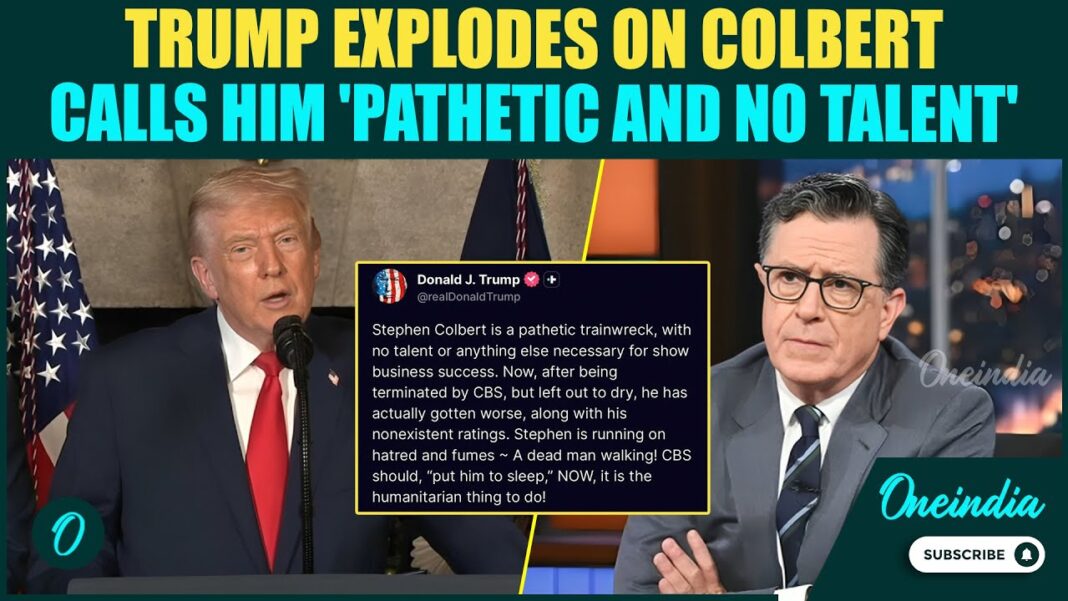
The timing of President Trump’s comments was hardly coincidental. As the CBS News report noted, the president’s post followed closely on the heels of sharp criticism aimed at “The Late Show” host Stephen Colbert, a comedian whose nightly monologues have become a reliable vehicle for anti-Trump invective. Colbert, whose program is slated to conclude in May 2026, was described by the president as a “pathetic trainwreck, with no talent or anything else necessary for show business success.”
While such language predictably sent legacy media commentators into paroxysms of outrage, it also highlighted a reality that CBS News itself has repeatedly documented: late-night television has largely abandoned its traditional role as bipartisan satire in favor of ideological conformity. Trump’s remarks about Colbert—particularly his claim that the host’s ratings are “nonexistent”—echo a broader conservative critique that these programs no longer entertain a diverse audience but instead preach to a dwindling choir of like-minded viewers.
“Now, after being terminated by CBS, but left out to dry, he has actually gotten worse,” the president continued, according to CBS News, “along with his nonexistent ratings.” In Trump’s telling, Colbert’s decline is not merely personal but emblematic of an entire genre that has traded humor for hostility.
The president did not confine his criticism to CBS alone. In another post cited by CBS News, he asked rhetorically, “Who has the worst Late Night host, CBS, ABC, or NBC???” His answer was unsparing: “They all have three things in common: High Salaries, No Talent, REALLY LOW RATINGS!” The statement crystallized a sentiment shared by millions of Americans who believe that late-night television has become an echo chamber insulated from accountability by corporate largesse and cultural inertia.
As CBS News has frequently reported, President Trump’s frustration with late-night hosts and network coverage is not new. Long before his return to the Oval Office, he openly challenged the assumption that broadcasters wielding public licenses should be free to engage in unrelenting political advocacy without consequence. Earlier this year, the president again floated the idea of revoking broadcast licenses for networks that persistently cover him in a negative light, suggesting in September that such decisions should fall to Brendan Carr, the chairman of the Federal Communications Commission.
CBS News contextualized those remarks by recalling the controversy surrounding ABC’s temporary suspension of Jimmy Kimmel following a monologue referencing the suspect in the assassination of Charlie Kirk. That incident, which briefly pierced the aura of impunity surrounding late-night television, served as a reminder that networks do, in fact, recognize limits—though those limits are rarely enforced when conservative figures are the targets.
The Federal Communications Commission, for its part, declined to comment immediately on the president’s most recent remarks, CBS News reported. ABC, CBS, and NBC likewise offered no response to inquiries, a silence that critics interpret as emblematic of an industry unaccustomed to scrutiny from outside its own ideological circle.
Central to this debate is the role of the FCC itself. As the CBS News report explained, the commission issues eight-year licenses to individual broadcast stations, many of which are owned and operated by the very networks now under fire. During a Senate hearing earlier this month, FCC Chairman Brendan Carr stated that the agency is “not formally an independent agency,” a remark that sent ripples through Washington. Axios later reported—information also referenced by CBS News—that the word “independent” had been removed from the FCC’s website during Carr’s testimony.
This revelation has fueled conservative arguments that the FCC’s supposed neutrality is more performative than real. While the commission insists on its website that “Broadcasters – not the FCC or any other government agency – are responsible for selecting the material they air,” it also acknowledges that “The First Amendment and the Communications Act expressly prohibit the Commission from censoring broadcast matter.”
Yet, as supporters of the president are quick to point out, the issue is not censorship but accountability. Broadcast licenses are public trusts, not private entitlements. They confer extraordinary economic value and cultural influence in exchange for a commitment to serve the public interest. When networks use those licenses to advance a singular political worldview—particularly one hostile to a sitting president and a major political party—they invite legitimate questions about whether they are honoring that obligation.
Throughout this unfolding controversy, CBS News has occupied a dual role: chronicler and combatant. On one hand, the network has diligently reported the facts of Trump’s statements, his criticisms of Stephen Colbert, and the broader regulatory context. On the other, CBS News is inextricably linked to the very late-night ecosystem the president condemns.
This tension has not gone unnoticed by media critics, who argue that CBS News’ coverage, while thorough on the surface, often lacks the introspection necessary to grapple with the substance of Trump’s claims. By framing the president’s remarks primarily as expressions of anger or retaliation, detractors say, the network risks sidestepping the deeper issue of ideological uniformity in broadcast media.
Nevertheless, CBS News’ detailed reporting has inadvertently underscored the president’s point. By documenting the absence of responses from ABC, CBS, and NBC, and by highlighting the FCC’s ambiguous posture, the network has illuminated a media landscape remarkably resistant to external critique.
What emerges from this episode is not merely another skirmish between Donald Trump and his media adversaries, but a broader confrontation over who controls the narrative in American public life. The president’s willingness to challenge the sanctity of broadcast licenses strikes at the heart of an industry that has long assumed its own moral authority.
To his supporters, Trump’s comments represent a necessary corrective—a demand that networks funded by public airwaves cease functioning as unelected political actors. To his critics, they are an affront to press freedom. Yet as CBS News’ own reporting makes clear, the boundaries between journalism, entertainment, and activism have grown increasingly porous.
In that sense, the president’s provocation may achieve what years of media criticism have not: forcing a serious, sustained debate about the responsibilities that accompany broadcast power. Whether or not any licenses are ever revoked is almost beside the point. The conversation itself, catalyzed in the early hours of a Wednesday morning and amplified across platforms including CBS News, signals a shift in the balance of cultural authority.
Donald Trump has once again placed the legacy media on trial in the court of public opinion. And as CBS News continues to report on the fallout, one thing is unmistakable: the era in which broadcast networks could operate without challenge, shielded by prestige and habit, is rapidly drawing to a close.