



|
Getting your Trinity Audio player ready...
|
By: Fern Sidman- Jewish Voice News
When eminent British commentator Charles Moore—a peer in the House of Lords, former editor of The Daily Telegraph, and authorized biographer of Margaret Thatcher—issues a political warning, conservatives across the Atlantic typically pay attention. But this week, Moore’s blistering appraisal of Vice President JD Vance has triggered unusually intense reverberations, amplified by coverage on Newsmax, which has closely followed the vice president’s posture toward the increasingly open strain of antisemitism emerging within certain segments of the American Right.
In a sharply worded column published in The Telegraph of the UK and summarized extensively in a report on Wednesday at Newsmax, Moore charges that Vance has allowed “the oldest hatred” to metastasize inside the GOP’s youth movement by refusing to confront the Groyper subculture—an online network of white-nationalist, hyper-right activists clustered around extremist figure Nick Fuentes.
Moore’s critique is notable not simply for its severity but for its historical framing. Drawing a direct parallel to the Labour Party under Jeremy Corbyn, Moore argues that the ideological environment forming around a subset of young conservatives today mirrors the conditions in which left-wing antisemitism flourished in Britain nearly a decade ago. He contends that the Republican Party’s leadership, and Vance in particular, now confronts a test that Corbyn failed: whether to confront extremist factions early, or to indulge them until they become embedded in the party’s identity.
Newsmax, which has reported extensively on rising antisemitism across the Western political spectrum, emphasized that Moore’s warning is not hyperbole but a serious ideological and strategic critique. The conservative broadcaster notes that Moore’s concerns reflect a growing unease within establishment conservatism about the role of extremist influencers—not least Tucker Carlson, the figure at the center of Moore’s rebuke.
According to Moore, Carlson now functions as “a major influencer” within the Republican Party, shaping the worldview of an entire generation of right-leaning young people. Newsmax coverage expands on this point, noting that Carlson’s program has long offered space and legitimacy to fringe personalities, including those on record making disturbingly explicit antisemitic remarks.
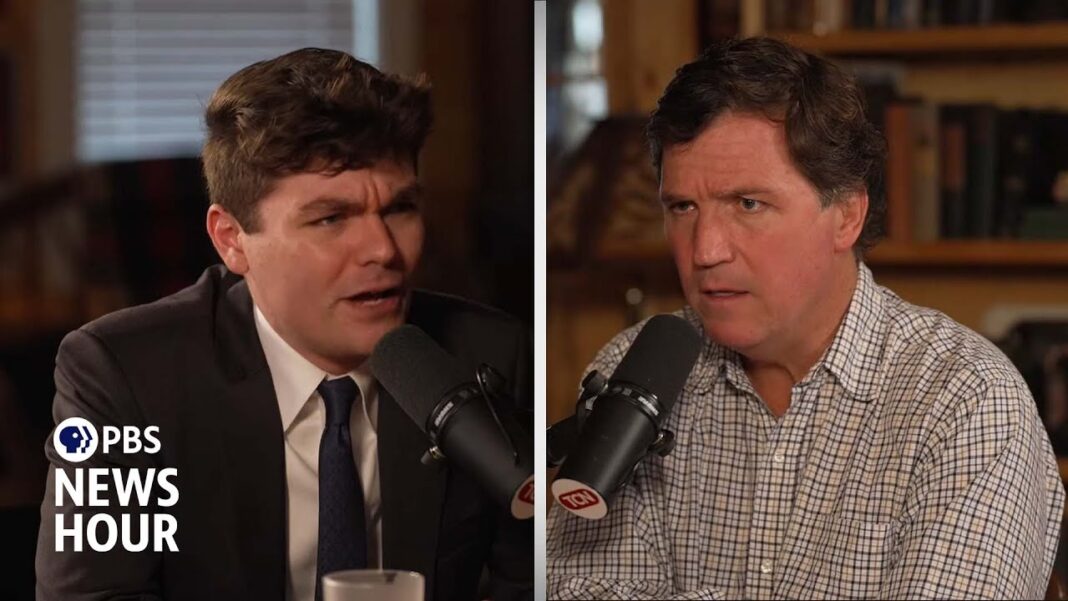
Much of Moore’s argument hinges on Carlson’s well-documented association with Nick Fuentes—who has praised authoritarian strongmen, spoken admiringly of Hitler and Stalin, and frequently delivers diatribes against what he calls “organized Jewry.” Newsmax reports that Moore specifically cites Carlson’s decision to give Fuentes a full hour-long interview, an act the British commentator views as dangerously normalizing a figure whose ideology is overtly hateful and fundamentally incompatible with democratic norms.
Carlson’s recent relocation to Qatar—a nation Moore describes pointedly as “Hamas-friendly”—has only intensified concern. Newsmax has highlighted the geopolitical undertones of this move, noting that Carlson’s reporting from Doha frequently aligns with narratives hostile to Israel and sympathetic to actors within the Islamist world—a shift that alarmed many conservatives who once viewed him as a reliable anti-establishment voice but not as a megaphone for illiberal foreign interests.
Against this backdrop, Moore contends that Carlson has become indispensable to Vance’s political standing. The Newsmax report called attention to a widely acknowledged point: Carlson is broadly credited with persuading Donald Trump to select Vance as his running mate in 2024. The alliance between the two men is thus not merely ideological but structural—Carlson’s endorsement gives Vance credibility with a segment of the conservative grassroots that the vice president appears reluctant to alienate.
When Carlson gave Fuentes a platform that triggered widespread backlash, Vance’s response was conspicuously measured. He condemned antisemitism in general terms, calling it “anti-American and anti-Christian,” but insisted that the Republican Party did not have a growing antisemitism problem, dismissing such claims as “positively slanderous.” Vance notably declined to criticize Carlson personally, despite the broadcaster being at the center of the controversy.
Moore argues that this silence is telling—and dangerous. According to the information provided in the Newsmax report, his view is that Vance appears to be embracing a political maxim once associated with the Corbynite Left: no enemies on one’s own side.
In Moore’s analysis, Vance is behaving like a presidential aspirant who understands that, eventually, Trump will leave the stage. When that moment comes, Carlson’s support—or at least his neutrality—will matter enormously. For Vance, antagonizing the movement’s most potent media force is seen as strategically unwise.
But Moore urges a longer view. By refusing to distance himself from Carlson’s open hospitality toward figures like Fuentes, Vance risks sending a signal that antisemitism—particularly when couched in pseudo-religious rhetoric and presented as youthful anti-establishment energy—can be tolerated or at least ignored.
Newsmax commentators have described this as Vance’s “Corbyn moment,” a crossroads where leadership either confronts extremism or quietly absorbs it. Moore’s argument rests on the historical observation that antisemitism, once allowed to fester unchecked, inevitably becomes corrosive not only to the targeted community but to the political institutions that tolerate it.
Moore’s critique is not an attack from the Left but a warning from the Right about the ideological health of the movement. As the Newsmax report noted, Moore has spent decades studying political currents that threaten democratic stability, from Marxist radicalism to Islamist extremism. His alarm over the Groypers stems from a belief that antisemitism is not merely a prejudice but a conspiracy framework that inevitably leads to authoritarian impulses.
In Moore’s words, as quoted in the Newsmax report, antisemitism is “the primordial example of political lunacy”—a worldview that imagines shadowy cabals, corrupt elites, and hidden puppet-masters manipulating society. For the Groypers, this narrative is often recast in pseudo-Christian language, portraying Jews as obstacles to national revival or cultural restoration.
According to Moore, ignoring such rhetoric endangers not only the Jewish community but the long-term integrity of the conservative movement. The Republican Party, he warns, could find itself replicating Labour’s descent under Corbyn, when extremists used institutional ambivalence to transform the character of the party’s base.
Newsmax experts note that while the Groypers remain a minority, their influence among young conservatives is significant. Commentator Rod Dreher estimated—cited prominently by Moore—that between 30% to 40% of Washington’s conservative “Zoomers” identify with Groyper ideology to some degree. If accurate, this represents not a fringe problem but a generational challenge.
For Moore, the danger lies not simply in the opinions of a radical minority, but in the reluctance of senior leaders to confront them. His critique of Vance centers on the idea that leadership sometimes requires rejecting political convenience in service of moral clarity.
And this, Moore argues, is a test Vance is failing.
The comparison to Corbyn is not incidental. Under Corbyn, Labour’s refusal to confront antisemitism early created space for extremists to flourish. Moore believes that a similar abdication by Republicans today will yield predictable and damaging results.
Moore concluded that Vance, as the Republican vice president and a likely future presidential contender, bears a particular responsibility. He need not share Carlson’s views, nor must he attack the broadcaster personally. But he does have an obligation to draw clear boundaries concerning the movement’s moral center.
Failing to lead, Moore writes, is itself a choice.
For conservatives who hope to build a durable governing coalition rooted in democratic norms, religious pluralism, and constitutional principles, Moore’s warning is stark: the seeds of extremism sprout quickly when watered with silence.
As the Newsmax report emphasized, the question now is whether JD Vance will ignore this warning—or rise to meet it.