



|
Getting your Trinity Audio player ready...
|
By: Tzirel Rosenblatt
In a political era defined by polarization, permanent outrage, and performative antagonism, few narratives feel more counterintuitive—or more revealing—than the increasingly cordial relationship between President Donald Trump and New York City Mayor Zohran Mamdani. As The New York Daily News reported on Tuesday of the evolving dynamic between the two men, their relationship defies the ideological logic of modern American politics: a conservative president whose national brand is built on confrontation and a progressive mayor who has publicly condemned him in some of the harshest possible terms, yet who maintain a surprisingly warm personal rapport.
That contradiction came into sharp relief once again this week, when President Trump, speaking on Sid Rosenberg’s 77 WABC radio program, offered effusive praise for Mayor Mamdani—despite the mayor’s recent, highly public attacks on the administration’s policies. According to The New York Daily News report, Trump acknowledged profound ideological disagreements with the mayor yet framed their relationship in almost personal terms.
“I think he’s got a really good personality,” Trump said. “I think he’s got tremendous assets, but he’s got some things… policy, concepts, that really haven’t worked over the last 10,000 years.”
The comment, delivered in Trump’s characteristic rhetorical style—simultaneously dismissive and admiring—captures the paradox at the center of the relationship. On substance, the two men occupy nearly opposite poles of the American political spectrum. On temperament, however, Trump has repeatedly signaled something bordering on affection.
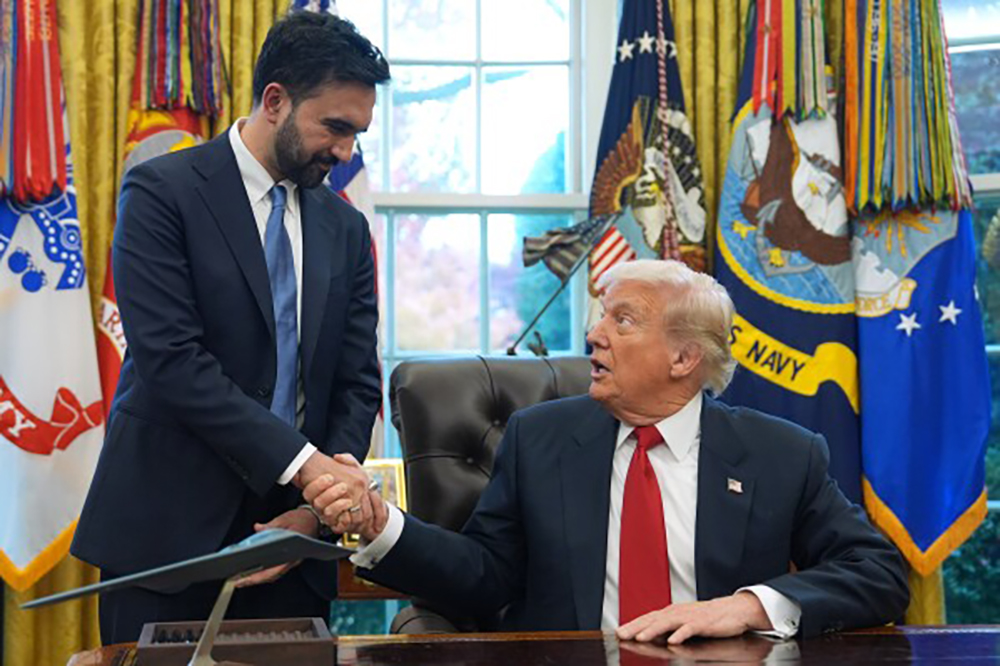
As The New York Daily News has chronicled, this is not an isolated episode. It is part of a broader pattern that began in November, shortly after Mamdani’s general election victory. During a White House meeting that stunned many political observers, Trump lavished praise on the newly elected mayor, offering assistance to his administration and publicly expressing admiration for his demeanor and leadership style. The encounter marked the beginning of what insiders, quoted by The New York Daily News, have half-jokingly referred to as a political “bromance”—an improbable alliance rooted not in ideology, but in personality.
That meeting set the tone for a relationship that has remained strikingly cordial, even as the political temperature between their respective camps has escalated. Mayor Mamdani has not tempered his rhetoric against the Trump administration. On the contrary, he has intensified it. This month alone, Mamdani has accused the administration of moral culpability in ICE-related killings in Minnesota, denounced federal immigration crackdowns, criticized pauses in federal funding, and publicly called for the abolition of Immigration and Customs Enforcement—statements that, in any other context, would likely provoke open hostility from the White House.
As The New York Daily News report detailed, Rosenberg himself pressed Trump on this contradiction during the radio interview, reminding the president that Mamdani had labeled his administration “evil” following the murder of Renee Good and had publicly advocated dismantling ICE.
“He called your administration evil,” Rosenberg said. “He actually came out and said he wants to abolish ICE on The View and in a tweet yesterday.”
For many in Trump’s political base, such rhetoric would place a public official firmly in the category of adversary. Yet Trump’s response was characteristically detached from ideological absolutism.
“You know, it’s politics,” he replied. “It’s a nasty world. It’s a nasty profession, if you want to know the truth, it really is. But I got along very well with him.”
The comment reveals a deeper truth about Trump’s political psychology—one that The New York Daily News has analyzed repeatedly in its coverage of his leadership style. Trump often distinguishes sharply between personal relationships and political conflict. Public attacks, even extreme ones, do not necessarily translate into personal enmity in his worldview. Loyalty, respect, and interpersonal chemistry often matter more to him than ideological alignment.
This dynamic is not unique to Mamdani. Trump also referenced his relationship with Governor Kathy Hochul during the same appearance, describing her as personally cordial while politically antagonistic.
“She calls me, ‘Hi, President. Hi, hi. How you doing?’” Trump said. “She cannot be nicer. And then I’ll see her the following day on television, knocking the hell out of me.”
As The New York Daily News report noted, this pattern suggests a form of compartmentalization that is rare in contemporary politics: the ability to maintain personal rapport amid public warfare. It is a style more reminiscent of old-school political culture, where fierce policy battles could coexist with private civility—an ethos largely lost in the age of social media politics and permanent outrage cycles.
What makes the Trump-Mamdani relationship particularly striking is not merely its cordiality, but its asymmetry. Mamdani’s public posture toward Trump has been consistently adversarial. His statements have not been rhetorical flourishes; they have been direct moral indictments. Yet Trump’s response has been neither retaliatory nor dismissive. Instead, he continues to speak of the mayor in terms of personal admiration.
According to the information provided in The New York Daily News report, Mamdani himself has acknowledged that the relationship extends beyond public appearances. He has said that he and Trump exchange text messages about issues affecting New Yorkers, suggesting a behind-the-scenes channel of communication that operates independently of public rhetoric.
This dual-track relationship—private civility, public conflict—creates a complex political theater. On the surface, it appears contradictory. Beneath the surface, it may be strategically rational for both sides.
For Trump, maintaining a cordial relationship with New York’s mayor serves several purposes. It reinforces his image as a dealmaker who can work with anyone. It positions him as above partisan pettiness. And it allows him to project magnanimity in the face of criticism, a posture that plays well with his supporters, who often admire strength expressed through restraint rather than retaliation.
For Mamdani, the relationship provides access. It preserves a channel of influence in federal decision-making that could benefit New York City. It allows him to advocate for the city’s interests directly, even while opposing Trump ideologically. And it complicates simplistic narratives that portray him as purely oppositional.
As The New York Daily News report observed, this dynamic also reflects a deeper structural reality of American governance: cities and federal administrations must coexist, regardless of ideology. Infrastructure, funding, emergency management, public safety, and economic development require cooperation across political divides. Personal relationships, even improbable ones, often facilitate that cooperation more effectively than formal diplomacy.
Yet the optics remain unusual. In a political culture that thrives on conflict, the spectacle of mutual compliments between ideological adversaries disrupts the expected script. It challenges the assumption that politics must always be personal—and that personal relationships must always mirror ideological alignments.
The language Trump uses when describing Mamdani is particularly revealing. He frames his disagreements as policy failures rather than character flaws. He critiques “concepts” and “policies,” not the man himself. In doing so, he preserves a distinction between ideological opposition and personal respect—a distinction largely absent from modern political discourse.
The New York Daily News has highlighted that this rhetorical separation may be strategic, but it is also deeply characteristic of Trump’s political persona. He often reserves personal hostility for those he perceives as disloyal or disrespectful on a personal level, rather than those who merely oppose him ideologically.
Mamdani, for his part, has not personalized his attacks in the same way. His criticisms target policies and actions, not Trump’s character. While his language has been morally charged, it has remained institutional rather than personal. This mutual restraint—rare in contemporary politics—may be one of the foundations of their unexpected rapport.
The broader implication of this relationship extends beyond the two men themselves. It reflects a deeper tension in American political culture between performative conflict and functional governance. Public rhetoric has become increasingly absolutist, while behind-the-scenes governance still requires negotiation, compromise, and human relationships.
As The New York Daily News has frequently argued, modern politics is increasingly bifurcated: the theater of outrage on one side, the machinery of governance on the other. Trump and Mamdani appear to operate comfortably in both realms, playing their respective roles in public while maintaining pragmatic communication in private.
Whether this relationship will translate into tangible policy outcomes remains uncertain. Ideological differences between the Trump administration and Mamdani’s city government remain profound. Immigration policy, law enforcement, federal funding, and social policy remain sources of deep conflict.
But the tone of their relationship matters. In a city as complex and politically charged as New York, the ability to maintain open channels between City Hall and the White House carries real significance.
In an age where political enemies are often portrayed as existential threats, the Trump-Mamdani relationship offers a rare reminder that politics, at its core, is still conducted by human beings.
And in that humanity—contradictory, complex, and often illogical—lies the possibility of dialogue in a system increasingly defined by division.
As The New York Daily News report observed, one thing remains clear: in a city built on conflict, and a nation addicted to polarization, the spectacle of mutual respect between adversaries is not just unusual—it is revolutionary.
