



|
Getting your Trinity Audio player ready...
|
By: Fern Sidman
As New York City’s mayoral hopefuls prepare to face off in their final televised debate Wednesday evening, the Anti-Defamation League (ADL) is urging them to confront what it calls an unprecedented wave of antisemitism gripping the five boroughs. With hate crimes targeting Jewish residents surging to record highs, the organization says the candidates must go beyond vague statements of tolerance and outline specific, enforceable plans to protect the city’s Jewish community.
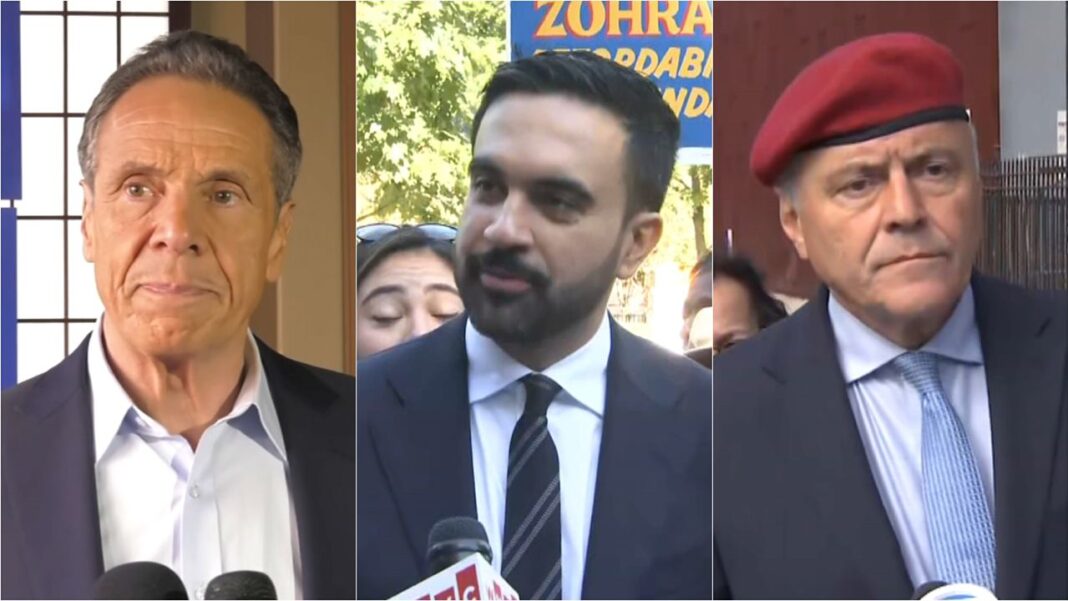
According to a report on Wednesday at VIN News, the ADL’s appeal comes amid mounting concern among Jewish leaders and civic watchdogs over a steep escalation in antisemitic violence, vandalism, and harassment across the city. As the campaign enters its final stretch, the issue has moved to the forefront of civic discourse, challenging candidates Zohran Mamdani, Andrew Cuomo, and Curtis Sliwa to take firm and public positions on an issue that has shaken the confidence of one of New York’s oldest and most visible minority communities.
In an interview ahead of the debate, ADL CEO Jonathan Greenblatt told the New York Post that the next mayor must make combating antisemitism a top priority. “At a time when antisemitic incidents in NYC have reached unprecedented levels, we hope that leaders at all levels of government are unequivocal in condemning antisemitism,” he said. “We call on all candidates in the upcoming election to clearly address how they will protect New York’s Jewish community.”
As VIN News reported, the ADL’s latest data paints a troubling picture. In 2024 alone, New York City recorded nearly one thousand antisemitic incidents, the highest number for any city in the United States. More than half of all hate crimes reported to the New York Police Department’s Hate Crimes Task Force last year targeted Jews — a figure the ADL has described as “deeply alarming and morally untenable.”
The ADL’s findings include a disturbing range of offenses: physical assaults on visibly Orthodox Jews in Brooklyn and Queens, threats against synagogues, and a proliferation of antisemitic graffiti on subway cars, storefronts, and public schools. In one recent case cited by VIN News, a man was arrested after threatening to “burn down” a yeshiva in Borough Park, while in another, a group of teenagers assaulted a Hasidic man near Crown Heights, filming the attack and posting it on social media.
“This is not an isolated spike,” Greenblatt warned. “It’s a sustained and dangerous trend that demands a comprehensive response — from education and law enforcement to civic leadership and moral clarity.”
Scott Richman, the ADL’s regional director for New York and New Jersey, echoed that assessment, telling the Post that antisemitism “is no longer hiding in the shadows.” He described a new reality in which Jewish residents are being targeted openly, often in broad daylight, and said that many are now fearful to wear religious symbols or walk near protest sites.
“It’s out in the open — and it’s making Jewish New Yorkers feel unsafe in one of the most important centers of Jewish life in the world,” Richman said.
According to the report at VIN News, New York City — home to more than 1.6 million Jews, the largest Jewish population outside Israel — has long prided itself on its pluralism and cultural tolerance. But the past two years have seen that reputation tested. The outbreak of the Israel–Hamas war in October 2023 triggered an explosion of anti-Israel protests, some of which veered into overt antisemitism, with demonstrators chanting slogans such as “Globalize the Intifada” outside Jewish institutions and synagogues.
The ADL has repeatedly condemned such rhetoric, warning that calls for “intifada” — historically associated with waves of Palestinian violence targeting Israeli civilians — are not abstract political expressions but threats that resonate as incitement for many Jewish New Yorkers.
As the VIN News report detailed, several synagogues in Manhattan and Brooklyn were forced to temporarily close their doors or cancel services after protesters surrounded their entrances and shouted antisemitic slurs at congregants. The NYPD, citing credible threats, increased patrols around Jewish schools and community centers in the aftermath.
Wednesday’s debate, which will air on NY1 at 7 p.m., will bring these tensions squarely into the political arena. The ADL has explicitly called on the three candidates to use the forum to address Jewish safety head-on — not with platitudes, but with concrete strategies.
For Zohran Mamdani, the Democratic nominee and a self-described socialist, the issue is particularly sensitive. His critics, including Jewish leaders and editorial boards, have accused him of tolerating antisemitic rhetoric within activist circles aligned with his campaign. Mamdani has also drawn fire for refusing to condemn the “Globalize the Intifada” slogan, a stance that has alienated many Jewish voters and prompted calls from community leaders for him to clarify his position.
By contrast, Andrew Cuomo, running as an independent, has made combatting antisemitism a centerpiece of his campaign, pledging to strengthen police protections around synagogues and Jewish schools and to create a mayoral Task Force on Religious Tolerance. “If New York City cannot protect its Jewish residents,” Cuomo said at a recent campaign stop, “it cannot call itself a beacon of diversity.”
Republican candidate Curtis Sliwa, who has long focused on public safety issues, has also condemned antisemitic hate crimes and promised to expand the Guardian Angels’ patrols in heavily Jewish neighborhoods. However, as VIN News noted, his campaign has been overshadowed by internal party divisions and calls from within conservative ranks to step aside for Cuomo in order to block Mamdani’s rise.
Still, Sliwa insists that his approach to antisemitism — rooted in grassroots, community-level enforcement — is what sets him apart. “You can’t fight hate from City Hall alone,” he said in a recent appearance. “You have to fight it on the streets, shoulder to shoulder with the people it targets.”
Beyond political rhetoric, the ADL has outlined a series of concrete policy recommendations it hopes to see adopted by the next administration. These include:
Expanding hate crime units within the NYPD and ensuring they have adequate resources for investigation and prosecution.
Increasing state and city funding for security at Jewish schools, synagogues, and community centers.
Mandating antisemitism education in public schools, paired with broader instruction on religious tolerance.
Holding public institutions and city agencies accountable for responding swiftly to hate incidents.
Addressing online antisemitism, which the ADL says often spills into real-world violence.
As VIN News reported, Greenblatt stressed that leadership on this issue cannot be reactive or partisan. “This is not about left or right — it’s about right and wrong,” he said. “Antisemitism is a threat to the moral fabric of this city, and it requires a unified response.”
For many Jewish New Yorkers, this election has taken on an unusually personal dimension. Synagogues have added armed guards, Jewish schools have introduced lockdown drills, and community organizations have increased coordination with law enforcement. The Jewish Community Relations Council (JCRC) recently warned that “a climate of hostility” now pervades neighborhoods once considered safe havens.
One Orthodox rabbi in Brooklyn, interviewed by VIN News, described how congregants now avoid walking home in traditional attire after evening prayers. “We tell people, tuck your tzitzit in, wear a baseball cap instead of a yarmulke,” he said. “It shouldn’t have to be this way in New York City.”
The ADL’s Richman agrees that the stakes extend beyond the Jewish community. “When antisemitism is normalized, other forms of hate follow,” he said. “This is a test of who we are as a city and what kind of future we want.”
As the three candidates prepare to take the stage, the ADL’s message is clear: New York City’s next mayor must make the fight against antisemitism a defining priority.
The organization’s call comes not merely as a plea for compassion but as a demand for leadership — one rooted in policy, enforcement, and moral clarity. For a city that has long served as both a sanctuary and a stage for global Jewish life, the question is not only how to stop hate crimes, but how to restore trust, safety, and belonging for a community that has helped define New York’s identity for more than a century.
As VIN News noted in its coverage of the ADL’s statement, the timing of this debate — just days before early voting begins — could prove decisive in shaping public perception of how each candidate intends to lead in the face of hate.
For now, the lights of the city may still shine brightly. But for many of its Jewish residents, the glow feels dimmer — and they are looking to their next mayor to make it bright again.