



|
Getting your Trinity Audio player ready...
|
By: Fern Sidman
Throughout 2025, Tucker Carlson has remained one of the most closely scrutinized—and polarizing—figures in American media. Once a prime-time cable news anchor and now the proprietor of a highly influential independent platform spanning X (formerly Twitter), video interviews, and long-form essays, Carlson continues to command an audience measured in the millions. His words reverberate far beyond the confines of partisan debate, shaping narratives, framing grievances, and legitimizing lines of inquiry that often migrate from the fringes into the political mainstream.
A comprehensive review of Carlson’s public statements, social media posts, and interviews during 2025 reveals a striking and consequential asymmetry in his rhetorical focus. Over the course of the year, Carlson devoted extensive attention—dozens of posts and long-form discussions—to Israel, Zionism, Jewish influence in American politics, and U.S. support for the Jewish state. By contrast, there is a conspicuous absence of commentary addressing radical Islam or Islamic extremism, despite those phenomena remaining central drivers of global terrorism, regional instability, and sectarian violence.
This disparity is not merely quantitative. It is thematic, tonal, and ideological. The imbalance invites deeper scrutiny, not only of what Carlson chooses to say, but of what he persistently declines to address.
A Record of Silence on Radical Islam
According to a thorough survey of Carlson’s 2025 output across X, YouTube, and his personal website, there are zero documented instances in which he expresses concern about radical Islam or Islamic extremism as a distinct ideological or security threat. This silence stands in stark contrast to earlier periods in his career, when he occasionally acknowledged Islamist terrorism as a challenge to Western societies, even while criticizing U.S. military interventions abroad.
In 2025, however, such commentary disappears almost entirely. Terrorist movements inspired by jihadist ideology—whether operating in the Middle East, Africa, or Europe—are largely absent from Carlson’s analytical frame. Attacks on religious minorities by Islamist groups, including Christians and dissident Muslims, receive little to no direct attention. Even when discussing violence in the Middle East, Carlson’s focus consistently shifts away from Islamist actors and toward Western policymakers or Israel itself.
For critics, this omission is not accidental. They argue that Carlson’s worldview increasingly treats radical Islam less as an ideological force in its own right and more as a secondary consequence of Western or Israeli actions—a framing that effectively absolves extremist movements of primary agency.
An Obsessive Focus on Israel and Zionism
If Carlson’s commentary on radical Islam is defined by absence, his treatment of Israel and Jewish-related topics is marked by frequency and intensity. By conservative estimates, Carlson referenced Israel, Zionism, Jewish political influence, or related themes at least 35 times in 2025 alone, often in accusatory or adversarial terms.
Beginning in January, Carlson criticized what he described as “neoconservative wars” allegedly engineered to benefit Israel, framing U.S. foreign policy as subservient to Israeli interests. This theme recurred throughout the year, becoming a central pillar of his critique of American interventionism. In interviews with figures such as Steve Bannon, Ted Cruz, and Dan Caldwell, Carlson repeatedly pressed the notion that pro-Israel advocacy—often personified through references to AIPAC—exerts undue influence over Congress and the executive branch.
By mid-year, the rhetoric intensified. Carlson accused prominent conservative commentators, including Sean Hannity and Mark Levin, of acting as de facto agents for Israeli priorities. He framed debates over Iran not as questions of regional security or nuclear proliferation, but as evidence of an American political class willing to sacrifice national interests on behalf of a foreign state.
The summer and fall of 2025 marked a crescendo. Carlson hosted interviews with academic critics of Israel such as John Mearsheimer, during which Israel’s military campaign in Gaza was repeatedly described as “genocide.” He aired extended conversations alleging systemic Israeli persecution of Christians, including interviews with clergy and activists who framed Israel as uniquely hostile to Christian life in the Holy Land.
While criticism of any government is, of course, legitimate within democratic discourse, the cumulative effect of Carlson’s coverage was to portray Israel not as a complex state navigating existential threats, but as a singular moral villain—one whose actions allegedly corrupt American politics, endanger Christians, and destabilize the global order.
The Fuentes Controversy and the Question of Boundaries
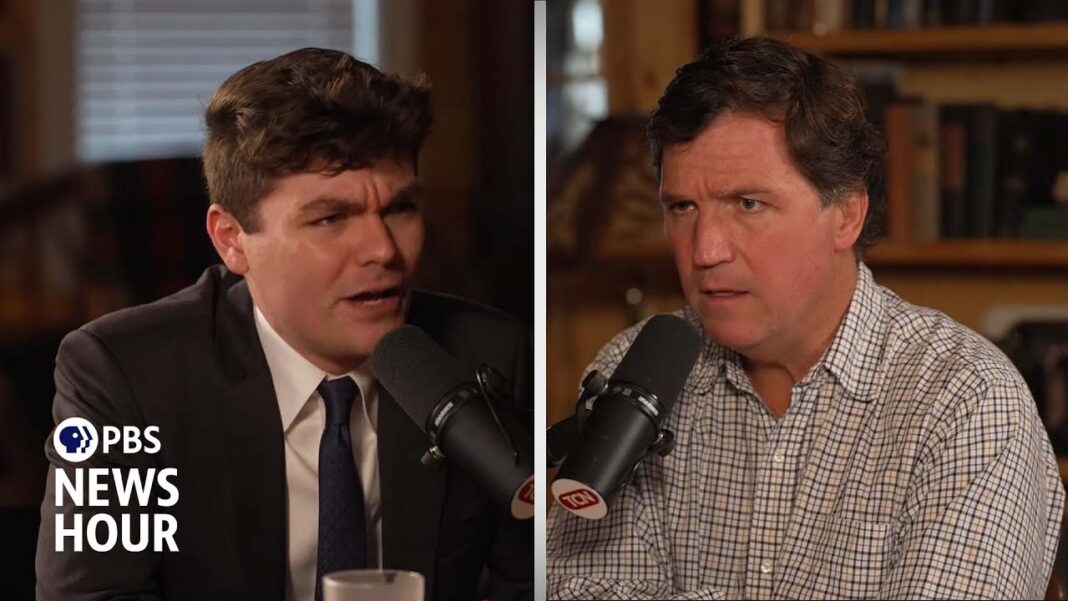
Perhaps the most controversial episodes of Carlson’s 2025 output involved his interviews with Nick Fuentes, a figure widely associated with explicit antisemitic ideology. In these conversations, Carlson did not merely challenge Fuentes; he engaged him at length, allowing discussions of “Zionist Jews,” Jewish power, and the legitimacy of Jewish inclusion in Western civilization to unfold with minimal pushback.
Defenders argue that Carlson’s intent was to expose or interrogate extremist ideas. Critics counter that the format and tone of the interviews functioned less as scrutiny and more as amplification. The absence of firm rebuttal, they contend, risked normalizing themes long associated with antisemitic conspiracy theories.
Compounding these concerns were Carlson’s subsequent essays and posts questioning the concept of a “Judeo-Christian” tradition, suggesting that the term artificially elevates Jewish influence within Western identity. In redefining Western civilization in ways that implicitly marginalize Jews, Carlson stepped into territory historically fraught with exclusionary and discriminatory implications.
Christian Persecution as a Selective Lens
A recurring motif in Carlson’s 2025 commentary was the persecution of Christians abroad. On its face, this concern resonates with genuine humanitarian issues. Christians are, indeed, among the most persecuted religious groups globally. Yet Carlson’s framing consistently directed blame toward Israel rather than toward Islamist regimes or extremist movements that have carried out mass killings, church bombings, and forced conversions.
In interviews and posts, Carlson suggested that Israeli policies were responsible for Christian suffering in the region, while largely ignoring or downplaying violence perpetrated by Hamas, ISIS affiliates, or other Islamist factions. This selective attribution further underscores the asymmetry in his moral accounting.
The Politics of Emphasis
Journalism is as much about emphasis as it is about facts. No commentator can address every issue, but patterns of focus reveal underlying priorities and assumptions. In Carlson’s case, the near-total absence of concern about radical Islam—paired with an almost obsessive fixation on Israel and Jewish influence—raises unavoidable questions.
Why, in a year marked by continued jihadist violence across multiple continents, did Carlson find no occasion to address Islamist extremism directly? Why did his critique of U.S. foreign policy consistently single out Israel, while excusing or ignoring the ideological motivations of its adversaries?
Supporters argue that Carlson is challenging taboos and interrogating sacred cows. Critics respond that he is replacing one orthodoxy with another—one that recasts Jews and Israel as the central animating force behind global disorder, while rendering other actors effectively invisible.
Consequences Beyond Commentary
The implications of this rhetorical imbalance extend beyond Carlson himself. As one of the most influential voices in the post-cable conservative media ecosystem, his framing shapes the assumptions of a broad audience. When criticism of Israel shades into insinuations about Jewish loyalty, influence, or legitimacy, it risks feeding narratives that have historically fueled prejudice and violence.
Equally troubling is the moral distortion that arises when radical Islam is treated as an afterthought rather than as a coherent ideology with its own agency, goals, and victims. Such omission does not merely skew debate; it impoverishes understanding.
A Year That Defined a Trajectory
By the end of 2025, Tucker Carlson’s evolution was unmistakable. His commentary had become narrower in its targets and broader in its accusations. Israel and Jews occupied a central place in his critique of American decline, while radical Islam faded into rhetorical irrelevance.
Whether this trajectory reflects strategic calculation, ideological conviction, or personal grievance is ultimately secondary. What matters is the record itself—a year of selective outrage that reveals as much through silence as through speech. In the realm of public discourse, omission can be as telling as condemnation.