



|
Getting your Trinity Audio player ready...
|
A Year After the Ceasefire: Amos Hochstein Maps a Fragile Horizon for Israel, Lebanon, and U.S. Jewry
By: Carl Schwartzbaum – Jewish Voice News
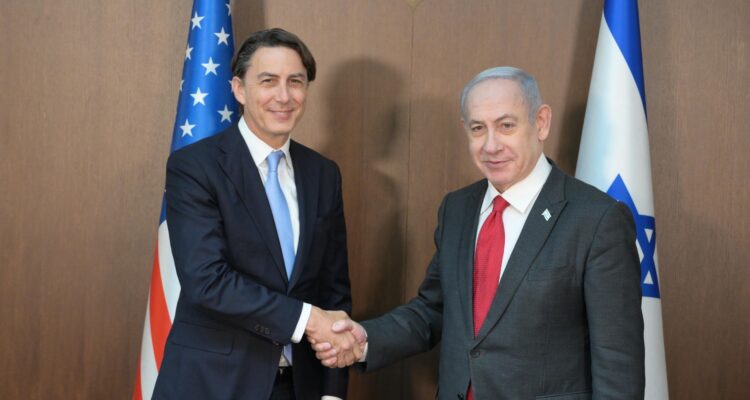
In an unusually candid and strategically layered conversation at the Israel Hayom Summit on Tuesday, Amos Hochstein — the Biden administration’s former special envoy and one of the most influential behind-the-scenes architects of U.S. policy in the Levant — delivered a nuanced, sober assessment of the turbulent year since the temporary Israel-Hezbollah ceasefire went into effect after the events of October 7. The interview, published and disseminated by Israel Hayom, underscored the deep complexity of the northern front, the fragility of Lebanon’s domestic politics, and the broader ideological battles shaping American support for Israel.
Hochstein, often regarded as one of Washington’s most pragmatic and hands-on operatives in Middle Eastern diplomacy, began with a warning against simplistic calls for renewed Israeli military action in Lebanon. “It’s very easy to say where these wars start and how we should conduct them,” he told Israel Hayom’s interviewer, stressing that the instinct to “finish the job” militarily may be emotionally compelling but strategically flawed.
Pressed on whether his caution echoed the same American warnings issued shortly before Israel’s 2024 ground incursion into Lebanon — a campaign that significantly degraded Hezbollah but failed to dismantle it — Hochstein offered a pointed clarification. “Let’s be fair,” he said. “We wanted to get to a ceasefire before the land invasion because that is what the Israeli government wanted, and that is what we wanted as well.”
At the time, he explained, the public messaging from both Washington and Jerusalem — that the war would not stop until Hamas stopped its war — had an unintended effect: “It meant that Hamas was going to decide the future of Lebanon.” According to Hochstein, this dynamic created a scenario in which Israel would inevitably “say enough is enough,” but the pathway would require strategic, not just military, planning.
One of the most revealing moments of the interview came when Hochstein directly addressed the origins of the current ceasefire. While some analysts have suggested that Hezbollah had chosen de-escalation for tactical or political reasons, Hochstein insisted that their decision was, above all, a function of weakness.
As he told Israel Hayom, the ceasefire “was not the result of Hezbollah’s goodwill but a demonstration of military weakness.” The group, battered by Israeli operations in late 2024, seized upon the ceasefire as a necessary pause, not an ideological shift.
However, Hochstein revealed that the ceasefire triggered an ambitious political project beneath the surface: “Alongside the ceasefire, efforts began to install a new presidency in Lebanon,” he explained, describing the candidate favored at the time as “the most pro-Western the country has had for years.” The objective, he told Israel Hayom, was to pave the road toward a Lebanese-led initiative to curb Hezbollah’s power.
A year later, he conceded, this vision has faltered. The Lebanese government failed to implement its commitments, and Hezbollah has not been weakened to the point of voluntary disarmament.
Hochstein articulated a hard truth that many policymakers consider privately but rarely state so openly: “Hezbollah must disarm, and the Lebanese government must fulfill what it committed to.” Yet he stressed that this cannot be achieved through Israeli force alone.
“Returning to war will not achieve this,” he warned Israel Hayom, “unless Israel plans a full occupation, which no one wants.”
This argument — couched in the pragmatic language of a seasoned diplomat — frames Hezbollah’s dismantling as a multi-stage process that requires U.S. leadership, Lebanese governmental initiative, and a clear action plan. Military power could create conditions, Hochstein noted, but it cannot by itself achieve the political transformation needed for long-term stability.
The solution, he said, must involve “evacuating the south [of Lebanon], disbanding long-range missiles, and implementing actionable steps on clear schedules,” all within an American-backed political framework.
Pressed on how long Israel should wait for Lebanon to act, he refused to impose any artificial timeline. But he did underscore what Israel Hayom described as the central thrust of his message: that Washington must lead a “practical path, rather than merely issuing declarations.”
Before delving into geopolitics, Hochstein opened the interview with a personal memory from the early days following the October 7 massacre. “I was there when Biden refused to leave the call — that is a moment that will stay with me all my life,” he said, recounting the harrowing conversations with the families of hostages.
Israel Hayom reported that Hochstein spoke with striking emotion, describing the “initial moments of anxiety” as U.S. officials scrambled to assure families that America was fully engaged in securing the captives’ release. This recollection, delivered before the more technical diplomatic analysis, framed the interview with an unmistakable sense of moral urgency.
In assessing the situation in Lebanon a year after the ceasefire, Hochstein did not mince words. The Lebanese government, he told Israel Hayom, has “not fulfilled its part,” and Hezbollah’s grip on the country remains stronger than any diplomatic wish could undo.
Still, he insisted that “Israel must give the Lebanese government a genuine opportunity to lead the move before opting for a military solution.” This approach, he argued, is not naïve but strategic: Lebanon must be pressured into reform, not allowed to collapse further into the hands of its most powerful militia.
In this sense, the U.S. envoy drew a sharp distinction between weakening Hezbollah militarily and dismantling its political architecture — a difference Israel Hayom noted as central to Hochstein’s doctrine.
Late in the interview, the discussion shifted to a contentious domestic issue in the United States: the perception that the Democratic Party is distancing itself from Israel.
Hochstein rejected this characterization outright. “There is still strong support, both in Israel and among American Jewry,” he told Israel Hayom. “Not all Democrats are Mamdani.”
The reference to Zohran Mamdani — the New York politician whose election has become a symbol of generational backlash against Israel — was deliberate. Hochstein stressed that the political dynamics driving younger, social-media-shaped constituencies should not be conflated with mainstream Democratic policy.
“The U.S. is still the safest place for Jews in the world,” he said. “And I believe it will remain so.”
Yet he did not shy away from acknowledging rising antisemitism, noting that it exists “on both the left and the right.” The issue, he argued — echoing themes reported repeatedly by Israel Hayom — is not partisan but cultural, generational, and deeply intertwined with online misinformation.
As Israel Hayom has emphasized throughout its summit coverage, one of the central looming questions in Israel’s strategic landscape is whether the northern front is sliding inevitably back toward war or whether international diplomacy can stabilize it.
Hochstein remains cautiously optimistic. He believes that war is not inevitable — but only if the United States, Israel, and Lebanon commit to a coordinated, meticulously staged plan.
Without such a plan, the status quo will deteriorate.
“You cannot live in a state of war,” he said bluntly. “The Lebanese have to do it.”
The remark — understated but clear — reflects Hochstein’s belief that Lebanon must reclaim sovereignty over its south. Yet according to Israel Hayom’s recounting, he repeatedly emphasized Israel’s right to defend itself and acknowledged that patience cannot be infinite.
The interview closed on a note of measured hope. Despite the challenges in Lebanon, the ongoing tension with Hezbollah, and the ideological battles roiling the United States, Hochstein argued that history offers reason for confidence.
“History has proven that it is possible to cope with these waves,” he said. “We need to fight — and not give up.”
As Israel Hayom reported, Hochstein’s message was neither fatalistic nor naïve. It was a call for strategic discipline, diplomatic resolve, and a recognition that the next phase — in Lebanon, in Israel, and in global Jewish life — will be defined not only by military force but by political endurance and the ability to outlast adversaries on every front.