



|
Getting your Trinity Audio player ready...
|
By: Fern Sidman
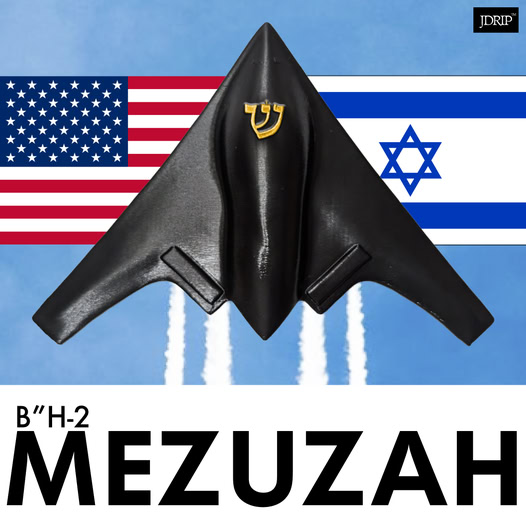
In a gesture both deeply symbolic and diplomatically charged, Israeli Prime Minister Benjamin Netanyahu on Tuesday evening presented President Donald J. Trump with a mezuzah molded in the shape of a B-2 Spirit stealth bomber — a singular tribute to the American aircraft that struck Iran’s nuclear installation at Fordow in June. The dinner, held in the intimate setting of the White House’s Blue Room, was marked by warmth, strategic alignment, and a shared sense of mission — one reflected in the evolving personal tradition of meaningful gift-giving between the two leaders.
According to a report that appeared on Wednesday in Israel Hayom, the mezuzah — typically affixed to doorposts in Jewish homes — was reimagined in polished silver alloy, with the iconic sweeping wings of the B-2 bomber forming its casing. Within it, as tradition requires, was a parchment inscribed with the Shema, the ancient Jewish declaration of faith and divine protection.
Sources within the Israeli delegation confirmed to Israel Hayom that the choice of the B-2 form was no arbitrary artistic flourish. Rather, it was intended as a symbolic fusion of ancient covenant and contemporary deterrence, of spiritual resilience and military strength — a message Netanyahu conveyed personally during the dinner, reportedly stating, “This is our shield, and the B-2 is yours. Together, we ensure the peace of generations.”
This offering followed a prior exchange that has become legendary in inner diplomatic circles. As Israel Hayom previously reported, five months ago Netanyahu gifted Trump a set of pagers — one golden, one standard — as a nod to Israel’s high-stakes “pager operation” that neutralized key Hezbollah operatives in southern Lebanon. Trump’s reaction, characterized by immediacy and insight, was reportedly: “That was a tremendous operation,” before the two proceeded to the Oval Office for further briefings.
The deepening of symbolic and strategic ties between Netanyahu and Trump was further cemented during an unscheduled, private two-hour session held on Wednesday — the second such encounter in just 24 hours. As confirmed by both Israeli and American officials speaking to Israel Hayom, this second meeting was conducted with the utmost discretion: no press access, no public remarks, no photos. It was a meeting designed for candor, continuity, and collaboration.
The B2 Mezuzah. Symbolizing Israel’s dream of peace, it arms itself with a mezuzah scroll, not a weapon. The B-2 may be essential today, but we long for a world where the mezuzah alone stands watch – our spiritual shield for over 3,000 years.❤️🇮🇱✡️ pic.twitter.com/oCoZ46G5ls
— j wall ✡ (@jwhaifa) June 28, 2025
Israel Hayom reported that Netanyahu and Trump discussed a broad range of high-priority issues, including the evolving ceasefire negotiations with Hamas, the implications of last month’s joint U.S.-Israel air campaign against Iran, and plans for the next phase of the Abraham Accords. The timing of the visit — coming on the heels of critical hostage negotiations and just weeks after U.S. B-2 bombers penetrated Iranian airspace to demolish the nuclear infrastructure at Fordow — added gravitas to what has become one of the most consequential bilateral relationships in recent decades.
Sources close to the Israeli Prime Minister’s Office told Israel Hayom that Netanyahu sees in Trump not only a geopolitical ally but a “historic partner in reshaping the Middle East.” That language was reflected in the tone of both meetings, described as “strategically urgent and personally warm,” with Netanyahu repeatedly thanking Trump for “your unwavering commitment to Israel’s security and sovereignty.”
While the mezuzah itself will likely find a place of honor among Trump’s diplomatic memorabilia, its deeper meaning — the fusion of American airpower with Jewish identity and resolve — will not be lost on either leader’s base. As one senior Israeli official told Israel Hayom, “This gift is not merely decorative. It is declarative. It says to Iran, to Hamas, to every adversary: our alliance is not symbolic. It is sacred.”
The timing of the gift is also significant. As the Israel Hayom report pointed out, Netanyahu’s Washington trip comes at a moment when questions are swirling in European and Middle Eastern capitals about the future of U.S. policy in the region — particularly in light of the unfolding ceasefire dynamics in Gaza. Presenting Trump with a mezuzah shaped like a B-2 bomber, then, is not just a moment of shared remembrance — it is a projection of future alignment.
During the dinner, Netanyahu reportedly updated Trump on the status of hostage negotiations and praised U.S. special envoy Steve Witkoff’s involvement in brokering terms. But it was the discussion surrounding Iran — its nuclear ambitions, its diminished air defenses post-strike, and its diplomatic isolation — that dominated the agenda. According to the information contained in the Israel Hayom report, the leaders reviewed operational outcomes from the Fordow strike and discussed next steps in countering Iranian proxies across the region.
The symbolism of the mezuzah may also reflect Netanyahu’s broader effort to anchor the Israeli-American relationship in values as well as interests. In Jewish tradition, the mezuzah is a daily reminder of divine vigilance, often viewed as a spiritual guardian of the home. By transforming this sacred object into the shape of an American weapon that protected Israeli lives and neutralized existential threats, Netanyahu appeared to be signaling a bond that transcends mere alliance — it is a covenant of survival.
Trump, for his part, responded with his characteristic mixture of appreciation and bravado. While no public readout of the dinner was issued, aides close to both leaders told Israel Hayom that Trump was visibly moved by the gift and praised Netanyahu for his “moral clarity and military precision.” One source quoted the president as saying, “Bibi always understands the message. He doesn’t just talk about defending his country — he defends it.”
As the two leaders left the dinner, the political theater may have been minimal — no handshakes for the cameras, no staged photo ops — but the substance, according to the report in Israel Hayom, was undeniable: two allies reaffirming their partnership not only in arms but in belief.
With regional tremors continuing and diplomatic tracks opening slowly through Qatar and the Abraham Accords, Tuesday’s symbolic exchange may yet be remembered not merely as an act of personal friendship — but as a marker of a new phase in Middle East strategy, one where symbols, too, are weapons.
For Netanyahu and Trump, the mezuzah in the form of a bomber wasn’t just a gift. It was a mission statement.
