



|
Getting your Trinity Audio player ready...
|
By: Fern Sidman
For nearly half a century, the Heritage Foundation has stood as one of the most formidable pillars of American conservatism—a think tank whose policy blueprints helped shape presidential agendas, judicial philosophies, and the intellectual infrastructure of the Republican movement. Today, however, the institution finds itself engulfed in an internal crisis of unprecedented scale. According to an exclusive report on Sunday by Newsmax, more than 60 senior staff members, fellows, and trustees have departed the organization in recent months, the fallout from a controversy that has shaken donor confidence, fractured internal cohesion, and raised fundamental questions about Heritage’s moral and strategic direction.
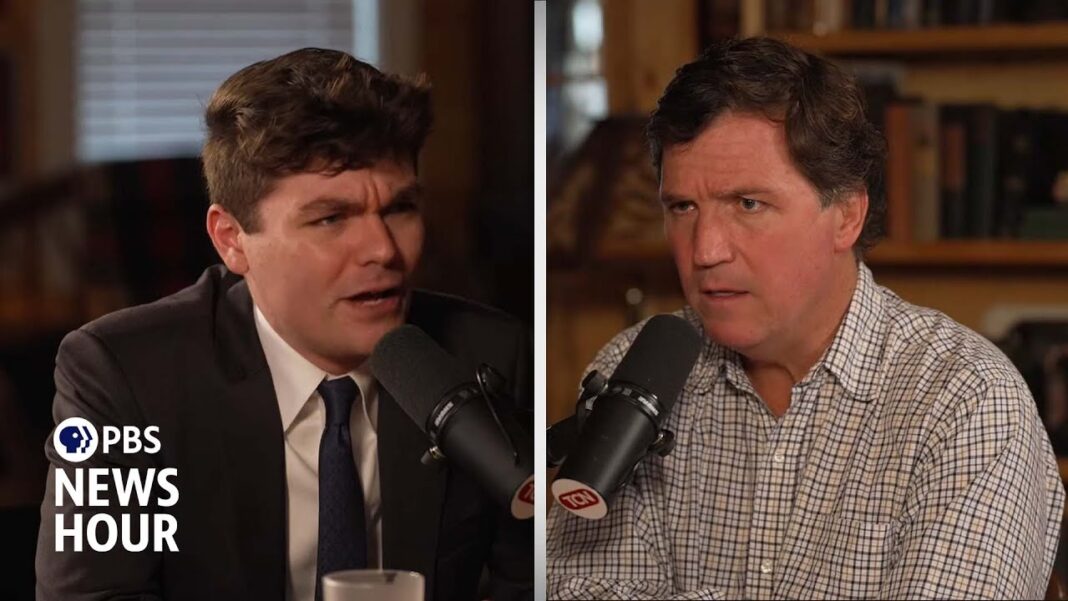
At the center of the storm is Heritage President Kevin Roberts, whose public defense of controversial media figures Tucker Carlson and Nick Fuentes ignited a backlash that continues to reverberate through Washington’s conservative ecosystem. Fuentes, a far-right commentator with a long record of white nationalist rhetoric and Holocaust denial, appeared on Carlson’s program in an interview that was widely condemned across the political spectrum. When criticism mounted, Roberts posted a video on social media vowing that Heritage would not “cancel” Carlson, whom he described as a close personal friend. He framed Carlson’s detractors as part of a “venomous coalition” seeking to silence conservative voices.
The statement, as the Newsmax report detailed, was met with immediate alarm both inside and outside the organization. Jewish leaders, longtime Heritage allies, and numerous staff members interpreted the language as an implicit defense of antisemitism and an unacceptable equivocation in the face of bigotry. Within days, senior analysts and respected scholars began to distance themselves from the institution.
Andrew Hale, a prominent policy analyst who recently left Heritage, captured the sentiment of many in comments reported by Newsmax and Jewish Insider: “I can roll with policy changes, but what I can’t roll with is a tolerance or an overlooking of antisemitism or any form of bigotry.” His departure, like dozens of others, underscored the widening gap between Heritage’s traditional image as a mainstream conservative policy shop and what critics now describe as a troubling drift toward extremist accommodation.
In the wake of the initial uproar, Roberts issued a follow-up video apology and addressed staff in an internal meeting, acknowledging that he had “made a mistake.” Yet as Newsmax noted in its report, the apology was widely viewed as incomplete. Roberts never explicitly criticized Carlson’s decision to platform Fuentes, nor did he clearly disavow the antisemitic views expressed in the interview. Compounding the problem, the original video defending Carlson remains posted on Roberts’ X account—an enduring symbol, critics say, of unresolved ambiguity at the organization’s highest levels.
The consequences have been swift and severe. Newsmax has learned that the exodus from Heritage has spanned multiple departments and levels of leadership, including longtime policy experts and senior fellows whose names were once synonymous with the think tank’s credibility. Among those who have stepped away are distinguished scholars such as economist Stephen Moore and legal experts Chris DeMuth and Hans von Spakovsky—figures who helped craft Heritage’s reputation as a serious intellectual force rather than a partisan megaphone.
Even more striking has been the upheaval on the board of trustees. According to the information provided in the Newsmax report, five board members—including Darryle Owens, Price Harding, Robert P. George, Abby Moffat, and Shane McCullar—have resigned in protest of Roberts’ leadership. Their departures signal not merely internal disagreement but a profound institutional rupture. In a joint statement provided to Newsmax, Owens and Harding directly contradicted Heritage’s suggestion that the resignations were part of a planned “realignment,” asserting unequivocally: “We each chose to resign.”
The loss of so many respected voices has had a predictable effect on donor confidence. Heritage has long depended on a network of conservative philanthropists to fund its ambitious policy agenda. But as Newsmax has reported, several major benefactors have curtailed or suspended contributions altogether, citing concerns over governance, strategic judgment, and reputational risk. Insiders told Newsmax that the organization has increasingly relied on its substantial endowment—estimated at more than $300 million—to meet operating expenses, a financial strategy widely considered unsustainable if donor enthusiasm does not return.
To understand the magnitude of the crisis, one must appreciate the historic stature of the Heritage Foundation. Founded in 1973, it became the intellectual engine behind the Reagan Revolution and, more recently, a central architect of the conservative policy agenda during the Trump years. Its research reports, legal analyses, and personnel recommendations have shaped everything from tax policy to Supreme Court nominations. For decades, it was regarded as the gold standard of right-of-center thought leadership.
Yet the developments chronicled by Newsmax suggest that Heritage now faces an existential crossroads. Critics argue that by aligning itself—intentionally or not—with figures associated with antisemitism and racial extremism, the organization risks alienating the very mainstream conservatives who once formed its core constituency.
Despite the turmoil, the current board of trustees, led by Chairwoman Barb Van Andel-Gaby, has declined to remove Roberts or issue a formal repudiation of Carlson. Newsmax reported that Van Andel-Gaby, who also serves on the board of Alticor, the parent company of Amway, continues to support Roberts’ leadership, even as internal dissent grows louder. For many observers, this steadfast backing has only deepened the perception that Heritage is unwilling—or unable—to confront the moral implications of its recent choices.
As Heritage struggles to contain the damage, rival institutions have moved quickly to capitalize on the upheaval. One of the clearest beneficiaries, according to Newsmax, is Advancing American Freedom (AAF), a think tank founded by former Vice President Mike Pence. In recent months, AAF has hired more than 20 former Heritage employees, effectively absorbing talent that once gave the older institution its intellectual heft. Former Attorney General Edwin Meese III has also lent his support to a new legal center at AAF, placing it in direct competition with a similarly named Heritage initiative.
The migration of personnel from Heritage to AAF is more than a bureaucratic reshuffling; it represents a broader realignment within the conservative movement. Where Heritage once functioned as the undisputed hub of policy expertise, a new generation of organizations is now emerging to fill the vacuum created by internal discord. As the Newsmax report observed, the erosion of Heritage’s intellectual bench could have long-term implications for its ability to influence Republican policymakers.
Heritage officials, for their part, have attempted to portray the departures as part of a deliberate restructuring aimed at increasing efficiency and impact. A spokesperson told Newsmax that the changes reflected an internal effort to modernize the organization and sharpen its focus. But such explanations have done little to quiet skepticism, particularly in light of the public statements by former trustees disputing that narrative.
Beyond the immediate personnel and financial consequences lies a deeper philosophical dilemma. The conservative movement has long prided itself on a commitment to constitutional principles, individual dignity, and moral clarity. The controversy over Roberts’ comments—and the perception that Heritage hesitated to draw a firm line against antisemitism—has forced many to ask whether those values are being compromised in the pursuit of short-term political alliances.
Newsmax’s ongoing coverage of the situation has underscored how rapidly reputational damage can accumulate in the modern media environment. What began as a single video statement has metastasized into a full-blown institutional reckoning, with ramifications that extend far beyond the walls of Heritage’s Washington headquarters.
Whether the foundation can recover remains an open question. Some longtime supporters hope that new leadership or a decisive policy reset could restore trust and stabilize the organization. Others fear that the brand, once tarnished, may never fully regain its former luster.
What is clear is that the Heritage Foundation now stands at a pivotal juncture. The departures of more than 60 senior figures are not merely statistics; they are a stark measure of the disillusionment felt by individuals who once dedicated their careers to advancing Heritage’s mission. The challenge ahead will be to determine whether that mission can be reclaimed—or whether a venerable institution is witnessing the twilight of its influence.
For an organization that once shaped the destiny of American conservatism, the stakes could hardly be higher.

They have lost my support. Roberts must go.