



|
Getting your Trinity Audio player ready...
|
By: Fern Sidman
In a dramatic and politically charged moment on Capitol Hill, more than 100 House Democrats voted against a Republican-led resolution on Monday that condemned both a recent antisemitic terrorist attack in Boulder, Colorado, and the state’s controversial sanctuary laws. As reported by The New York Post, the resolution — introduced by Rep. Gabe Evans (R-Colo.) — passed the House in a 280–113 vote, with 75 Democrats breaking ranks to join Republicans in support.
The measure, while ostensibly a condemnation of an act of terrorism targeting Jewish Americans, quickly became a lightning rod for partisan dispute. At issue for many Democrats was not the denunciation of antisemitism itself, but language in the bill praising law enforcement and specifically Immigration and Customs Enforcement (ICE) personnel. According to the information provided in The New York Post report, the resolution commended “law enforcement, including US Immigration and Customs Enforcement personnel, for protecting the homeland,” a clause that proved divisive and was seen by critics as politicizing what should have been a unified response to a hate crime.
The resolution emerged in response to a violent June 1 attack in Boulder, where an Egyptian national, Mohammed Sabry Soliman, allegedly firebombed a peaceful pro-Israel demonstration using Molotov cocktails and a makeshift flamethrower. The New York Post report indicated that the suspect — who reportedly shouted “Free Palestine” during the attack — had overstayed his visa and was living in Colorado under the protection of its sanctuary policies. The assault injured 15 people and has been widely condemned as an act of antisemitic terrorism.
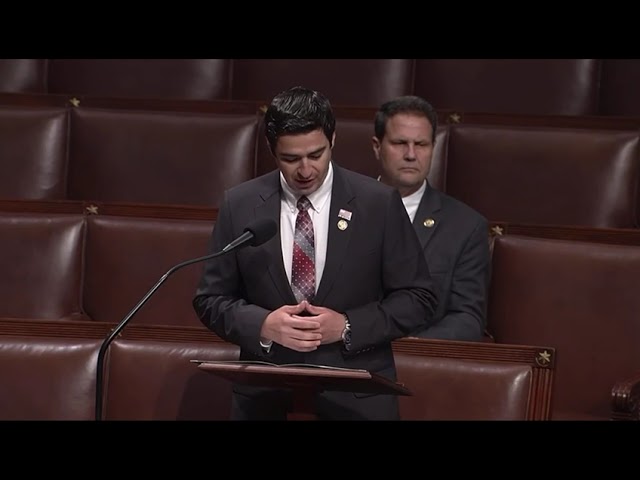
In his floor speech, Evans, a former police officer and U.S. Army veteran, forcefully argued that Colorado’s sanctuary laws facilitated the tragedy. “Colorado’s radical leftist leaders and laws prioritize illegal immigrants over public safety — allowing antisemitic terrorists like Mohammed Sabry Soliman to strike,” he said, as per The New York Post report. He framed the resolution as not merely symbolic but as an urgent call for policy coherence between local and federal law enforcement.
“This resolution ensures we condemn all acts of antisemitism and affirms that the free and open collaboration between state and local law enforcement with their federal counterparts is key in preventing future attacks like this,” Evans declared from the House floor.
Yet despite the horrific nature of the attack, many in the Democratic caucus criticized the resolution as political theater. The report in The New York Post said that House Minority Leader Hakeem Jeffries (D-NY) dismissed Evans as a “joke” and condemned what he described as an insincere attempt to address antisemitism. “Who is this guy?” Jeffries asked during a press gaggle. “He’s not seriously concerned with combating antisemitism in America. This is not a serious effort. Antisemitism is a scourge on America. It shouldn’t be weaponized politically.”
Evans fired back swiftly, calling Jeffries’ comments “wildly offensive” and emblematic of why antisemitism continues to fester. “The Left is unserious about finding real solutions,” he said on X. “Condemning terrorism is not a joking matter.”
The New York Post report noted that the backlash didn’t stop with party leadership. Rep. Dan Goldman (D-NY), who is Jewish and often outspoken on issues affecting the Jewish community, voted against the resolution. Taking the floor, Goldman accused Republicans of using Jewish suffering as a “pawn” in their political game. “You weren’t here, Mr. Evans, last term,” he said. “But there were about 10 antisemitism resolutions that effectively said the same thing solely to score political points.”
Goldman’s remarks struck a chord with many Democrats who felt that the invocation of ICE and the emphasis on sanctuary policies were attempts to conflate immigration issues with legitimate concerns about antisemitism. However, the report in The New York Post said that Republicans were quick to highlight the contradiction of opposing a measure that clearly denounced an antisemitic terrorist act.
The National Republican Congressional Committee (NRCC), the House GOP’s campaign arm, wasted no time in turning the vote into a potent political talking point. “Democrats have become the pro-terrorist, anti-cop, antisemitic caucus. And they’re proud of it,” the NRCC wrote on X. The organization accused Democrats of siding with a terrorist over police officers by refusing to support the resolution.
In what The New York Post report described as a damning post-vote summary, the NRCC argued that “Democrats voting against the bill sided with terrorists over police officers and flat-out refused to condemn antisemitism.”
The statement struck a raw nerve and is likely to be replayed in campaign ads and conservative media, particularly in swing districts with significant Jewish populations or strong support for law enforcement.
Interestingly, the same session saw another resolution — introduced jointly by Reps. Jeff Van Drew (R-NJ) and Joe Neguse (D-Colo.) — that more broadly condemned the national rise in antisemitic incidents. The Post report said that resolution passed unanimously, 400-0, underscoring that consensus on the issue of antisemitism is possible — when stripped of controversial policy linkages.
But Evans maintained that his version was the one that addressed the core issues behind the Boulder attack. “Without the ability for ICE to work with local law enforcement, violent individuals like Soliman slip through the cracks,” he argued, adding that “feel-good resolutions are no substitute for confronting the policies that create danger.”
As The New York Post report observed in its coverage, the vote exposed not only ideological divisions but a deeper discomfort over how antisemitism should be addressed within the broader context of national politics. For Republicans, especially in an election year, the resolution serves as a cudgel against Democrats who appear reluctant to align with law enforcement or take a hard stance on immigration enforcement. For Democrats, it’s a warning sign of how quickly a shared concern — the safety of Jewish Americans — can be politicized beyond recognition.
The fallout from the vote is expected to reverberate for weeks, if not months, as both parties try to define their approach to combating antisemitism amid an increasingly polarized political environment. And as The New York Post report indicated, the voices of those injured in Boulder — and the communities still living in fear — may ultimately be drowned out by the noise of partisan warfare on Capitol Hill.
