



|
Getting your Trinity Audio player ready...
|
By: Fern Sidman
Ukrainian President Volodymyr Zelenskyy arrived at the White House on Monday for a meeting with President Donald Trump and a cadre of senior European leaders, marking what observers described as one of the most critical moments in the transatlantic alliance since the Russian invasion of Ukraine began nearly three years ago. According to an Associated Press report, the high-profile gathering signaled both progress in Western diplomacy and the underlying anxieties following Trump’s recent summit with Russian President Vladimir Putin in Alaska.
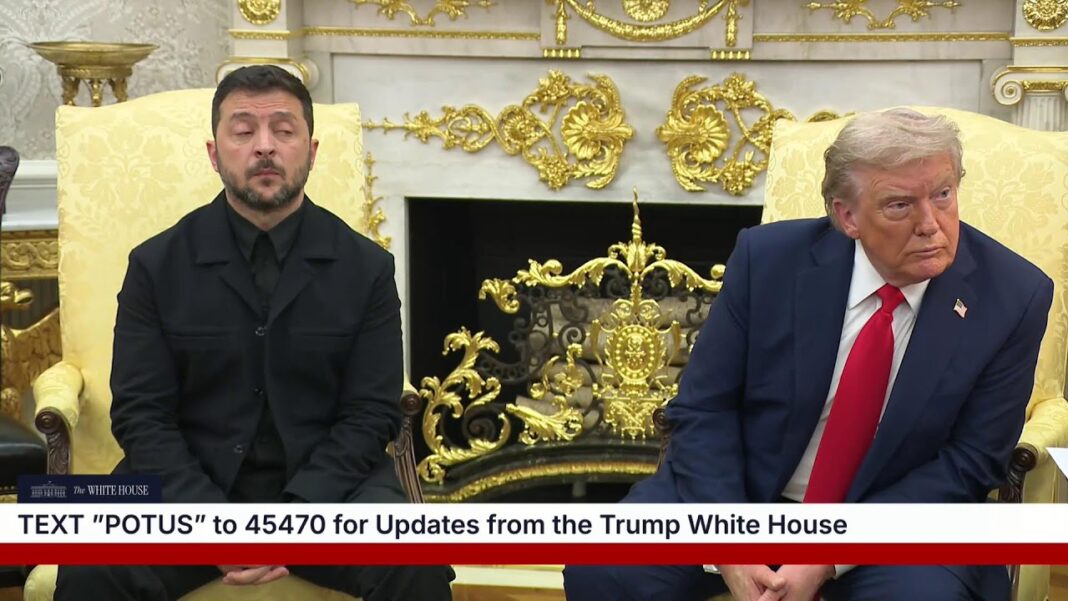
The Associated Press reported that Zelenskyy, dressed entirely in black—a button-to-neck dress shirt, trousers, and a boxy jacket—arrived at approximately 1:15 p.m. ET to a warm reception from Trump at the South Portico. The austere attire underscored the somber stakes of the meeting, as the Ukrainian leader sought to remind Washington and its European allies of the existential struggle his country continues to wage against Moscow’s aggression.
Trump, smiling and extending a firm handshake, led Zelenskyy into the White House, where a roster of European leaders, many of whom had been excluded from last week’s U.S.-Russia talks, were already gathered.
The Associated Press report emphasized that Monday’s convening represented more than a bilateral exchange; it was a staging ground for Europe’s leading statesmen to assert their voice after being sidelined in Trump’s one-on-one summit with Putin. Held in Anchorage just three days earlier, that meeting produced ambiguous signals—public declarations of “constructive dialogue” from both leaders, coupled with concerns among European capitals that Washington might be inching toward concessions on Ukraine without their input.
The White House, according to the Associated Press report, invited figures from France, Germany, Poland, and the Baltic states, creating a tableau of unity but also a tacit acknowledgment that the Western alliance is not fully aligned in its approach to Moscow.
“This is a rare and sweeping show of diplomatic force,” one European official told the Associated Press, speaking on condition of anonymity. “It is a clear message that the fate of Ukraine will not be decided in Washington and Moscow alone.”
During brief remarks ahead of the private talks, Trump told reporters: “If everything works out well today, we’ll have a trilat—and I think there will be a reasonable chance of ending the war when we do that.”
The Associated Press report noted that Trump’s use of the term “trilat” appeared to suggest a trilateral arrangement involving the United States, Ukraine, and Russia. Such a configuration would represent a marked shift from the multilateral Normandy Format, which has historically involved Germany and France alongside Ukraine and Russia.
Analysts told the Associated Press that Trump’s framing raised concerns in European capitals that Washington may be contemplating a streamlined process that excludes some long-standing partners. While Trump insisted that any agreement would safeguard Ukraine’s sovereignty, diplomats from Berlin and Paris expressed unease that reducing the negotiating table could weaken Europe’s leverage and embolden Moscow.
For Zelenskyy, the stakes could not be higher. As the Associated Press reported, his primary objective was to secure explicit guarantees of continued U.S. military and financial support, particularly in the face of war fatigue among Western publics. His secondary goal, European envoys suggested, was to ensure that any U.S.-Russia dialogue does not leave Ukraine vulnerable to territorial concessions or diminished sovereignty.
“Ukraine is not here to be spoken about, but to be spoken with,” a senior Ukrainian official told the Associated Press on the eve of the summit. “President Zelenskyy is determined to make sure our voice is heard directly.”
Zelenskyy’s presence in Washington also carried symbolic weight. His decision to wear all black, according to aides cited by the Associated Press, was intended as a visual reminder of Ukraine’s ongoing mourning for thousands of civilians and soldiers lost in the conflict.
The Associated Press report highlighted that Monday’s gathering also exposed fault lines within Europe itself. While Eastern European nations such as Poland and Lithuania have pressed for uncompromising positions against Moscow, larger powers like France and Germany have shown greater openness to exploring diplomatic off-ramps, albeit cautiously.
For many, the overriding priority was to prevent Trump and Putin from dictating the terms of peace in a manner that sidelined European interests. “We are here to safeguard not only Ukraine, but the security architecture of Europe itself,” one German diplomat told the Associated Press.
Both Trump and Zelenskyy carried domestic pressures into the room. Trump, entering the latter half of his term, faces mounting scrutiny from Congress over his handling of foreign policy and the perception that he has been overly accommodating toward Moscow. According to the information provided in the Associated Press report, some lawmakers privately fear that Trump’s eagerness for a headline-grabbing peace deal could come at the expense of Ukraine’s security.
Zelenskyy, for his part, has confronted eroding public confidence at home, where the toll of war has strained Ukraine’s economy and tested the resilience of its population. The Associated Press reported that Zelenskyy’s approval ratings have slipped in recent months, increasing the urgency for him to demonstrate tangible results from his trip to Washington.
Despite the lofty rhetoric, few expected Monday’s meeting to yield immediate breakthroughs. Instead, the gathering was widely viewed as a staging ground for further talks—possibly a summit that would indeed include Russia in the coming months.
According to the information contained in the Associated Press report, White House officials have been careful to frame the event as part of an ongoing process rather than a definitive turning point. National Security Adviser Robert O’Brien told reporters that the administration is “laying the groundwork for a pathway to peace,” but cautioned that “this will take time, persistence, and unity among allies.”
As the delegations prepared for a series of closed-door sessions, the atmosphere in Washington was one of cautious optimism tinged with unease. The Associated Press described the scene as emblematic of the larger challenge facing the West: balancing the pursuit of peace with the imperative of not compromising the principles of sovereignty and security that underpin the international order.
For Zelenskyy, Trump, and the assembled European leaders, Monday’s meeting may prove less a moment of resolution than a test of endurance—an early indication of whether the fractured alliance of democracies can remain united in the face of an aggressive Kremlin.
And while Trump spoke of a “reasonable chance of ending the war,” the Associated Press report emphasized that the road from Washington to peace in Ukraine remains uncertain, fraught with peril, and defined by the relentless calculations of geopolitics.
