



|
Getting your Trinity Audio player ready...
|
By: Tzirel Rosenblatt
The Trump administration has sharply escalated its pressure campaign on the Palestinian Authority (P.A.), issuing sweeping new restrictions on visa applications by holders of Palestinian Authority travel documents, The New York Times reported on Sunday. According to four senior American officials, the policy—outlined in an Aug. 18 diplomatic cable sent to all U.S. missions worldwide—represents the most far-reaching attempt yet to limit Palestinian entry into the United States.
As The Jewish News Syndicate (JNS) has noted in its coverage on Monday of U.S.-Israel relations, the move calls attention to Washington’s determination to hold both the Palestine Liberation Organization (PLO) and the P.A. accountable for their ongoing refusal to renounce terrorism and end systematic incitement within Palestinian educational and political structures.
Until now, U.S. policy had already imposed a near-total suspension of visitor visas for Palestinians in the Gaza Strip, a measure announced on Aug. 16. The new restrictions, however, extend far beyond Gaza. They now encompass Palestinians residing in Judea and Samaria who hold only P.A.-issued travel documents.
Under the new rules, such individuals will be barred from entering the United States for virtually all purposes—including higher education, medical treatment, family visits, business travel, or conferences. The only exceptions, according to officials cited in The New York Times report, are for Palestinians who hold dual nationality and apply with their second passport, or for those who already possess valid U.S. visas.
A spokesperson for the State Department confirmed the new measures, telling the Times that embassies and consulates had been instructed to enforce the restrictions immediately. The department described the decision as “concrete steps in compliance with U.S. law and our national security in regards to announced visa restrictions.”
The JNS report highlighted that these measures mark a significant tightening of U.S. policy and reflect a broader Trump administration strategy of aligning U.S. immigration law with the fight against Palestinian terror finance and incitement.
The administration is reportedly invoking Section 221(g) of the Immigration and Nationality Act of 1952 to justify the denials. Ordinarily, this provision is applied in narrow cases to request additional documentation from visa applicants. In this instance, however, Washington has used the statute in a sweeping fashion to deny visas outright to holders of P.A. travel papers.
According to the information provided in the JNS report, this creative use of immigration law reflects the administration’s intent to use every available legal tool to increase pressure on Ramallah’s leadership.
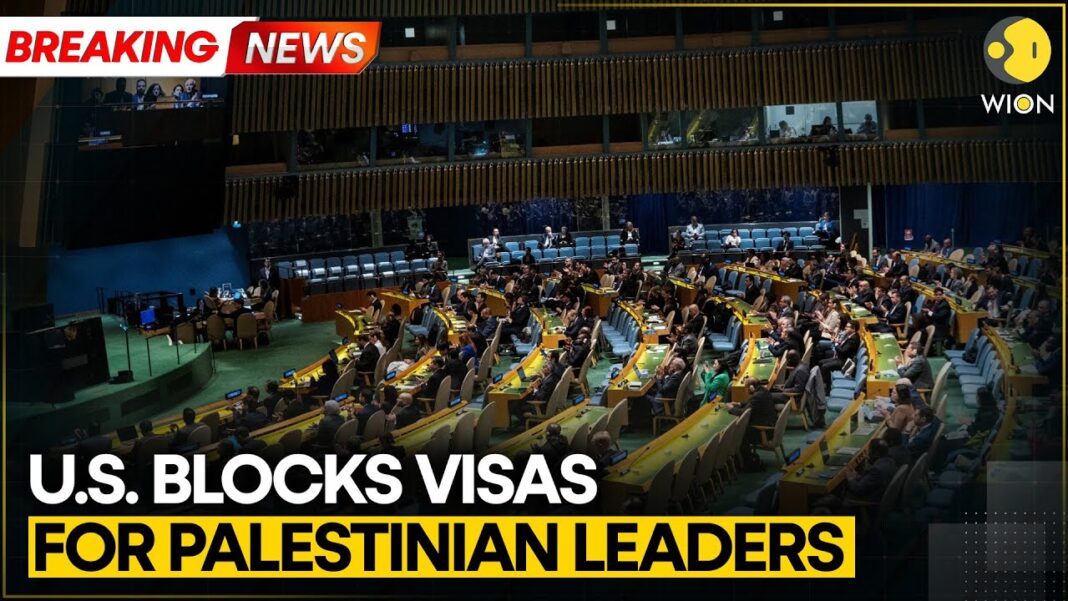
The visa crackdown follows another move by the State Department on Aug. 16 to deny new visas and revoke existing ones for individuals affiliated with the PLO and the Palestinian Authority ahead of next month’s United Nations General Assembly (UNGA) in New York.
“The Trump administration has been clear: It is in our national security interests to hold the PLO and P.A. accountable for not complying with their commitments and for undermining the prospects for peace,” a State Department memo declared.
The statement added pointedly: “Before the PLO and P.A. can be considered partners for peace, they must consistently repudiate terrorism—including the Oct. 7 massacre—and end incitement to terrorism in education, as required by U.S. law and as promised by the PLO.”
As JNS reported extensively in the aftermath of Hamas’s Oct. 7 massacre across southern Israel, Washington has become increasingly critical of Palestinian leaders who continue to glorify violence, subsidize “pay-to-slay” stipends for convicted terrorists, and encourage anti-Israel indoctrination in schools.
For ordinary Palestinians in Judea and Samaria who hold only P.A. travel documents, the new rules will carry serious consequences. Many who had sought visas for medical treatment at advanced U.S. hospitals, or students accepted into American universities, will now find their applications categorically denied.
According to the information contained in the JNS report, the administration’s calculus appears to be that such inconveniences, though painful on an individual level, pale in comparison to the imperative of ending institutional support for terrorism. By placing the burden squarely on the P.A., Washington is signaling that change in Ramallah’s political culture is the only path to improved relations.
The move also comes against the backdrop of shifting U.S. policy toward the Israeli-Palestinian conflict. The Trump administration has made no secret of its skepticism toward the P.A.’s role as a legitimate peace partner. Instead, it has focused on bolstering direct U.S.-Israel ties and brokering normalization agreements between Israel and Arab states.
The JNS report noted that by barring P.A. officials from attending the United Nations General Assembly, the administration has undercut Palestinian efforts to wage “lawfare” against Israel in international forums. Washington has explicitly cited the P.A.’s attempts to bypass direct negotiations by appealing to the International Criminal Court (ICC) and the International Court of Justice (ICJ) as violations of U.S. expectations under existing agreements.
Reactions to the policy have been predictably polarized. Pro-Israel groups welcomed the announcement, with some analysts telling JNS that the administration is “finally holding the Palestinian Authority accountable for decades of duplicity.”
Palestinian officials, by contrast, decried the measure as collective punishment. Human rights advocates expressed concern that sick patients and students would be disproportionately harmed. Yet U.S. officials countered that exceptions already exist for those with dual nationalities or pre-existing visas, and that the underlying issue is the P.A.’s continued complicity in violence and incitement.
The sweeping new restrictions on visas for holders of P.A. travel documents mark a dramatic escalation in the Trump administration’s policy toward the Palestinian leadership. By invoking rarely used provisions of U.S. immigration law and extending the visa ban beyond Gaza into Judea and Samaria, Washington is signaling that it intends to hold Palestinian officials to account for their refusal to renounce terrorism and their persistent glorification of violence.
As the JNS report emphasized, the move shines a proverbial spotlight on a fundamental shift in U.S. strategy: leveraging immigration policy, diplomatic forums, and international law to curtail Palestinian maneuvering and press for change. Whether these measures will alter the P.A.’s behavior remains uncertain, but what is clear is that the administration has raised the stakes dramatically—and placed Ramallah’s leadership under intense new pressure.
