



|
Getting your Trinity Audio player ready...
|
By: Fern Sidman
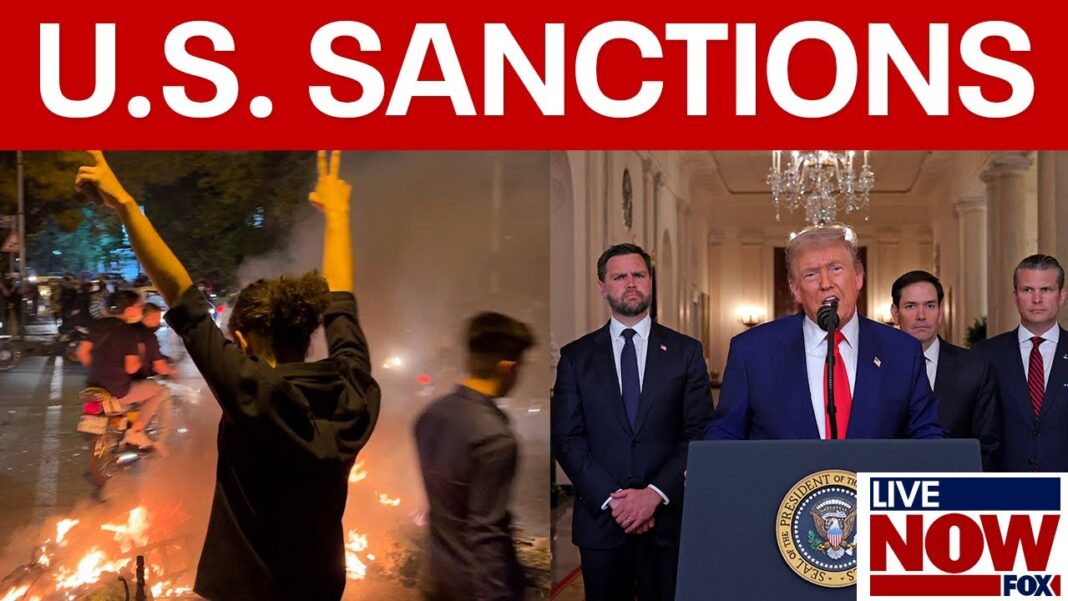
In a dramatic escalation of Washington’s confrontation with Tehran, the Trump administration has launched a new and far-reaching sanctions campaign against the Iranian regime, targeting what officials describe as a clandestine “shadow fleet” of vessels used to secretly transport Iranian النفط and petroleum products across international waters. According to a report on Friday by Israel National News, the move represents not merely another punitive economic measure, but a strategic strike at the financial lifelines that sustain Iran’s internal repression, regional terror infrastructure, and weapons programs.
The sanctions, announced Friday by the U.S. Treasury Department, place nine vessels — along with their owners and management companies — under direct U.S. sanctions authority through the Office of Foreign Assets Control. The administration maintains that these ships form part of a covert maritime network designed to evade international oversight and funnel “hundreds of millions of dollars” in oil revenues into Iranian state coffers. Those revenues, according to U.S. officials cited by Israel National News, are then diverted to fund regional proxy militias, terrorist organizations, and domestic repression campaigns.
This latest round of sanctions extends what the Trump administration has consistently framed as a “maximum pressure” strategy — a comprehensive economic and geopolitical campaign designed to isolate the Iranian regime financially, diplomatically, and militarily. As Israel National News reported, the policy is unfolding amid an intensifying internal crisis inside Iran, where widespread protests demanding basic freedoms have been met with violent crackdowns by state security forces.
Treasury Secretary Scott Bessent, speaking on behalf of the administration, described Iran’s current trajectory in stark terms. In comments cited by Israel National News, Bessent declared that the regime is engaged in “economic self-immolation,” a collapse accelerated by the pressure campaign initiated by President Trump. He accused Tehran of prioritizing terrorist financing over the welfare of its own citizens, warning that the regime’s currency, living standards, and economic stability are now in free fall as a direct result of its own policies.
The moral framing of the sanctions campaign has become a defining feature of the administration’s rhetoric. As the Israel National News report emphasized, the sanctions are not being presented merely as geopolitical leverage, but as instruments of moral accountability. U.S. officials argue that Iran’s economic networks are inseparable from its human rights abuses, and that dismantling those networks is essential to protecting Iranian civilians who are demanding freedom, dignity, and political reform.
Only days earlier, the Treasury Department imposed sanctions on Iranian security officials accused of directing violent crackdowns against peaceful demonstrators. That sequence — targeting individuals responsible for repression, followed by targeting the financial infrastructure that enables repression — reflects a coordinated strategy, one that Israel National News describes as a fusion of human rights policy, economic warfare, and national security doctrine.
But sanctions are only one dimension of the unfolding confrontation.
As Israel National News has reported, President Trump has simultaneously signaled a dramatic military escalation in the region. Speaking to reporters during an in-flight briefing while returning from the World Economic Forum in Davos, Trump described a massive U.S. military buildup in the Middle East, including the deployment of what he called a “big flotilla” and a “massive fleet” heading toward Iran’s sphere of influence.
“We have a lot of ships going in that direction, just in case,” Trump said, in remarks quoted by Israel National News. “We have a big force going toward Iran. I’d rather not see anything happen, but we’re watching them very closely.”
The language was deliberate, calibrated, and unmistakably strategic — signaling deterrence while preserving ambiguity. Trump’s message, as interpreted by Israel National News, was not a declaration of imminent war, but a demonstration of overwhelming capability, designed to alter Iranian calculations without triggering immediate conflict.
Yet Trump’s rhetoric went beyond deterrence.
In one of the most startling claims of his presidency, Trump asserted that he personally intervened to prevent the mass execution of hundreds of Iranian citizens. According to statements cited by Israel National News, Trump said that Iranian authorities had planned to execute 837 people — “mostly young men” — before reversing course following his warning.
“I stopped 837 hangings last Thursday,” Trump said. “They would have been dead. Every one of them would have been hung. This is like from a thousand years ago.” He claimed that after issuing a direct warning to Tehran — threatening unprecedented retaliation — Iranian officials canceled the executions outright. “They didn’t postpone it. They canceled it,” Trump said. “So that was a good sign.”
The claim, whether symbolic, strategic, or literal, became a central narrative thread in the Israel National News report, illustrating the administration’s portrayal of Trump as a direct intervenor in human rights crises — using military deterrence and diplomatic intimidation as tools of humanitarian leverage.
Despite presenting the halted executions as a success, Trump made clear that military preparations would continue unabated. “We have an armada,” he said. “We have a massive fleet heading in that direction. And maybe we won’t have to use it. We’ll see.”
The message was unmistakable: restraint remains possible, but force remains ready.
The confrontation has also extended into economic warfare. Trump announced that new tariffs would soon be imposed on countries that continue trading with Iran, declaring that any nation doing business with Tehran would face a 25 percent tariff penalty. This policy, according to the report at Israel National News, represents a dramatic expansion of secondary sanctions — extending pressure not just to Iran, but to any state or corporation enabling its economy.
At the same time, Trump has repeatedly returned to the Iranian nuclear issue, insisting that Tehran must abandon its nuclear ambitions. “They gotta stop with the nuclear,” he told CNBC in an interview highlighted by Israel National News in their report. The nuclear dimension remains the strategic core of the confrontation, linking economic pressure, military deterrence, and diplomatic isolation into a unified doctrine.
In parallel interviews with CNBC and NewsNation, Trump issued even more explicit threats, declaring that any assassination attempt against him or mass killing of protesters by the Iranian regime would trigger catastrophic retaliation. “Anything ever happens, the whole country is going to get blown up,” he said. “They’re going to wipe them off the face of this earth.”
The language was raw, unfiltered, and intentionally terrifying — designed not for diplomatic subtlety, but for deterrent clarity.
From the perspective of Israel National News, the unfolding events represent a historic inflection point in U.S.–Iran relations. The combination of sanctions on Iran’s shadow fleet, sanctions on security officials, military deployments, economic threats, and nuclear warnings signals a comprehensive pressure architecture — one that fuses financial warfare, military deterrence, moral framing, and strategic intimidation into a single doctrine.
This is not a return to traditional diplomacy. It is not multilateral consensus-building. It is not incremental negotiation.
It is confrontation as strategy.
At the heart of the administration’s narrative, as emphasized in the Israel National News report, lies a moral dichotomy: a regime that funds terror, represses its people, and pursues nuclear weapons versus a global coalition that seeks stability, human rights, and security. The shadow fleet sanctions symbolize this dichotomy — ships that operate in darkness, secrecy, and evasion, mirroring the regime’s own political methods.
By targeting those vessels, the administration is not merely restricting oil flows. It is attempting to sever the hidden arteries of Iran’s power structure.
The broader regional implications are profound. As the Israel National News report noted, Iran’s oil revenues fuel not only domestic repression, but Hezbollah in Lebanon, militias in Iraq and Syria, Houthi forces in Yemen, and a network of regional destabilization that stretches from the Mediterranean to the Persian Gulf. Economic pressure on Iran is therefore pressure on the entire architecture of Iranian regional influence.
The Trump administration’s strategy is designed to collapse that architecture from within — starving it of resources, isolating it diplomatically, deterring it militarily, and delegitimizing it morally.
Whether this strategy leads to reform, collapse, negotiation, or confrontation remains uncertain. But one reality is clear: the era of calibrated ambiguity has ended.
Sanctions are no longer symbolic. Deployments are no longer quiet. Warnings are no longer coded.And diplomacy is no longer insulated from force.
In the language of Israel National News, the confrontation between Washington and Tehran has entered a new phase — one defined by visibility, velocity, and volatility.
Armadas now move openly. Sanctions strike infrastructure, not just individuals. And rhetoric is no longer restrained by tradition. The shadow fleet has been exposed. The pressure campaign has intensified. And the geopolitical horizon has darkened.
Whether the result is deterrence or disaster will define the next chapter of Middle Eastern history.
But the message, from Washington to Tehran, could not be clearer: The shadows are gone. And the reckoning has begun.
