



|
Getting your Trinity Audio player ready...
|
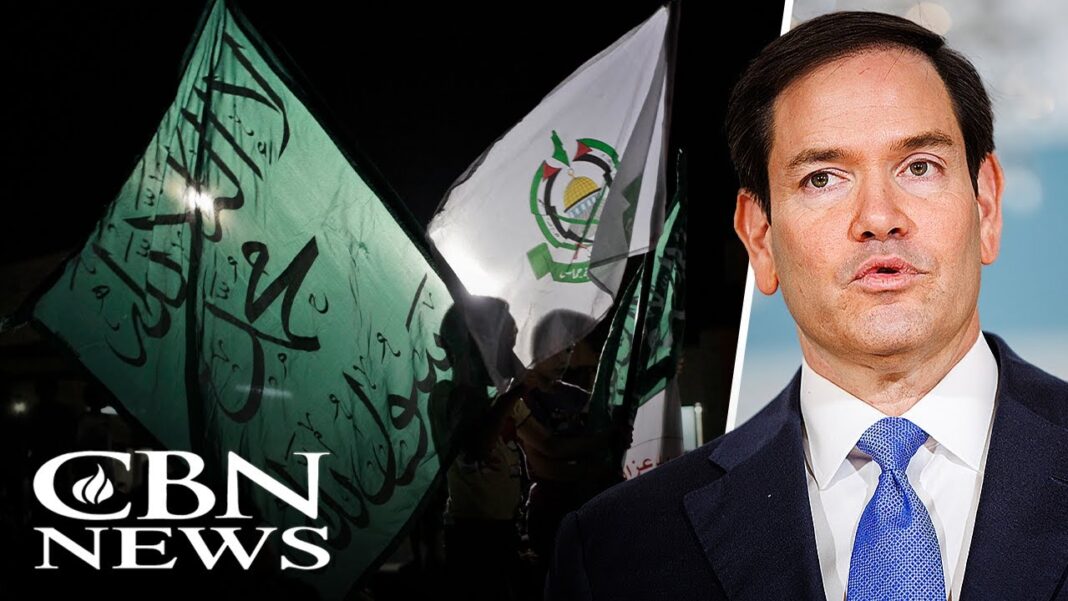
(TJV NEWS) The United States is taking concrete steps to formally designate the Muslim Brotherhood — a sprawling Islamist network and ideological progenitor of Hamas — as a foreign terrorist organization (FTO), a move that could significantly deepen Washington’s support for Israel’s struggle against regional extremist movements.
As The Algemeiner reported on Thursday, Secretary of State Marco Rubio confirmed on Tuesday that his department is engaged in the complex process of assessing the Brotherhood’s global branches with the aim of designating them under US counterterrorism law.
Speaking on the influential radio program Sid and Friends in the Morning, Rubio underscored the intricacies involved in such a move, noting that the Brotherhood is a transnational entity with multiple semi-autonomous branches, each with its own legal and organizational identity.
“All of that is in the works, and obviously there are different branches of the Muslim Brotherhood, so you’d have to designate each one of them,” Rubio said, stressing the need to craft an airtight case capable of withstanding inevitable court challenges.
Rubio acknowledged that any designation would almost certainly be contested in the US judicial system.
“These things are going to be challenged in court,” he explained. “Any group can say, ‘Well, I’m not really a terrorist. That organization is not a terrorist organization.’”
The secretary likened the evidentiary standard to solving “a math problem” in which the State Department must meticulously document its findings to justify the designation before a judge.
“All you need is one federal judge — and there are plenty — that are willing to do these nationwide injunctions and basically try to run the country from the bench. So we’ve got to be so careful.”
This insistence on precision reflects a long-standing reality in US counterterrorism policy: while the executive branch has wide discretion to label foreign groups as terrorist entities, those decisions must be grounded in robust intelligence and legal reasoning to survive judicial scrutiny.
Rubio’s comments arrive at a moment of growing bipartisan alignment in Congress on the issue. Last month, Florida Representatives Jared Moskowitz, a Democrat, and Mario Díaz-Balart, a Republican, reintroduced the Muslim Brotherhood Terrorist Designation Act in the House. The bill would direct the State Department to classify the Brotherhood and its affiliates as terrorist entities under US law.
Moskowitz, in remarks cited by The Algemeiner, framed the designation as a necessary step for national and allied security: “The Muslim Brotherhood has a documented history of promoting terrorism against the United States, our allies, and our society. Countries such as Bahrain, Egypt, Austria, Jordan, Saudi Arabia, UAE, and France have already taken important steps to investigate and crack down on the Muslim Brotherhood and its affiliates. The US government has to have the authority to crack down on the serious threats posed by this group as well.”
In the Senate, Texas Republican Ted Cruz has been leading parallel efforts, emphasizing that the designation would bring the US into closer alignment with key Middle Eastern partners who view the Brotherhood as a destabilizing force.
If successful, a US designation would place the country in lockstep with several of its most critical regional allies. Egypt — where the Brotherhood was founded in 1928 — has outlawed the organization since 2013, following a surge in political violence. Saudi Arabia, the United Arab Emirates, and Bahrain have also banned the group, citing its role in fomenting radicalism and undermining state stability.
Outside the Middle East, Austria has moved to proscribe the Brotherhood under its anti-extremism laws, and in April of this year, Jordan officially outlawed the organization.
As The Algemeiner report highlighted, the Brotherhood’s ideology and organizational structures have served as a breeding ground for Islamist movements worldwide, with Hamas — the Gaza-based terrorist group — emerging as one of its most infamous offshoots. Hamas has ruled the Gaza Strip since 2007 and was responsible for the October 7, 2023, cross-border assault on Israel, in which 1,200 people were brutally massacred and 251 hostages taken in what has been described as the deadliest single-day attack on Jews since the Holocaust.
Hamas’s foundational charter explicitly acknowledges its roots in the Muslim Brotherhood, framing the Palestinian armed struggle as part of a broader Islamist mission. This ideological lineage, The Algemeiner report noted, has been central to arguments by US lawmakers that designating Hamas without targeting its parent movement leaves a significant gap in counterterrorism strategy.
For nearly two decades, Hamas has used its control of Gaza to build an entrenched military infrastructure, much of it funded and facilitated through networks of sympathetic organizations abroad. Congressional advocates argue that sanctioning the Brotherhood’s global branches could disrupt financial, logistical, and recruitment pipelines that feed directly into Hamas and similar groups.
The idea of designating the Muslim Brotherhood is not new in Washington. During President Donald Trump’s first term, the White House and congressional allies made initial moves toward targeting the group’s international branches. These efforts included interagency consultations and draft proposals for the State Department to consider.
However, as The Algemeiner report recalled, a formal designation never materialized, in part due to concerns within the national security establishment about diplomatic fallout in countries where Brotherhood-affiliated parties participate in mainstream politics.
If the Trump administration — under Rubio’s stewardship at the State Department — proceeds with a designation, lawmakers have identified multiple legal pathways.
The most prominent is to add the Brotherhood to the State Department’s Foreign Terrorist Organization (FTO) list, a status that would criminalize providing material support to the group, freeze its assets under US jurisdiction, and bar its members from entering the country.
Another option is to place the Brotherhood on the Specially Designated Global Terrorist (SDGT) list maintained by the Treasury Department’s Office of Foreign Assets Control (OFAC). While the SDGT designation carries similar financial penalties and travel restrictions, it can be applied more flexibly and swiftly, especially to individuals and sub-entities within the broader Brotherhood network.
Either route would effectively cut the group off from the US financial system and subject its leadership to extensive sanctions.
Rubio’s remarks make clear that the administration is bracing for pushback in the courts. Advocacy groups sympathetic to the Brotherhood, as well as legal organizations concerned about overreach, are likely to argue that the group’s political activities in certain countries — particularly in parliamentary democracies — do not meet the statutory criteria for terrorism.
Proponents of designation counter that the Brotherhood’s global structure allows ostensibly “political” branches to funnel resources and legitimacy to militant arms, blurring any such distinction.
As The Algemeiner report noted, Rubio’s warning about “nationwide injunctions” reflects a broader frustration among policymakers about the ability of single federal judges to halt executive branch actions with nationwide effect.
For Israel, a US designation of the Muslim Brotherhood would represent a significant diplomatic and strategic victory. Jerusalem has long urged Washington to recognize the ideological and operational continuum linking the Brotherhood to groups such as Hamas and Palestinian Islamic Jihad.
Such a move would also be symbolically potent in the aftermath of the Oct. 7 attacks, reinforcing the perception that the US is willing to confront not just the proximate perpetrators of anti-Israel terrorism but also their ideological architects.
In practical terms, it could facilitate closer intelligence-sharing and coordinated sanctions against individuals and entities operating in both the Middle East and the West who are tied to the Brotherhood’s networks.
Despite the strategic benefits, the designation carries diplomatic risks. In some countries, Brotherhood-affiliated political parties hold seats in parliament or enjoy substantial grassroots support. A sweeping US terrorist designation could complicate relations with governments that tolerate such groups as part of their domestic political fabric.
Moreover, in regions where the Brotherhood operates through charitable or educational arms, Washington could face criticism for targeting organizations that present themselves as social service providers — even when those services are used to build political influence.
The current bipartisan momentum, combined with the geopolitical climate after Oct. 7, may give this effort more traction than previous attempts. Rubio’s deliberate emphasis on methodical, legally defensible action suggests that the administration is seeking to avoid the procedural pitfalls that have derailed similar initiatives in the past.
The debate over the Muslim Brotherhood’s designation is not simply about one organization; it is a proxy for the larger struggle over how the US defines and confronts Islamist extremism at its ideological roots.
With the State Department “actively working” on the designation and both chambers of Congress pressing for legislative support, the coming months could see a rare convergence of executive and legislative priorities in US counterterrorism policy. Whether this results in a full FTO designation or a more targeted SDGT listing, the outcome will signal how far Washington is willing to go in aligning itself with allies — especially Israel — in confronting the network that gave birth to Hamas.
