



|
Getting your Trinity Audio player ready...
|
By: Fern Sidman
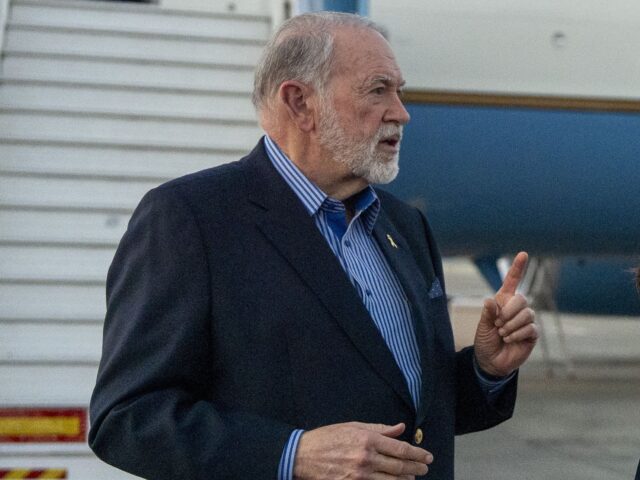
As sirens echoed through the night sky and tensions between Israel and Iran reached new and dangerous heights, one voice stood out amid the uncertainty—unwavering, faith-driven, and grounded in biblical conviction. That voice belonged to Mike Huckabee, the U.S. Ambassador to Israel, whose brief yet poignant message from the U.S. Embassy in Jerusalem on Thursday night struck a deeply spiritual chord: “At our Embassy in Jerusalem and closely following the situation. We will remain here all night. ‘Pray for the peace of Jerusalem!’”
The former Arkansas governor, presidential candidate, and ordained Baptist minister has long been recognized not only for his political career but for his deeply rooted religious commitment to the Jewish state. As Israel National News has frequently reported, Huckabee is no stranger to Jerusalem’s embattled front lines—spiritual, ideological, and, at times, militarized. His consistent presence and heartfelt solidarity with Israel are not diplomatic formalities; they are the natural outgrowth of a worldview in which the defense and flourishing of the Jewish people hold profound theological significance.
From his post inside the U.S. Embassy in Jerusalem, Huckabee’s message Thursday evening resonated far beyond the realm of politics. At a time when Israeli citizens were rushing to shelters and the nation was bracing for potential retaliatory strikes following its precision campaign against Iranian nuclear infrastructure, the ambassador’s simple yet powerful invocation of Psalm 122—“Pray for the peace of Jerusalem”—served as a reminder of his unique identity as both statesman and spiritual ally.
Israel National News reported extensively on the high-alert status across Israel, particularly in Jerusalem, where defense forces remained in a state of elevated readiness. Huckabee’s declaration of remaining at the embassy “all night” signaled more than just a commitment to duty; it was a symbolic gesture of solidarity—of standing shoulder-to-shoulder with the Israeli people in moments of national peril.
Huckabee’s relationship with Israel predates his ambassadorial appointment and runs deeper than geopolitical alignment. As Israel National News has chronicled over the years, Huckabee has been a frequent visitor to Israel, often leading faith-based tours, advocating for the recognition of Jerusalem as Israel’s eternal capital long before it became U.S. policy, and speaking passionately about the moral imperative of supporting the Jewish state.
In a 2017 interview with Israel National News, Huckabee described the U.S.-Israel alliance as “not merely strategic, but spiritual.” He emphasized that America’s blessings were, in his view, closely tied to how it treated Israel, referencing the Genesis 12:3 promise: “I will bless those who bless you.”
This worldview is not simply a matter of personal theology but has influenced his advocacy on key issues: opposition to the Iran nuclear deal, support for moving the U.S. embassy to Jerusalem, and unwavering condemnation of antisemitism—particularly the form that masquerades as anti-Zionism.
Thursday night’s crisis unfolded as Israeli fighter jets executed a preemptive strike on Iranian military and nuclear installations in what has been dubbed Operation Rising Lion. The operation, as Israel National News has documented, targeted facilities in Natanz, Kermanshah, and Tehran itself, aiming to cripple the Islamic Republic’s rapidly advancing nuclear program and decapitate key nodes of its command structure.
In this context of potential regional escalation, Huckabee’s declaration takes on added weight. His choice to publicly declare his presence in Jerusalem and to frame the moment in explicitly spiritual terms reflects a longstanding belief that defending Israel is not only the right thing politically, but divinely ordained.
He did not need to say more. The message—clear and scriptural—was delivered with characteristic clarity and conviction. It was a nod to the millions of evangelical Christians who share his view of Israel’s role in biblical prophecy and who regard moments like this not with fear, but with fervent prayer.
In recent years, as Israel National News has frequently emphasized, Israel has come under intensifying pressure from both its adversaries and from sectors of the international community. Whether in the form of terror attacks, UN censure, or academic boycotts, the Jewish state remains a lightning rod for criticism and confrontation.
In such a climate, Huckabee’s steadfast support is more than an act of diplomacy—it is a beacon of moral clarity. His refusal to vacate the embassy, to retreat in the face of threat, or to offer lukewarm reassurances, has been noted by many in Israel as a gesture of rare political courage and spiritual alignment.
Even as U.S. policy may shift with administrations, Huckabee’s presence offers a semblance of constancy. His message—echoing ancient scripture—reminds Israel’s citizens that their struggle is not merely military but civilizational. And in that struggle, they are not alone.
“Pray for the peace of Jerusalem.” The psalm that Huckabee quoted ends with a blessing: “May those who love you be secure.” In choosing this verse, he did more than signal concern. He extended a promise—one that reflects his lifetime of advocacy for Israel’s safety, sovereignty, and sacred standing.
Ambassador Huckabee’s message will be remembered not for its length, but for its faith. In the cold calculus of international relations, there remains room—even need—for a voice that speaks from the heart.
In Huckabee, Jerusalem does not just have a diplomat—it has a defender.

Yes, he is wonderful. It’s a shame that he works for a son of a bitch like Trump who has betrayed Israel.