



|
Getting your Trinity Audio player ready...
|
U.S. War Preparations Hint at Near-Term Intervention in Iran, European Sources Report
By: Fern Sidman
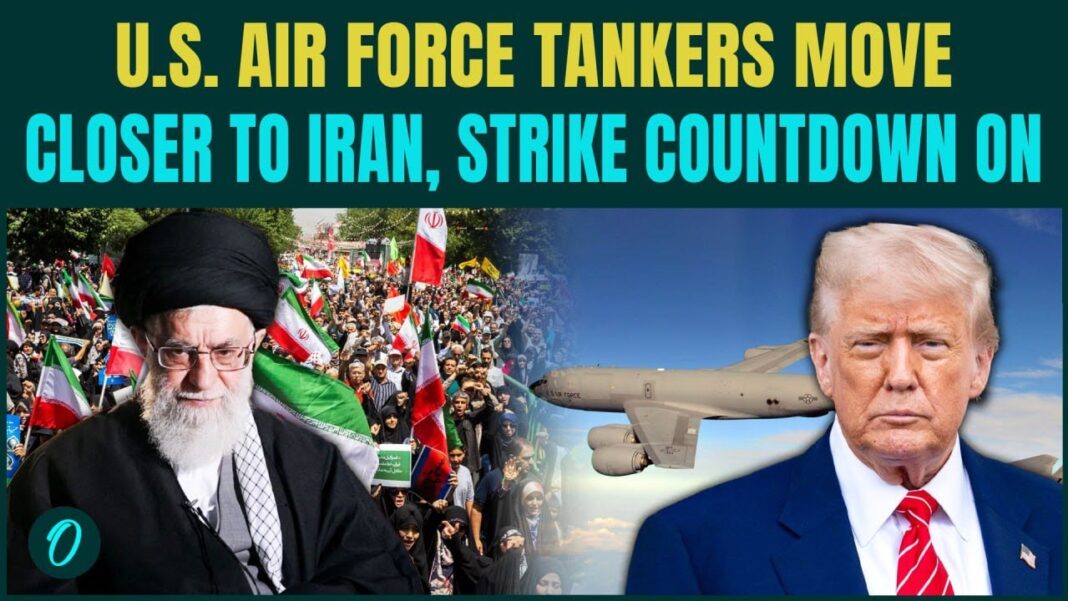
By any historical measure, the choreography now unfolding across the Middle East bears the unmistakable hallmarks of a region edging toward conflagration. Diplomats, defense officials, and anxious foreign ministries are no longer speaking in abstractions or coded euphemisms. They are speaking in hours. As Reuters reported late Wednesday, two European officials now believe that American military intervention against Iran could materialize within the next 24 hours — a timeframe so compressed that it has triggered a cascade of evacuations, troop redeployments, and emergency advisories across continents.
An unnamed Israeli official, also speaking to Reuters, said that it appeared President Trump had already made the decision to intervene, though the magnitude, modalities, and sequencing of such an action remain opaque. The comment, delivered in the guarded idiom of diplomatic anonymity, nevertheless reverberated across foreign ministries from Rome to Warsaw and from Doha to Ankara.
The first concrete signal that Washington is preparing for a contingency operation arrived earlier Wednesday when a senior U.S. official told Reuters that American personnel were being withdrawn from key bases in the region. This was not framed as a full evacuation but as a “posture change,” a term that masks its gravity only thinly.
Nowhere has this been more conspicuous than at Al Udeid Air Base in Qatar — the largest American military installation in the Middle East and the forward headquarters of U.S. Central Command. According to the Reuters report, U.S. personnel were instructed to depart the base by Wednesday evening, a move that came amid escalating warnings from Tehran and rising speculation that the White House is preparing to act in defense of Iranian protesters facing violent repression.
Britain, in a parallel move reported by Reuters, has also begun withdrawing personnel from its own airbase presence in Qatar. London has offered no formal explanation, and the British defense ministry has remained publicly silent, but the synchrony of these actions with American repositioning has not been lost on analysts.
“It’s a posture change and not an ordered evacuation,” one diplomat told Reuters, adding that no specific operational rationale had been publicly shared. In the world of military signaling, however, the distinction is largely semantic.
If Washington’s redeployments signaled preparation, Tehran’s rhetoric has been nothing short of incendiary. Earlier on Wednesday, a senior Iranian official told Reuters that Iran had delivered explicit warnings to a broad swath of regional governments — including Saudi Arabia, the United Arab Emirates, and Turkey — that American bases on their soil would be targeted if the United States launched strikes against Iran.
“Tehran has told regional countries, from Saudi Arabia and UAE to Turkey, that U.S. bases in those countries will be attacked if the U.S. targets Iran,” the official said, adding that Iran was urging those same states to restrain Washington from moving forward with any military action.
The threat represents a strategic gambit of breathtaking scope. Rather than confining retaliation to U.S. forces alone, Tehran is effectively internationalizing the conflict before it has even begun, attempting to transform regional hosts into diplomatic shock absorbers who might restrain Washington in order to shield their own populations from becoming collateral damage.
The reverberations were immediate. Poland’s foreign ministry posted an unequivocal directive on X: “The Ministry of Foreign Affairs urges the immediate departure from Iran and advises against all travel to this country.” Italy followed suit hours later, telling its citizens to leave Iran without delay. Rome estimates that roughly 600 Italians remain in the country, most concentrated in the greater Tehran metropolitan area.
The Italian foreign ministry’s statement, also cited by Reuters, underscored the gravity of the situation: the move was not precautionary but urgent.
These warnings came less than a day after Washington issued its own advisory. In a notice released Tuesday by the U.S. virtual embassy in Tehran, American citizens were told to leave immediately, preferably by land through Turkey or Armenia. “U.S. citizens should leave Iran now,” the notice stated starkly. “Consider departing Iran by land to Turkiye or Armenia, if safe to do so.”
The message was unmistakable: commercial air routes may soon close, borders could become flashpoints, and the diplomatic safety net is already unraveling.
Perhaps the most revealing element of this unfolding crisis is not the troop movements or the evacuation orders, but the collapse of the diplomatic architecture that only days ago seemed to offer at least a thread of de-escalation.
The same senior Iranian official who warned of retaliatory strikes told Reuters that direct communications between Iran’s Foreign Minister Abbas Araghchi and U.S. Special Envoy Steve Witkoff have now been suspended. Potential meetings between the two, aimed at salvaging dialogue over Iran’s nuclear program and the spiraling unrest inside the country, have been canceled.
These comments confirm President Trump’s own declaration on Tuesday, posted to his Truth Social platform, that he had canceled all meetings with Iranian officials. The official said that American threats were actively undermining diplomacy and that Washington’s posture had extinguished what little space remained for negotiation.
This stands in stark contrast to an Axios report earlier in the week claiming that Araghchi had “reached out” to Witkoff over the weekend, discussing the Iranian protests and possible off-ramps from confrontation. That channel, fleeting as it was, now appears definitively closed.
President Trump has not attempted to cloak his intentions. Over the past several days, he has publicly warned Iran against escalating violence against protesters and has explicitly threatened military force if executions resume. At the same time, he has warned Tehran that retaliation against the United States would provoke a response of unprecedented ferocity.
“If Iran retaliates,” Trump said earlier this week, “we will respond at levels never seen before.”
Such language, amplified through Reuters and echoed across global media, is no longer rhetorical flourish. It is a warning calibrated to resonate not only in Tehran but also in Moscow, Beijing, Riyadh, and Brussels — capitals now scrambling to anticipate a cascade of consequences.
The broader regional context is volatile in ways that magnify every decision. Iran is in the grip of the most severe domestic unrest it has faced since the 1979 revolution, with thousands reportedly killed in a sweeping crackdown. Its airspace has been intermittently closed. Its economy is battered by sanctions. Its leadership is visibly anxious to project control while privately pleading for regional states to restrain Washington.
Meanwhile, U.S. forces remain deeply embedded across the Middle East — from Bahrain, home to the Navy’s Fifth Fleet, to Kuwait, Iraq, and Syria. Each installation is now a potential flashpoint in a retaliatory strategy that Iran has telegraphed in unambiguous terms to Reuters.
Qatar, caught in the middle as host to Al Udeid, has said that drawdowns at the base are being undertaken in response to “current regional tensions.” But for Doha, the stakes are existential: it is simultaneously a U.S. strategic partner and a neighbor to Iran across the narrow waters of the Persian Gulf.
European capitals are scrambling to calibrate their responses. Two European officials told Reuters bluntly that American military action could occur within 24 hours. That level of precision suggests more than conjecture; it implies briefings, intelligence streams, and strategic assessments that have already crossed thresholds normally reserved for the final stages before hostilities.
In Rome, Warsaw, and Paris, the tone has shifted from concern to crisis management. Advisories to leave Iran are no longer bureaucratic rituals — they are acknowledgments that governments may soon lose the ability to assist their citizens inside Iranian territory at all.
It is still theoretically possible that the United States will step back, that the posture change will remain just that, and that Tehran’s warnings will remain threats rather than preludes. But the choreography unfolding, as documented relentlessly by Reuters, suggests that both sides are already preparing for the worst while publicly insisting that escalation is not inevitable.
Yet history rarely offers examples where such tightly wound sequences end with restraint.
For Iran, striking American bases in Saudi Arabia, the UAE, or Turkey would be a gamble that risks igniting a regional war from which it may not recover. For Washington, intervening militarily against a regime already cornered by domestic revolt risks accelerating precisely the spiral it seeks to contain.
And for the rest of the world, the next 24 hours may well mark the moment when the geopolitical map of the Middle East is irrevocably redrawn.